
Something weird happened in 2025. Individual investors now control 20% of US stock trading. Meanwhile, crypto markets flipped completely institutional.
This isn’t just a quirky stat. It signals a fundamental shift in how risk moves through financial markets. Plus, it challenges everything we thought we knew about these asset classes.
Retail Investors Just Hit Their Second-Biggest Stock Market Share Ever
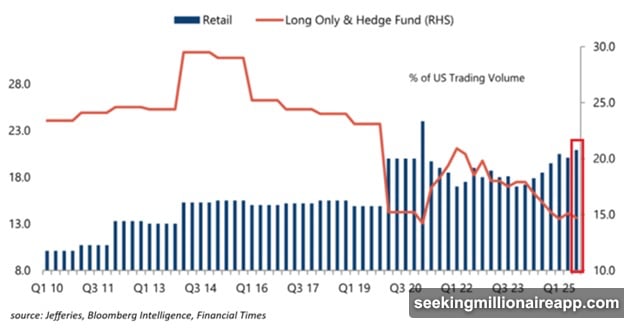
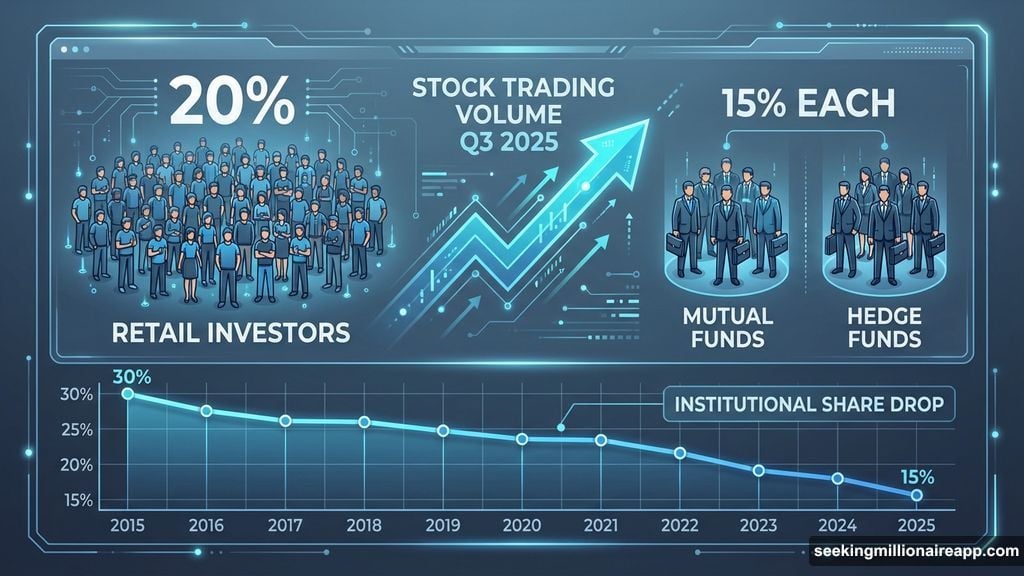
Individual traders captured about 20% of US stock trading volume in Q3 2025. That’s the second-highest level in history. Only the meme stock frenzy of Q1 2021 saw higher retail participation.
Before 2020, retail investors consistently held around 15% of trading volume. So this 20% figure represents a major structural change. More importantly, retail now outpaces every individual institutional category.
Long-only mutual funds and traditional hedge funds each accounted for roughly 15% last quarter. That’s half their 2015 market share. All fund categories combined, including quants, made up just 31% in Q3.
The Kobeissi Letter summed it up bluntly. “Retail investors are taking over the market at a historic pace.”
Crypto Markets Show the Exact Opposite Pattern
While retail floods into stocks, crypto went institutional. JPMorgan’s recent analysis confirmed what many suspected. Retail participation in digital assets dropped sharply in 2025.
The bank noted crypto is “moving away from resembling a venture capital style ecosystem to a typical tradable macro asset class supported by institutional liquidity rather than retail speculation.”
CryptoQuant data backs this up. Institutional Bitcoin holdings expanded throughout 2025. Retail investors moved in the opposite direction. The chart shows a clear divergence between large holder accumulation and retail withdrawal.
Exchange-traded fund demand slowed. Digital asset treasury firms faced pressure. Yet buying interest didn’t vanish. It just changed hands from individuals to institutions.
Why This Flip Actually Matters
High retail activity in stocks creates sentiment-driven markets. Price action becomes reactive. Short-term narratives dominate. Momentum chasing accelerates.
Individual investors move fast. Social media amplifies their decisions. Options activity magnifies price swings. Fundamentals matter less during these periods. Emotion drives more trades.
This creates specific market behaviors. Volatility spikes in individual stocks. Momentum runs happen faster. But reversals hit harder too. Overreactions become the norm rather than the exception.
Crypto’s institutional turn suggests the opposite. More professional capital typically means deeper liquidity. Pricing becomes more stable. Volatility theoretically declines.
Institutions think longer-term. They use better risk management. Their capital doesn’t panic-sell during 20% corrections. This should enable steadier growth instead of wild price swings.
Barclays Says Don’t Get Too Excited About Crypto
Despite growing institutional presence, Barclays forecasts a down year for crypto in 2026. The bank sees limited structural growth ahead. Major catalysts appear absent.
Sure, US political sentiment toward crypto improved in 2025. But Barclays believes markets already priced in this shift. The crypto-friendly policy changes won’t drive another massive rally.
Institutional money brings stability. It doesn’t guarantee upside. Professional investors demand returns. They’ll rotate capital elsewhere if crypto can’t deliver.
Mutual Funds Lost Half Their Market Share Since 2015
Traditional investment funds got crushed by this shift. Long-only mutual funds and hedge funds each dropped from roughly 30% market share in 2015 to 15% in Q3 2025.
All professional fund categories combined now represent less trading volume than retail investors alone. That’s a stunning reversal in market structure.
Where did that capital go? Some moved to passive index funds. Some exited markets entirely. But a significant portion just changed hands. Former fund investors became direct retail traders.
What Happens When Markets Get Too Retail-Heavy
History shows high retail participation creates specific market conditions. Most aren’t positive for long-term stability.
Options-driven moves amplify both rallies and selloffs. Stocks can surge 30% on excitement alone. Then crash 40% when sentiment flips. Fundamental analysis gets drowned out by narrative trading.
Social media accelerates these dynamics. A viral post can move billions in market cap. Coordinated buying pushes stocks beyond rational valuations. Then the inevitable correction wipes out late buyers.
This environment rewards timing over analysis. It punishes buy-and-hold strategies during volatile periods. Yet it also creates opportunities for those who can navigate the chaos.
Institutional Crypto Doesn’t Mean Boring Crypto
Some crypto enthusiasts worry institutional dominance kills the market’s spirit. Professional investors supposedly lack the conviction that drove previous bull runs.
Maybe. But institutional capital also brings legitimacy. It enables product innovation. ETFs became possible because institutions got involved. Custody solutions improved. Regulatory clarity increased.
Plus, institutional money is patient money. Retail investors panic-sell during 30% drawdowns. Institutions view those as buying opportunities. This capital acts as a stabilizing force during market stress.
That said, institutions demand returns. They won’t hold underperforming assets out of ideological commitment. So crypto must deliver actual value to retain their capital.
The Psychology Behind This Market Switch

Why did retail flock to stocks while abandoning crypto? Risk appetite tells part of the story.
Crypto experienced brutal drawdowns before institutions arrived. Retail investors got burned. Many swore off digital assets entirely. Those who stuck around saw their conviction rewarded. But most quit before the recovery.
Meanwhile, stocks offered accessible excitement. Meme stocks proved retail could move markets. Options trading exploded in popularity. Individual investors felt empowered. They found stocks more responsive to their capital.
Crypto’s institutional shift made it less retail-friendly. Professional strategies dominated. Retail edge disappeared. Individual investors migrated to markets where they still felt relevant.
Both Trends Might Reverse Eventually
Market cycles tend to mean-revert. Today’s retail-heavy stock market could flip institutional again. Crypto’s professional dominance might give way to another retail mania.
Nothing says these dynamics persist forever. In fact, extremes usually signal turning points. When everyone trades the same way, contrarian plays become attractive.
Still, structural changes take time to reverse. Retail won’t abandon stocks overnight. Institutions won’t dump crypto holdings on a whim. These trends probably persist through 2026 at minimum.
This creates a strange market environment. Stocks behave emotionally. Crypto acts rationally. The asset classes essentially swapped personalities. Traders must adjust their strategies accordingly.
Retail dominance makes stocks unpredictable. Institutional control makes crypto more boring. Neither outcome was what most people expected a few years ago. Yet here we are. Markets always find new ways to surprise us.