AI is automating everything. Code writing, image generation, ad scheduling, meeting summaries. But most workers won’t benefit from this shift. They’ll just lose their jobs while tech companies profit.
One platform is testing a radical alternative. What if the people training AI systems actually owned them?
Action Model launched an invite-only Chrome extension that flips the automation script. Instead of companies extracting your work to replace you, you train an AI agent and earn ownership rights in return. The bet is simple: if automation is inevitable, ownership should be too.
Large Action Models Operate Software, Not Just Generate Text
Action Model built what they call a Large Action Model (LAM). Unlike ChatGPT or Claude, LAMs don’t just write responses. They perform digital tasks directly by controlling software interfaces.
The distinction matters. Chatbots generate content. LAMs execute work.
“If a human can do a digital task with a mouse and keyboard, a trained AI agent should be able to do it too,” says Action Model founder Sina Yamani.
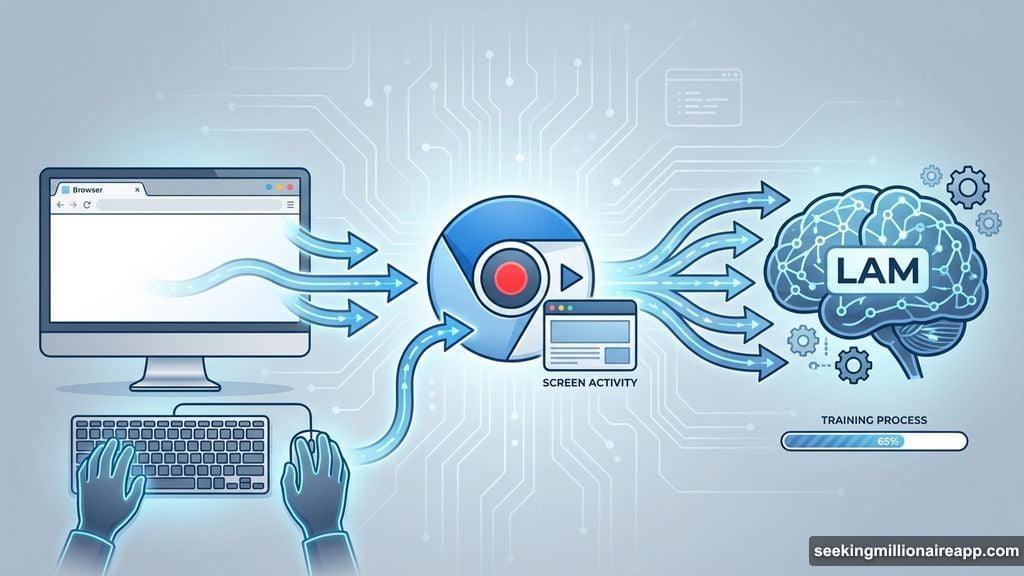
Here’s how it works. Users install a Chrome extension and approve specific browser activities for training. The AI watches how you complete tasks like submitting payroll, updating CRM entries, or processing invoices. It learns your patterns, timing, and decision-making. Then it can repeat those tasks autonomously.
Contributors receive points that may convert into $LAM governance tokens. Those tokens represent ownership rights in how the platform evolves.
One Billion People Use Computers for Work. Most Are Automatable
The numbers are stark. Around one billion people worldwide earn their living by using computers. Office workers, data entry specialists, customer service reps, schedulers, coordinators.
“If a company is offered a tool that performs the same work continuously at a fraction of the cost, they will use it,” Yamani says.
Traditional automation tools like Zapier rely on APIs. But only about 2 percent of the internet is accessible that way. The other 98 percent requires human interaction through browsers, legacy systems, internal dashboards.
“Zapier automates software. We automate work,” Yamani explains.
So Action Model doesn’t need integrations or code. You just record how you complete a task. The AI learns from real user flows and becomes capable of repeating them independently. That flexibility captures edge cases and undocumented workflows that rigid automation systems miss entirely.
Privacy Controls Let Users Decide What Gets Shared
All training is opt-in. Sensitive sites like email, healthcare platforms, and banking are blocked by default.
Users can pause training, block specific domains, or delete contributions entirely. Deleted data is permanently removed and cannot be recovered, even by the company itself.
“The first principle is simple. We don’t need your data. We just need patterns,” Yamani says.
Training data is processed locally and anonymized before contributing to the model. Contributions are aggregated using k-anonymity to prevent individual reidentification. A dashboard lets contributors view and manage their training history and rewards at any time.
“While Big Tech collects this kind of data without real consent, we are transparent, user-controlled, and rewarding the people who actually train the AI,” says Yamani.
Bots Can’t Fake Real Work Patterns
Early crypto reward systems collapsed under bot farms and fake engagement. Projects that paid for social posts or clicks generated massive AI spam. Platforms banned them. Token ecosystems died.
Action Model uses behavioral analysis to verify real user input. The system looks for structure, timing, variation, and decision-making signals that bots can’t easily replicate.
“Mindless clicking is almost useless,” says Yamani. “Real workflows include intent, pauses, corrections, retries, and decisions. You cannot fake that at scale.”
ActionFi, the platform’s reward engine, doesn’t pay for tweets or clicks. It rewards verified workflows that reflect real, structured digital labor.
“We don’t pay for noise. We pay for useful paths,” Yamani adds.
Plus, over 40,000 users have already joined through waitlists and referral systems. Access remains invite-only to maintain contributor quality and reward early participants.
Token Holders Will Eventually Control the Platform
Right now, Action Model controls the extension, training logic, and reward systems. But the project has committed to transitioning ownership to $LAM token holders over time.
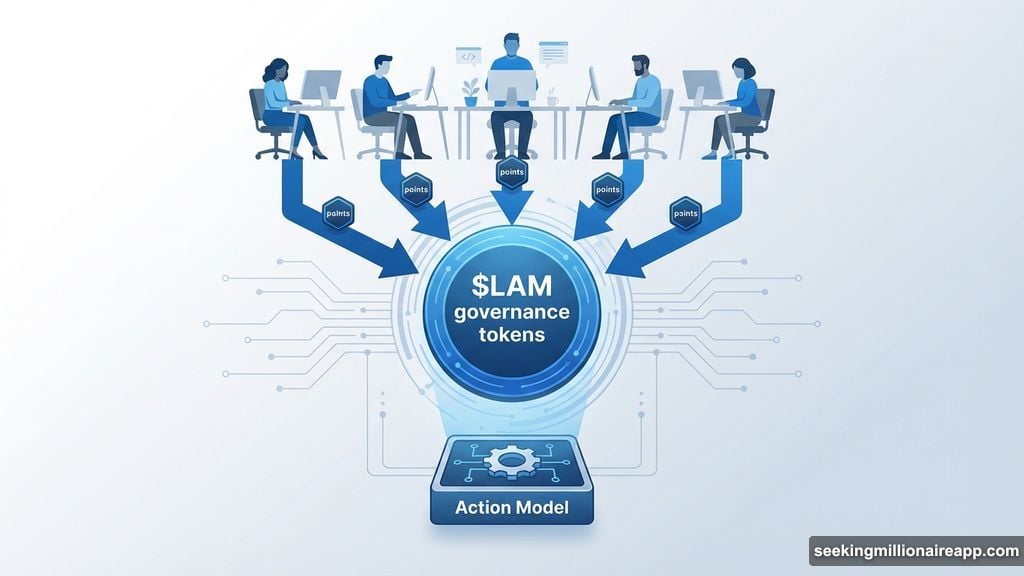
A DAO structure will eventually allow contributors to govern platform decisions, incentive mechanisms, and model deployment.
“Early systems need coordination. What matters is whether they are centralized by design,” Yamani says.
If implemented as described, ownership would give token holders influence over infrastructure decisions tied to the data they helped generate. Contributors publish automations to a public marketplace, where usage can be tracked and rewarded under the platform’s incentive model.
The Automation Wave Hits Faster Than Economies Can Adapt
Screen-based jobs are vanishing faster than most people realize. Not decades away. Happening now.
Experts warn that generative AI could trigger massive job displacement that hits faster and deeper than most economies are prepared for. Office work, operations, data processing—all within reach of intelligent agents.
“You’ve heard that millions of screen-based jobs will be automated. That isn’t decades away—it’s happening now,” Yamani says.
Traditional labor protections won’t help. Unions can’t negotiate with algorithms. Minimum wage laws don’t apply to AI agents. Retraining programs take years while automation deploys in months.
So Action Model’s bet is clear: if your data helps train AI, you should own what gets built.
Ownership Determines Who Benefits From Automation
The next generation of AI is being built on labor, not just language. From office work to operations, many tasks that happen behind a screen are now within reach of intelligent agents.
Whether Action Model can scale, stay transparent, and build a sustainable economy remains to be seen. But its core principle is hard to argue with.
“If AI is going to replace digital labour then workers should own the machines doing the replacing,” says Yamani.
As AI reshapes work, the defining question isn’t just what it can do. It’s who it works for. Will the future be owned by platforms extracting value from workers? Or by the people whose labor trains the systems replacing them?
The answer will determine whether automation creates shared prosperity or deepens inequality. Action Model is testing one possible path forward. Time will tell if ownership can be as inevitable as automation itself.