
Bitcoin slipped below $65,000 during early Asian trading hours on February 23, 2026. Renewed tariff tensions are weighing on broader risk sentiment, and now Tether’s USDT is sending a warning that has only appeared once before in crypto history.
The question on everyone’s mind is simple. Does this signal a major turning point, or is more pain ahead?
Crypto’s “Dry Powder” Is Shrinking Fast
Think of stablecoins like USDT as the crypto market’s cash reserves. When that cash pile grows, fresh money is flowing into the ecosystem. When it shrinks, investors are pulling funds out or sitting on the sidelines.
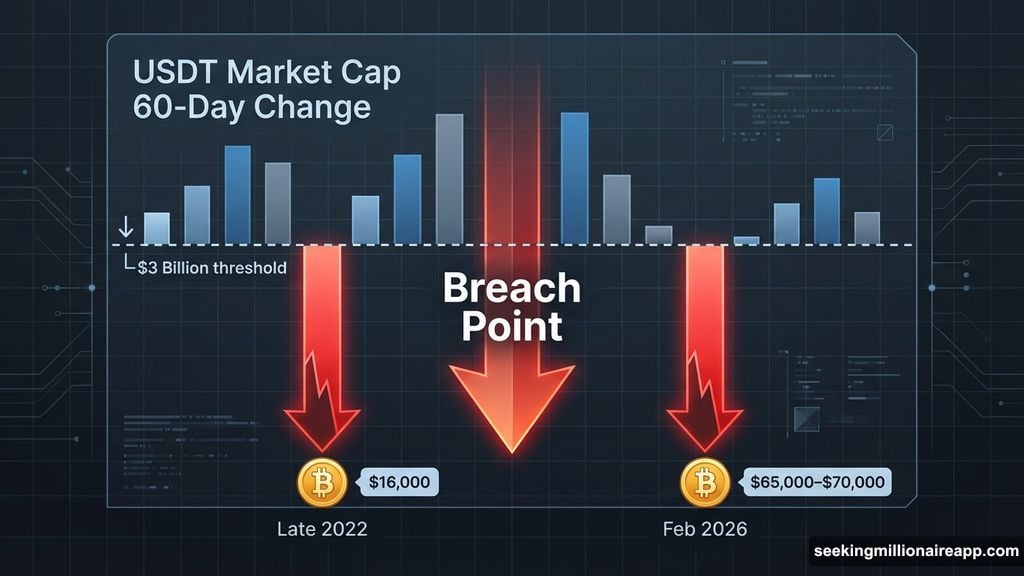
Right now, that cash pile is shrinking fast. Analyst Moreno recently flagged that the 60-day market cap change for USDT has dropped below negative $3 billion. That’s a significant threshold. And according to his analysis, it has only been breached once before.
That previous breach happened during the brutal late 2022 bear market. Bitcoin was bottoming near $16,000 at the time, surrounded by widespread fear and forced selling. The same metric has now reached those same alarm levels again, but this time Bitcoin is trading between $65,000 and $70,000 following a prior all-time high rally.
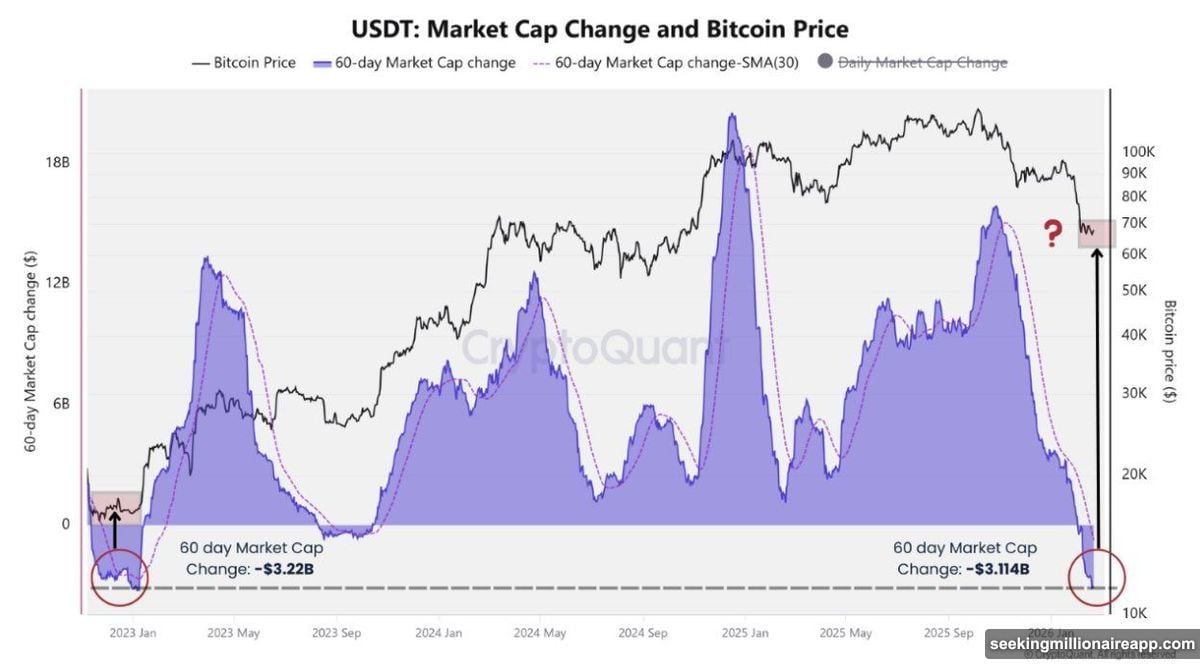
So the context is very different. But the signal is the same.
Three Billion-Dollar Single-Day Exits
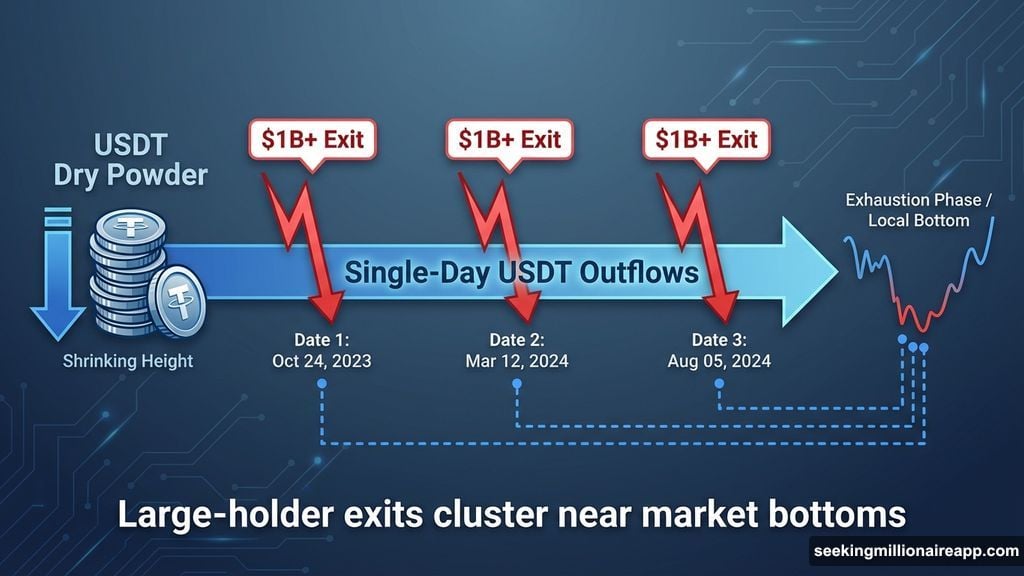
The USDT contraction isn’t just a gradual fade. Moreno also highlighted something more striking. On three separate occasions, USDT recorded single-day net outflows exceeding $1 billion each.
That’s not a quiet repositioning. That’s large-scale capital leaving the ecosystem in a hurry.
Historically, events of that magnitude tend to cluster around periods of intense volatility or local market bottoms for Bitcoin. Moreno suggests these episodes often reflect institutional or large-holder exits rather than retail panic. And importantly, he argues they tend to happen closer to exhaustion phases than at the start of prolonged declines.
In other words, when the biggest players run for the exits all at once, they often aren’t early. They’re often late.
What USDT Stabilization Could Mean for BTC
Moreno stops well short of calling this a guaranteed buying opportunity. Context matters here, and he makes that point clearly.
He explains that in previous cycles, once forced deleveraging completed and USDT flows stabilized, Bitcoin transitioned into strong medium-term upside as liquidity conditions normalized. But that stabilization hasn’t happened yet.
“If flows flatten or reverse, the asymmetry shifts rapidly in favor of upside,” he noted. “Extreme liquidity stress has historically marked opportunity, but only once selling exhaustion is confirmed.”
So the next few weeks of USDT supply movement matter enormously. If the contraction continues, downward pressure on Bitcoin could persist. If flows stop falling and start recovering, that could be the early signal that conditions are shifting in bulls’ favor.
Bitcoin’s Macro Bottom Could Still Be Months Away
Even if the USDT signal eventually resolves bullishly, not everyone believes Bitcoin is close to its cycle floor. Some analysts point to a much longer timeline before a confirmed macro low arrives.
One forecaster suggested the next major bottom could be 230 to 240 days out from current positioning. That framework places the projected low window between October 11 and October 21, 2026. Another market observer independently pointed to November 2026 as a potential cycle bottom timeframe.
If those projections hold, the current range between $65,000 and $70,000 might represent an extended consolidation phase rather than a launching pad for the next leg up. As one analyst put it, “Until the cycle completes, rallies may remain relief bounces, not a confirmed macro reversal.”
That’s an important distinction. Relief bounces feel good in the moment. But they can also trap buyers who mistake short-term strength for a structural recovery.
Of course, cycle models are probabilistic tools, not crystal balls. Historical timing frameworks provide useful structure, but external variables, whether regulatory, macroeconomic, or geopolitical, can easily accelerate or delay expected turning points.
What Comes Next
The USDT signal flashing at these levels is genuinely significant. The fact that it has only appeared once before, at one of the most painful bottoms in crypto history, means it deserves serious attention rather than dismissal.
But the honest answer right now is that nobody knows if the selling exhaustion Moreno describes has been reached. The USDT supply trend over the coming weeks will likely provide that answer. Stabilization would be an encouraging sign. Further contraction would suggest more downside risk remains.
If you’re watching Bitcoin closely, keep one eye on the stablecoin data. It might tell you more about what’s coming than the price chart itself.