
Crypto just had one of its best years in Washington. Now the Senate seats that made it possible are emptying out fast.
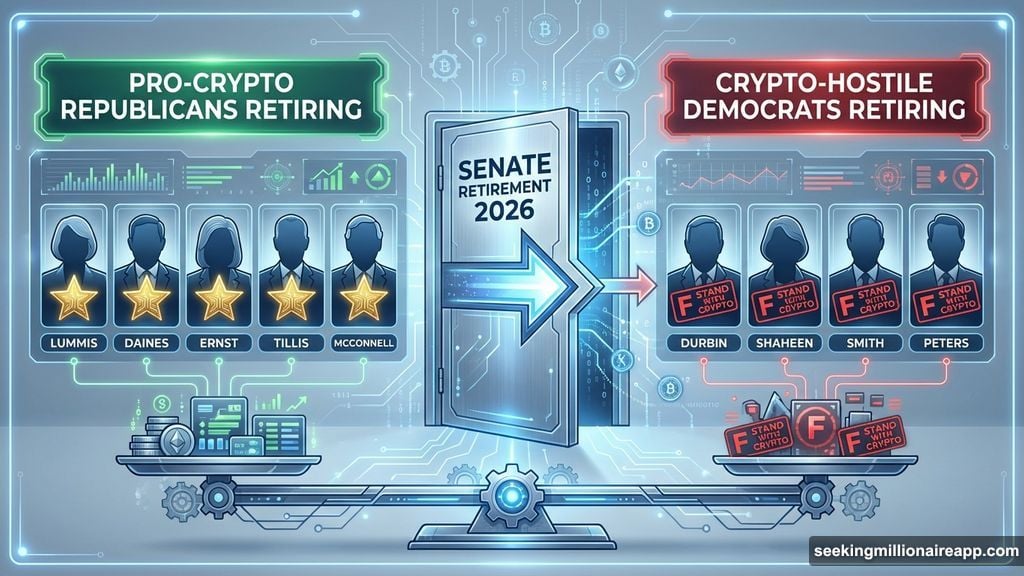
Nine sitting senators have announced they won’t seek reelection ahead of this year’s primaries. Five are pro-crypto Republicans. Four are crypto-hostile Democrats. And the candidates stepping into those seats will largely determine whether landmark digital asset legislation keeps moving forward — or stalls out entirely.
This isn’t just political shuffle. It’s a direct threat to the congressional coalition that passed the GENIUS Act and pushed the CLARITY Act through committee.
The Senators Crypto Relied On Most
Let’s start with what the industry is actually losing.
Wyoming’s Cynthia Lummis has been crypto’s loudest Senate champion for years. She championed the GENIUS Act, led the push for a national Bitcoin strategic reserve, and served as a driving force behind the CLARITY Act. She’s not coming back.
Joining her exit are Montana’s Steve Daines, Iowa’s Joni Ernst, North Carolina’s Thom Tillis, and Kentucky’s Mitch McConnell. Stand With Crypto, a Coinbase-backed nonprofit that grades politicians on their digital asset positions, rates all four as “strongly supportive.”
That’s a lot of institutional knowledge and political capital walking out the door at once.
But here’s where things get interesting. Four Democratic senators who earned “F” ratings from Stand With Crypto are also leaving. Dick Durbin of Illinois, Jeanne Shaheen of New Hampshire, Tina Smith of Minnesota, and Gary Peters of Michigan are all stepping down. Their replacements may actually be more crypto-friendly than they were.
So this reshuffling cuts both ways.
Swing States Will Decide Everything
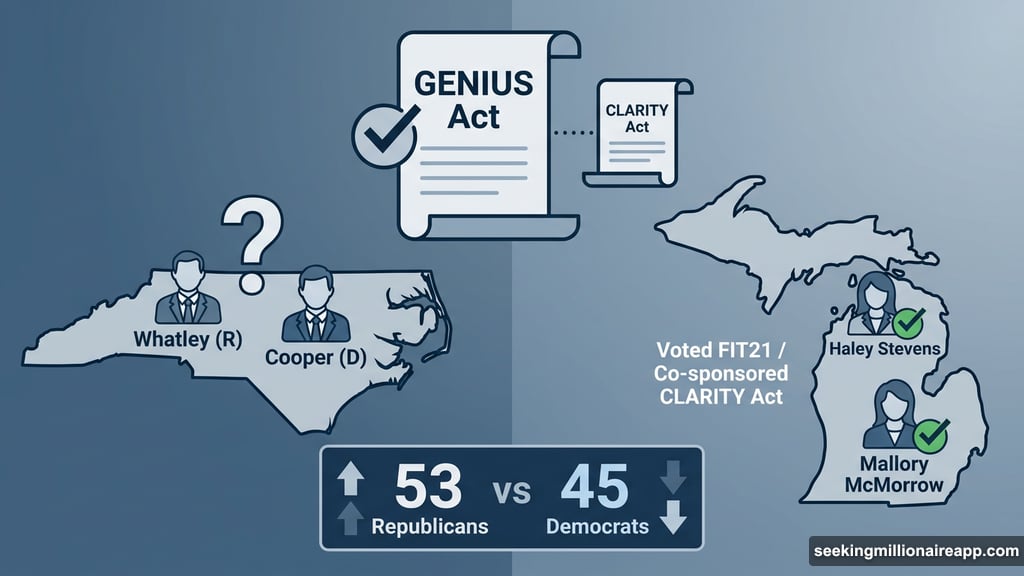
The Senate currently sits at 53 Republicans, 45 Democrats, and 2 Independents. How that balance shifts after 2026 elections will set the ceiling for what crypto legislation can realistically achieve.
The safest seats for the industry are in deeply red states like Kentucky and Iowa, where Republican replacements with solid pro-crypto records are already running. The real tension is in the competitive states.
North Carolina is a genuine toss-up. Tillis was a key GENIUS Act vote and an outspoken advocate for clear crypto rules. His replacement race now features Republican Michael Whatley and Democrat Roy Cooper — a former governor. Neither has a documented public position on crypto, according to Stand With Crypto. That’s a real problem. A swing state seat with zero clarity on where either candidate stands is exactly the kind of uncertainty the industry hates.
Michigan is even more consequential. Trump barely won it in 2024. Peters leaving opens a competitive race where several Democratic candidates have actually staked out pro-crypto positions. Representative Haley Stevens voted for the GENIUS Act and FIT21, and co-sponsored the CLARITY Act. State Senator Mallory McMorrow has supported self-custody rights and called for an end to debanking practices targeting crypto businesses. On the Republican side, former House Representative Mike Rogers backed both the GENIUS Act and the CLARITY Act. Michigan could end up sending a more crypto-supportive senator to Washington regardless of which party wins. That’s genuinely good news for the industry.
The Races That Will Set the Tone
Wyoming matters enormously, even though it’s a safe Republican seat. Whoever replaces Lummis inherits one of the most crypto-focused Senate legacies in American history. Right now, Representative Harriet Hageman is the frontrunner. She voted for both the GENIUS Act and the CLARITY Act during House votes, and Stand With Crypto rates her as “strongly supportive.” Senior Wyoming Senator John Barrasso has already endorsed her. If Hageman wins, the Lummis seat stays solidly in the industry’s corner.
Montana is murkier. Daines made his retirement announcement just five minutes after Kurt Alme, Montana’s top federal prosecutor, entered the race — moments before the ballot deadline closed. Daines endorsed Alme in the same video. That timing raised eyebrows. Alme has said little publicly about crypto. But endorsements from President Trump and Senate Banking Committee Chairman Tim Scott suggest he may align with the pro-crypto wing of the party.
Illinois is interesting precisely because it’s safely Democratic. Representative Raja Krishnamoorthi is the leading Democratic contender. He’s raised concerns about the FTX collapse and crypto’s potential use in terrorist financing — but still voted for the GENIUS Act, the CLARITY Act, and FIT21. He’s also accepted more than $90,000 from Trump-aligned donors, which has become a flashpoint in the primary. His main rivals include Lieutenant Governor Juliana Stratton and Representative Robin Kelly, whose crypto record is more mixed. Kelly voted for the GENIUS Act but opposed the CLARITY Act.
New Hampshire leans competitive. Former Senator John Sununu is seeking the Republican nomination with Trump’s backing. Stand With Crypto notes that Sununu supports self-custody rights, opposes debanking, and backs the CLARITY Act. On the Democratic side, Representative Chris Pappas has a strong pro-crypto voting record across the GENIUS Act, CLARITY Act, and FIT21. New Hampshire could send a crypto-friendly senator to Washington from either party.
What the GENIUS Act Coalition Actually Needed
The GENIUS Act passed because of a specific political alignment — Republican dominance in both chambers, plus enough bipartisan support to clear procedural hurdles. That alignment doesn’t disappear overnight, but it’s not guaranteed either.
Crypto industry lobby spending has shifted decisively toward Republicans in recent cycles, and that investment produced real results. But legislation like the CLARITY Act still needs sustained Senate support to move through committee, reach the floor, and survive a vote. Losing five “strongly supportive” Republicans from key positions creates genuine gaps.
The Agriculture Committee, where Ernst helped advance the CLARITY Act, and the Banking Committee, where Tillis was a vocal advocate, will both see leadership and membership changes. Those committee dynamics matter as much as floor votes.
Minnesota offers one more wild card. Lieutenant Governor Peggy Flanagan has been vocal in opposing Trump’s meme coin launch and positioned her campaign around fighting corporate influence in crypto. Representative Angie Craig, by contrast, earned an “A” rating from Stand With Crypto, co-sponsored the CLARITY Act, and backed the GENIUS Act. If Craig wins the Democratic primary, Minnesota’s open seat could flip from a crypto skeptic to a crypto ally.
The Industry Can’t Assume Any of This Goes Its Way
The passage of the GENIUS Act felt like a turning point. And it was. But politics doesn’t stop moving after a legislative win.
Every one of these nine races will shape the Senate that decides whether the CLARITY Act crosses the finish line, whether a national Bitcoin reserve becomes real policy, and whether the regulatory clarity that crypto companies have spent years lobbying for actually materializes into law.
The industry has done an impressive job building a congressional base. Now it has to rebuild parts of that base from scratch, in competitive states, with candidates who haven’t always made their positions clear.
That’s not a crisis. But it’s a serious test. And the outcomes of primaries happening right now will matter far more than most crypto holders realize.