Jeffrey Wilcke, one of Ethereum’s original co-founders, just moved a massive chunk of ETH to a major exchange. And the crypto market is not happy about it.
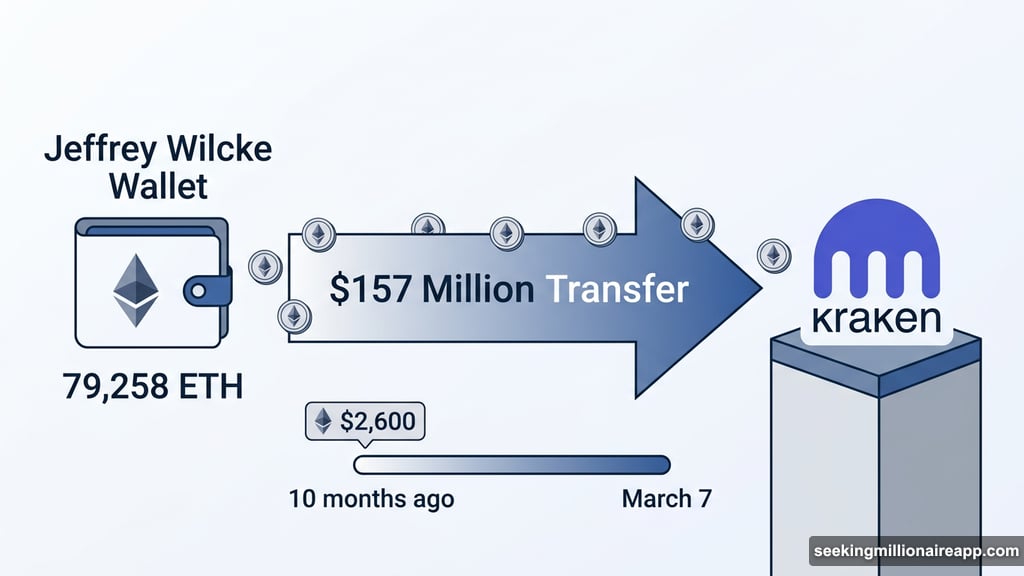
On March 7, Wilcke transferred 79,258 ETH — worth roughly $157 million — to Kraken. In crypto circles, sending that much to an exchange almost always means one thing: you’re getting ready to sell. Combined with other recent insider moves, ETH is now facing serious selling pressure at a time when it can least afford it.
The $157 Million Transfer That Spooked the Market
Blockchain analytics firm SpotOnChain spotted something interesting in the transaction data. These weren’t freshly moved coins sitting in a cold wallet somewhere. Instead, the firm identified a clear “round-trip” pattern.
The same wallets actually pulled this exact amount of ETH out of Kraken about ten months ago. Back then, ETH was trading around $2,600. So the theory is straightforward — Wilcke distributed those assets for custody purposes, and now he’s consolidating them back onto the exchange to liquidate.
That’s a meaningful distinction. This isn’t panic selling from a sudden market dip. It looks more like a planned, deliberate exit from a significant position.
Still, Wilcke isn’t walking away from ETH entirely. He still holds 27,241 ETH on-chain, currently worth about $53.56 million. That’s not exactly pocket change.
Vitalik Buterin’s Recent Sales Add to the Pressure
Wilcke isn’t the only big name moving ETH right now. In February, Ethereum’s most recognizable figure, Vitalik Buterin, sold 17,196 ETH — roughly $34.96 million worth.
Interestingly, that amount actually exceeded Buterin’s previously announced plan to sell 16,384 ETH. He’s been transparent about his reasons, though. Buterin stated publicly that proceeds are funding open-source software and hardware development across finance, governance, and biotech sectors.
So the motivations here are quite different. Buterin is funding ecosystem development. Wilcke, who has largely stepped away from active Ethereum work to focus on private gaming ventures, hasn’t offered a similar public explanation.
But here’s the uncomfortable truth — the market doesn’t really care about intent when prices are already sliding. Both sales are piling downward pressure onto an already struggling asset.
ETH’s Fight to Hold $2,000
The $2,000 level has become a critical psychological line for Ethereum. And right now, ETH is losing that battle.
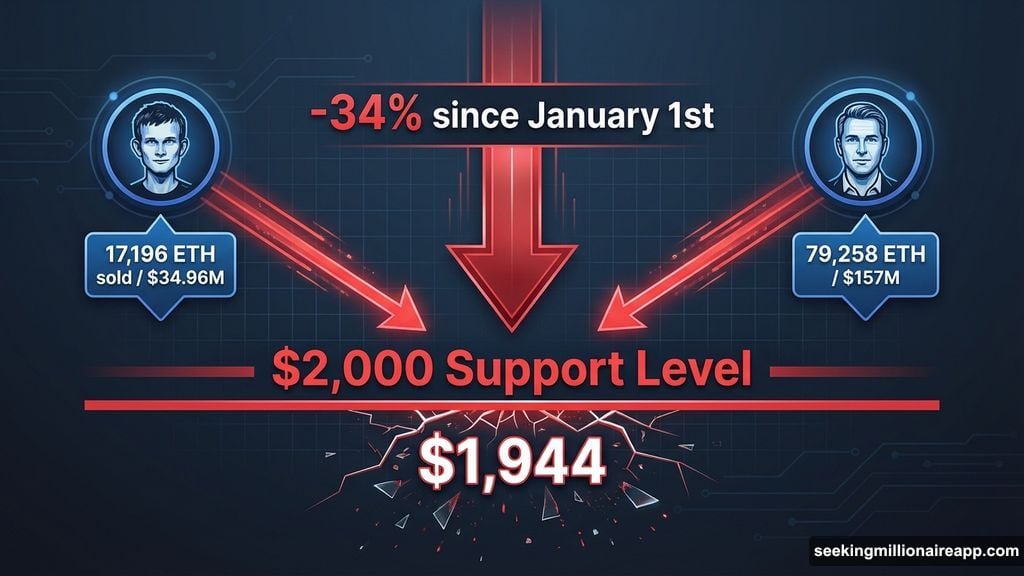
According to BeInCrypto data, ETH has dropped 34% since January 1st, trading at $1,944 as of press time. That’s a brutal start to the year, and it’s not just about insider sales. Analysts point to shifting macroeconomic conditions as a broader headwind dragging the entire crypto market lower.
The short-term picture looks even rougher. Traders on Polymarket, a decentralized prediction platform, currently give a 67% probability that ETH drops further to $1,800. That’s not a fringe view — it reflects genuine market sentiment from people putting real money behind their predictions.
What This Really Means for Ethereum Holders
Insider selling always grabs headlines, and for good reason. When founding team members offload large positions, it naturally raises questions about their confidence in the asset’s near-term prospects.
But context matters here. Wilcke stepped away from Ethereum development years ago. His financial decisions likely reflect his own personal portfolio strategy, not a statement about Ethereum’s future. And Buterin’s sales have a clear, stated purpose that directly benefits the broader ecosystem.
That said, the timing is genuinely rough. ETH is already under pressure from macro conditions. Adding $157 million in potential sell orders to an already fragile market isn’t helpful, regardless of the reasoning behind it.
If you’re holding ETH right now, the honest assessment is this — the next few weeks look bumpy. The $1,800 level is firmly in play, and there’s no obvious catalyst on the immediate horizon to reverse that trend. Watch the $2,000 level closely. If ETH can reclaim and hold that mark convincingly, sentiment could shift. If it can’t, lower support levels will come into focus fast.