
Bitcoin reaching a million dollars per coin sounds wild. But Bitwise CIO Matt Hougan says the math is actually pretty straightforward — if you stop looking at the store-of-value market as a fixed number.
His argument isn’t built on hype or wishful thinking. Instead, it rests on historical growth patterns, shifting institutional behavior, and one key insight most critics miss. Let’s walk through how he gets there.
The “Static Market” Mistake Everyone Makes
Most analysts who dismiss a $1 million Bitcoin price run the same calculation. They look at today’s store-of-value market, see Bitcoin at roughly 4% of it, and conclude that Bitcoin would need to grab over 50% of the market to justify a seven-figure price. That feels impossible. So they stop there.
Hougan calls this a “pretty basic mistake.”
The store-of-value market isn’t frozen in time. It grows. And the historical data backs that up in a pretty compelling way.
Gold’s 13% Annual Growth Rate Changes Everything
Gold’s market cap sat at about $2.5 trillion back in 2004. Today it’s close to $40 trillion. That’s roughly a 13% compound annual growth rate, driven by rising government debt, geopolitical instability, and decades of easy monetary policy.
So the combined store-of-value market — currently just under $38 trillion — has been quietly expanding for twenty years straight.
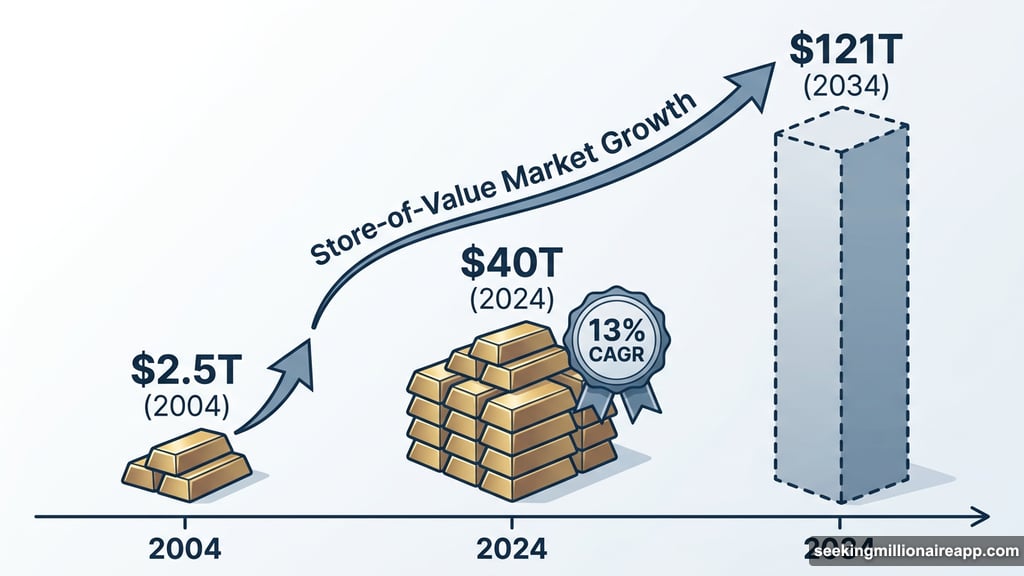
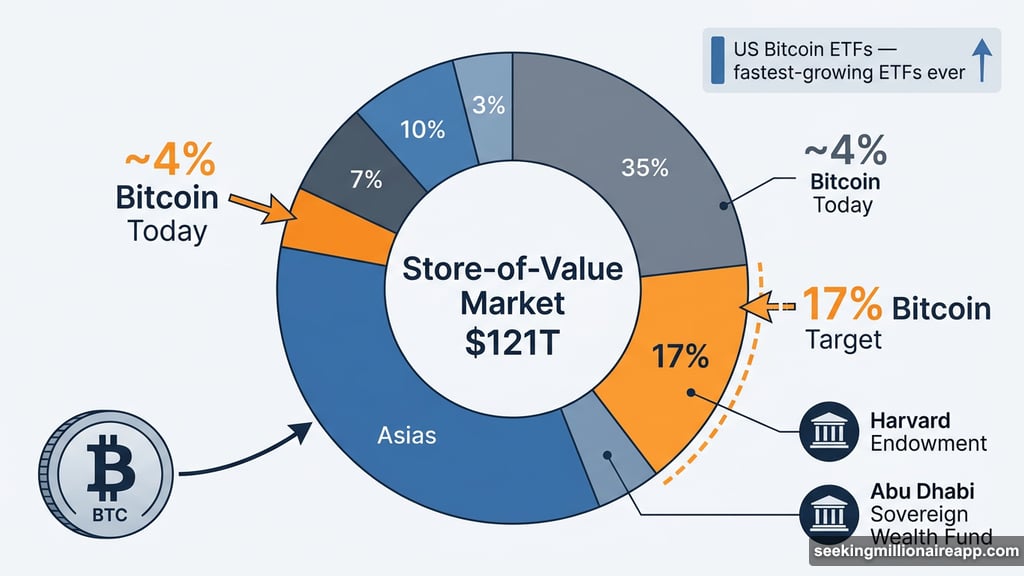
If that pace continues, Hougan projects the total market reaches approximately $121 trillion within the next decade. In a market that size, Bitcoin needs just a 17% share to justify a $1 million valuation. That’s still significant growth from the current ~4% share. But it’s a very different target than 50%.
“That’s still a lot of growth — from ~4% to ~17% — but it feels well within reach when you reflect on all the progress bitcoin has made recently,” Hougan wrote.
Institutional Adoption Is Already Happening
Hougan’s case doesn’t rest on future predictions alone. He points to structural changes already underway in how institutions treat Bitcoin.
US Bitcoin exchange-traded funds (ETFs) have become the fastest-growing ETFs ever launched. Entities as different as the Harvard endowment and the Abu Dhabi sovereign wealth fund now hold BTC. According to BeInCrypto, institutions added roughly 829,000 BTC in 2025.
There’s also a quieter shift worth noting. A few years ago, professional investors treated a 1% Bitcoin allocation as the sensible ceiling. Now, many consider 5% reasonable. That’s not a small change — it reflects a fundamental rethinking of how Bitcoin fits into a serious portfolio.
“There are still miles to go,” Hougan acknowledged. “But with these undercurrents, capturing one-sixth of the store-of-value market in 10 years doesn’t seem extreme. It seems more like a continuation of recent trends.”
What Could Go Wrong
To his credit, Hougan doesn’t ignore the risks. He flags two specific concerns worth taking seriously.
First, the macro conditions that powered gold’s growth over the past two decades were unusually turbulent. The global financial crisis, the invention of quantitative easing, and extended low-rate environments all pushed investors toward hard assets. A calmer economic backdrop could slow the store-of-value market’s expansion considerably.
Second, Bitcoin could simply fail to gain ground even if the market grows. Regulatory setbacks, technological vulnerabilities, or a fading narrative could stall adoption regardless of favorable conditions.
But Hougan also sees equal risk on the upside. If government debt concerns escalate to crisis levels, demand for non-sovereign stores of value could accelerate sharply. In that scenario, Bitcoin could claim far more than 17% of a rapidly expanding market.
The Complication Nobody Wants to Address
Here’s where Hougan’s framework runs into a real tension. His entire thesis depends on Bitcoin behaving like a store of value — a safe haven asset that attracts capital when things get shaky.
But recent market behavior tells a different story. During periods of macro stress, Bitcoin has tended to trade more like a high-beta tech stock than digital gold. When the tariff-driven market crash hit, capital rotated into traditional safe havens. Bitcoin didn’t benefit the way gold did.
That doesn’t kill the thesis. But it does add an important caveat. The store-of-value market may very well expand toward $121 trillion. Whether Bitcoin rides that wave or gets left behind depends on a question that math alone can’t answer — does the world actually come to treat it like gold?
Hougan clearly believes it will. The institutional momentum supports that belief. But the behavioral pattern in stress periods is still something Bitcoin needs to decisively break before the store-of-value narrative becomes unassailable.
The math works. Whether Bitcoin earns the right to sit in that math is the part still being written.