
Gold is getting hit from two directions at once. Institutional money is flowing toward Bitcoin, and Tether’s USDT is quietly becoming the payment rail of choice for illegal gold traders in Latin America.
These aren’t isolated stories. Together, they suggest gold faces real pressure from digital assets in ways that would have seemed unlikely just a few years ago. Let’s unpack what’s actually happening.
Bitcoin ETF Inflows Beat Gold as Iran Conflict Escalates
JPMorgan’s managing director Nikolaos Panigirtzoglou flagged a sharp reversal in institutional fund flows after the Iran conflict began. The numbers are striking.
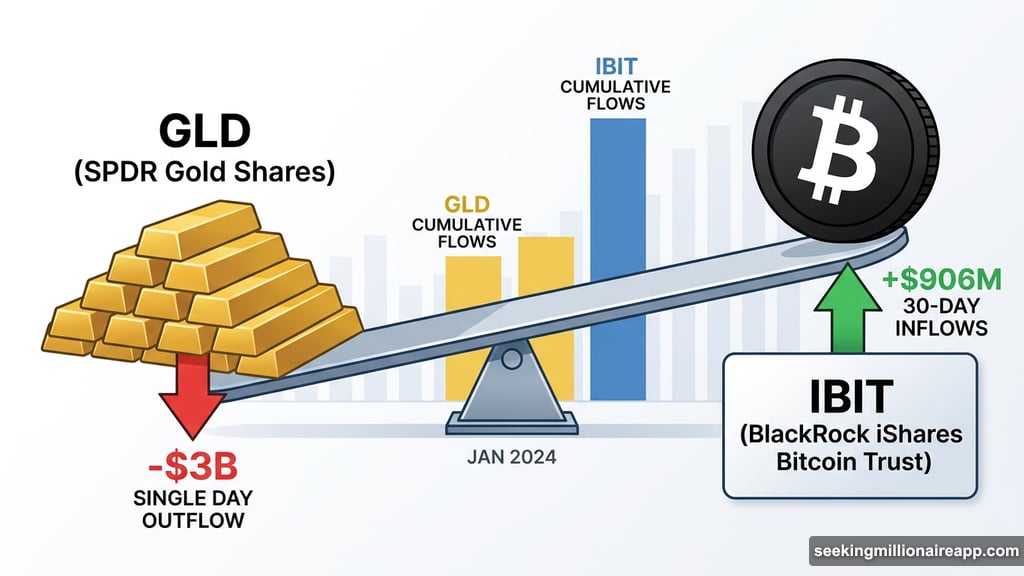
SPDR Gold Shares (GLD), the largest gold ETF in the world, has seen outflows equal to about 2.7% of its assets under management since the conflict erupted. BlackRock’s iShares Bitcoin Trust (IBIT), by contrast, recorded inflows of roughly 1.5% over the same period.
That represents a meaningful shift. From October 2025 onward, retail investors had been rotating out of Bitcoin and into gold. GLD was pulling in strong inflows. IBIT was bleeding. Then the conflict changed the calculus entirely.
Zooming out, IBIT still leads GLD by a wide margin in cumulative flows since its launch in 2024. Total inflows into IBIT remain roughly double those of GLD over that period. Plus, IBIT’s assets under management nearly matched GLD’s last July before a market correction widened the gap again.
GLD’s $3 Billion Single-Day Outflow Tells the Story
The numbers on the gold side are hard to ignore. GLD lost $3 billion in a single day on March 6 — the largest daily outflow in two years.
Meanwhile, Bitcoin ETF 30-day net inflows recovered to $906 million as of March 11. That’s a significant rebound from a $1.9 billion outflow recorded just a month earlier.
JPMorgan also noted that hedge fund positioning shifted before the current reversal. Short interest in IBIT climbed in recent months while short interest in GLD fell. So institutional players had actually reduced Bitcoin exposure and moved into gold right before the trend flipped again.
One more detail worth noting: JPMorgan analysts say Bitcoin’s volatility profile is compressing. They attribute that to deeper institutional ownership and improving market liquidity. For an asset once dismissed as too volatile for serious portfolios, that’s a meaningful development.
USDT Becomes the Currency of Illegal Gold Trading
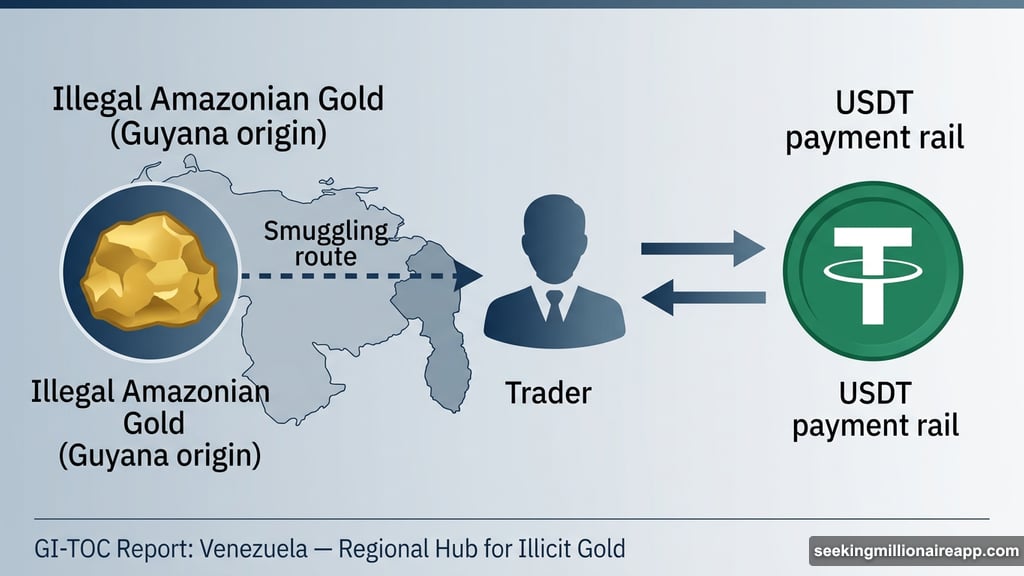
While Bitcoin gains ground with institutional investors, USDT is showing up in a very different context. A report from the Global Initiative Against Transnational Organized Crime (GI-TOC) found that Venezuela has become a regional hub for illegally traded Amazonian gold over the past two years.
That’s a reversal from earlier patterns. Previously, illicit gold flowed out of Venezuela toward Brazil and Guyana. Now, the GI-TOC found that gold originating from Guyana is being sold inside Venezuela in exchange for USDT.
Marcena Hunter, the report’s co-author and Head of Extractives at GI-TOC, confirmed that illicit gold traders have been using the stablecoin for over a year. “This highlights the increasing relevance of stablecoins in global illicit transactions alongside broader concerns about crypto and organised crime,” the report stated.
Venezuela’s Dependence on USDT Runs Deep
The GI-TOC findings align with a separate December report from TRM Labs, which concluded Venezuela has grown increasingly reliant on USDT. Sanctions and hyperinflation have effectively cut the country off from traditional banking infrastructure. USDT fills that gap.
Venezuelan gold mining generated just over $2.2 billion in revenue last year, according to GI-TOC estimates. As oil revenues declined, gold became a critical income source. The report also described how the Maduro government used gold trade revenue to maintain loyalty among politicians and security forces, while certain government elements coordinated with criminal networks gaining control of mining operations in the Amazon Basin.
Tether, for its part, pointed to its cooperation with global law enforcement as evidence it takes these concerns seriously. The company says it has frozen approximately $4.3 billion in assets connected to illicit activity.
Senate Bill Targets Illegal Gold, but Misses the Crypto Angle
Congress is paying attention to the illicit gold problem. The U.S. Legal Gold and Mining Partnership Act, a bipartisan bill co-sponsored by Senators John Cornyn, Tim Kaine, Ted Cruz, and Jacky Rosen, passed the Senate Foreign Relations Committee in late January.
The legislation would require the State Department to build a multi-year strategy targeting illegal gold mining across the Western Hemisphere. It would specifically direct agencies to investigate Venezuela’s trade and create public-private partnerships for responsible supply chains.
However, Hunter pointed out a significant gap. The bill, as written, doesn’t address crypto’s growing role in laundering gold proceeds. She argued that any effective strategy needs to focus on disrupting the financial flows of illicit actors and blocking foreign persons from accessing the U.S. financial system — including through stablecoin rails.
That’s a meaningful omission. If USDT has become the settlement currency for illegal gold, a bill that ignores crypto may struggle to actually curb the trade it’s targeting.
Two Forces, One Pressure Point
What makes this moment interesting is how the two trends combine. Bitcoin is pulling institutional capital away from gold as a safe-haven asset. That’s a slow, structural shift but an accelerating one. At the same time, USDT is reshaping how physical gold moves through criminal supply chains, making the commodity harder to track and regulate.
Policymakers face a two-front challenge. On one side, they need to decide whether digital assets deserve the safe-haven status traditionally reserved for gold. On the other, they need to close regulatory gaps that allow stablecoins to serve as settlement tools in illicit commodity markets.
Whether Congress decides to add crypto provisions to the mining bill could determine how effective it actually is. The stablecoin angle isn’t a sideshow. Right now, it looks like the main event.