The Strait of Hormuz is making headlines for all the wrong reasons. US-Israeli strikes on Iran in late February triggered a chain reaction that’s now rippling through global oil markets, inflation forecasts, and cryptocurrency prices simultaneously.
So what does a potential oil crisis actually mean for Bitcoin? The answer is more complicated than you might expect.
Bloomberg Maps Three Scary Oil Scenarios
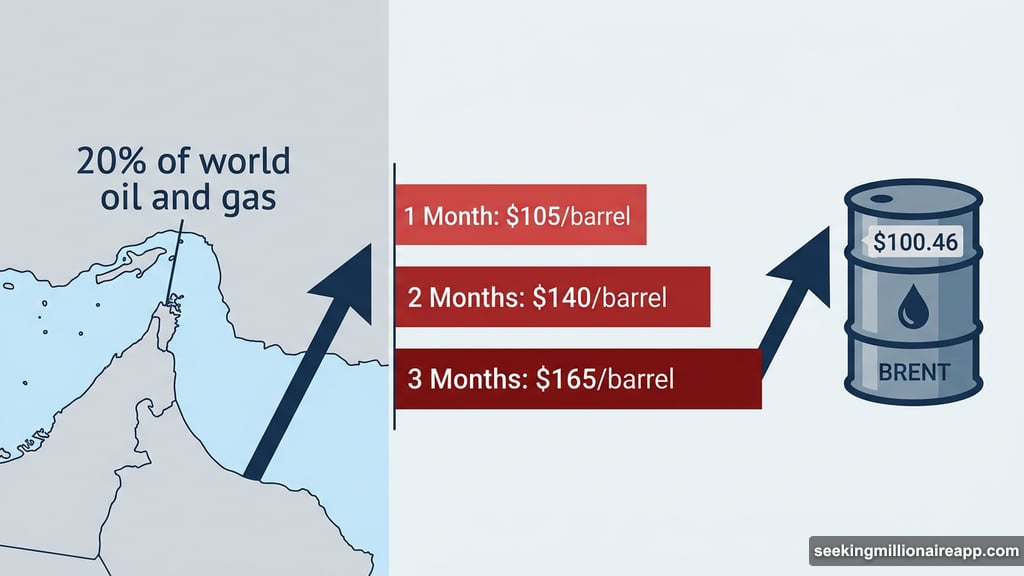
About one-fifth of the world’s oil and natural gas flows through the Strait of Hormuz. That single chokepoint suddenly looks very fragile right now.
Bloomberg has already modeled three scenarios based on how long the disruption lasts. A one-month shutdown could push oil to around $105 per barrel. Stretch that to two months and prices could jump to roughly $140. And if the closure drags on for three months? Bloomberg projects oil hitting approximately $165 per barrel.
For context, Brent crude futures already closed at $100.46 per barrel on a recent Thursday, according to the Wall Street Journal. That marked the first time the benchmark settled above $100 during regular trading hours since August 2022. So the lower end of these projections isn’t theoretical anymore.
![Aerial view of oil tanker navigating through the Strait of Hormuz with rising price chart overlay representing Bloomberg’s three oil disruption scenarios]
Stagflation Zone Ahead?
Analysts at Milk Road Macro broke down exactly what different price levels mean for the global economy, and the picture gets progressively uglier.
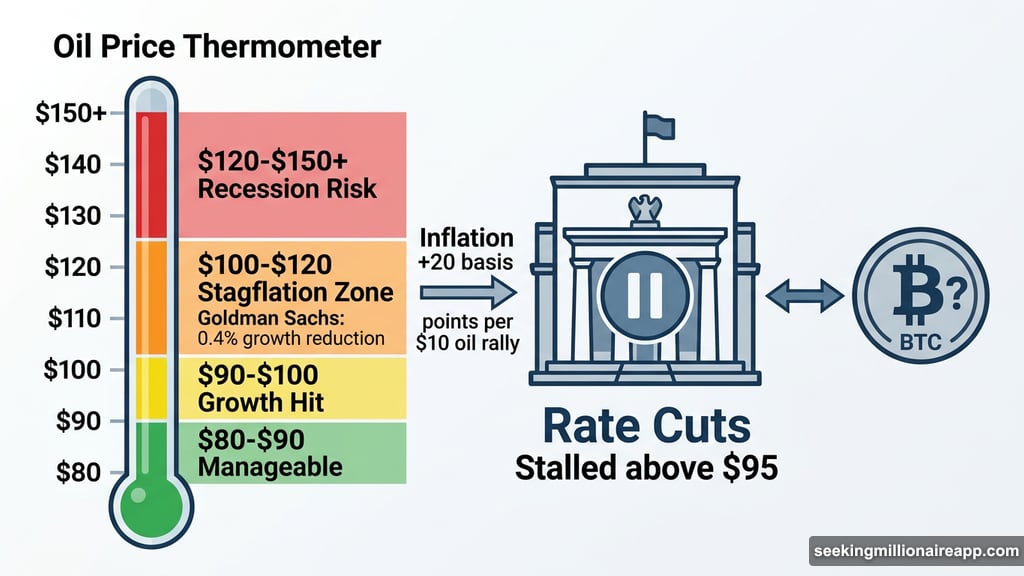
Brent crude between $80 and $90 per barrel is manageable. Push into the $90 to $100 range and growth starts taking a visible hit. Goldman Sachs estimated that even a temporary move to $100 could shave about 0.4 percentage points off global growth.
The $100 to $120 range is what Milk Road Macro calls the stagflation zone. Slow growth pairs with sticky inflation, and that combination is particularly nasty for central banks trying to manage policy.
Things get worse from there. The $120 to $150 window shifts the conversation from “macro drag” to “heightened recession risk.” Milk Road Macro noted that the US economy likely remains mostly resilient unless oil sustains above $125. But if prices exceed $150, all bets are off. Transportation costs, manufacturing expenses, food prices, and energy bills all spike at once, functioning as a broad tax on economic activity.
Brent Crude Above $95 Could Stall Fed Rate Cuts
Here’s where it gets really interesting for crypto investors. High oil prices don’t just hurt the economy directly. They complicate everything the Federal Reserve is trying to do.
Adam Kobeissi, founder of The Kobeissi Letter, cited a Fed study showing that every $10 rally in oil prices increases inflation by approximately 20 basis points. His models indicate that if US oil prices rise above $95 per barrel and stay there for three months, US CPI inflation would climb to around 3.2%. That would put inflation at its highest level since May 2024.
Currently, markets price in a 99.1% probability that the Fed holds rates steady at the upcoming FOMC meeting, according to CME FedWatch data. But sustained oil-driven inflation could force the Fed to delay or cancel anticipated rate cuts entirely.
Tighter financial conditions are bad news for risk assets. As Treasury yields rise and liquidity tightens, speculative markets lose a key support structure. The combination of stubborn inflation and fewer rate cuts creates a genuinely tough climate for Bitcoin and broader crypto markets.
Bitcoin Outperforms S&P 500, Nasdaq, Gold, and Silver
Now for the surprising part. Despite all this economic turbulence, Bitcoin has been holding up remarkably well.
Since the late February strikes on Iran, Bitcoin climbed 7.3%. Meanwhile, the S&P 500 and Nasdaq each dropped between 1% and 2% over the same period. Gold lost 3.7%. Silver tumbled more than 10%.
![Bitcoin price performance chart compared to S&P 500, gold, and silver during the late February to March 2026 period showing Bitcoin’s 7.3% gain against declining traditional assets]
Bitcoin outperforming traditional safe havens during a geopolitical crisis is genuinely notable. It suggests some investors are treating it as a hedge against the kind of monetary instability that oil shocks can trigger.
But the short-term picture doesn’t tell the whole story. Crypto markets run 24 hours a day, seven days a week, which means both rapid gains and sudden losses get amplified during global shocks. If liquidity dries up significantly, leveraged crypto derivative positions could face cascading liquidations very quickly.
Bitcoin’s Real Test Is Still Coming
The 7.3% gain looks impressive right now. But sustained high oil prices and a Fed committed to tight monetary policy would put serious pressure on that performance.
If the Strait of Hormuz disruption cools and risk appetite returns, Bitcoin could extend its gains. But continued disruption means continued inflation risk, which means continued pressure on the Fed to hold firm, which means continued headwinds for speculative assets.
The honest assessment is that Bitcoin is threading a needle right now. Its recent strength suggests some genuine resilience, maybe even a developing identity as a macro hedge. Whether that identity holds up under sustained economic pressure is the question nobody can answer yet.
What’s clear is that the Hormuz situation bears watching closely. Oil prices, Fed decisions, and Bitcoin’s next move are all tied together in ways that would have seemed unusual just a few years ago.