
Former British Prime Minister Boris Johnson just stirred up a fierce debate. And the crypto community is not staying quiet about it.
In a recent op-ed, Johnson dismissed Bitcoin as a “giant Ponzi scheme” destined for collapse. He painted the world’s largest cryptocurrency as nothing more than a confidence trick propped up by naive new investors. Predictably, some of the biggest names in crypto pushed back hard.
A Personal Story Driving a Big Claim
Johnson’s argument starts with a personal anecdote. An acquaintance of his reportedly turned a 500-pound investment into a 20,000-pound loss, caught up in confusing internet fees and what Johnson describes as a “predatory environment.”
For Johnson, that story is not just a cautionary tale. It is proof of a fundamental design flaw.
“I have always suspected from the outset that all cryptocurrencies were basically a Ponzi scheme, with very few good-use cases,” he wrote in the op-ed.
His core argument is that Bitcoin lacks the one thing real money needs: authority. He pointed to the Roman Empire as an example. Rome kept inflation low partly because people trusted the authority stamped on every coin. Modern governments, despite their flaws, back their currencies with sovereign power.
Bitcoin, by contrast, has no such backing. Johnson describes it bluntly as “a string of numbers stored in a series of computers.”
No Central Authority Means No One to Blame
Johnson does acknowledge Bitcoin’s appeal to its supporters. He gets the pitch. Decentralization means politicians cannot interfere. Governments cannot debase it through reckless spending. That sounds attractive.
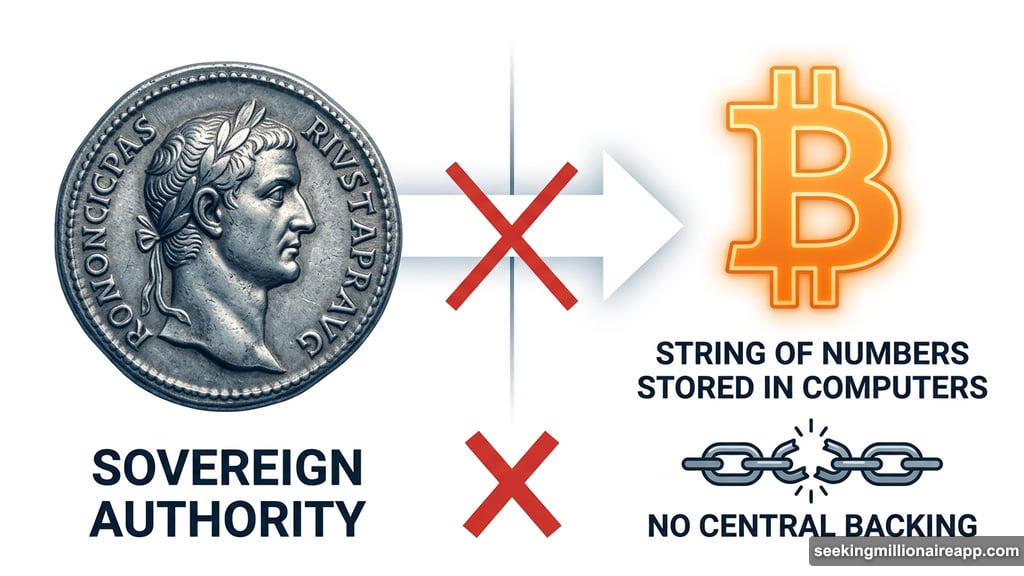
But he flips the argument on its head. That same decentralization means there is nobody to hold accountable when things go wrong. No central banker to fire. No government to vote out. No regulator to call when your coins disappear in a hack.
“There is no one to hold to account if the whole thing is suddenly hacked,” he argued.
He also compared Bitcoin unfavorably to gold and even collectible Pokémon cards. At least those have recognizable, tangible appeal. Bitcoin, in his view, runs entirely on the “suspension of disbelief.”
His prediction is stark. Once confidence cracks, he warns, the whole thing collapses and leaves late investors with nothing. He even suggested that in ten years, Pokémon cards might look like the smarter long-term bet.
Michael Saylor and Kwasi Kwarteng Push Back
The crypto world wasted no time responding. And the counterarguments came from people with real credibility on both sides of the finance world.
MicroStrategy Executive Chairman Michael Saylor rejected the Ponzi comparison directly. His argument is straightforward. A real Ponzi scheme needs a central operator who promises returns and secretly pays early investors with new money coming in. Bitcoin has none of that. There is no issuer, no promoter, and no guaranteed yield. It is an open network governed by transparent code and actual market demand.
Former UK Chancellor Kwasi Kwarteng went even further. Kwarteng, who now co-founds Stack Bitcoin Treasury, compared Johnson’s criticism to calling the early internet a pyramid scheme. He argued that the British political class is “asleep at the wheel” and “years behind” on financial innovation.
“Bitcoin didn’t appear in a vacuum. It is the latest chapter in a very long story, the evolution of money itself,” Kwarteng wrote on X. He traced that evolution from gold, to gold-backed paper, to purely fiat currencies. His point is that a decentralized monetary network with a fixed supply was not some random invention. It was, he argues, practically inevitable.
Institutional Adoption Complicates Johnson’s Case

Beyond the theoretical debate, the market reality also pushes back against Johnson’s narrative.
Bitcoin has attracted serious institutional money over recent years. Wall Street asset managers now oversee tens of billions of dollars in spot Bitcoin exchange-traded funds (ETFs). These are not fringe investors chasing a quick profit. These are major financial institutions making long-term allocations.
And the adoption goes beyond corporations. Nation-states are now getting involved. The United States is actively establishing and proposing strategic national Bitcoin reserves as part of securing long-term financial infrastructure. That is a far cry from a confidence trick waiting to implode.
Johnson’s Ponzi label becomes harder to defend when sovereign governments are treating Bitcoin as a reserve asset. Ponzi schemes do not typically get added to national balance sheets.
Where This Debate Actually Stands
Both sides are making real arguments here, and that is what makes this interesting.
Johnson is not entirely wrong that Bitcoin relies on confidence. All money does, including the pound and the dollar. His concern about vulnerable people losing savings to crypto scams is also legitimate and worth taking seriously.
But calling Bitcoin a Ponzi scheme misses something important. A Ponzi scheme has a hidden architecture designed to deceive. Bitcoin’s architecture is entirely visible and open to inspection. Anyone can audit the code, verify the supply, and trace every transaction on the blockchain.
The debate Johnson sparked is actually healthy. It pushes the crypto community to explain what Bitcoin is and why it works, rather than just expecting everyone to trust the price chart. And it pushes critics like Johnson to engage with the actual mechanics rather than relying on personal anecdotes and historical comparisons to Roman coins.
Neither side is going to convince the other overnight. But the conversation is worth having, especially as Bitcoin moves further into mainstream finance and national policy.