Something interesting happened in early March 2026. As missiles flew over the Middle East and investors rushed toward safety, Bitcoin quietly outperformed gold, US equities, and nearly every traditional safe-haven asset on the market.
That’s not what the textbooks predict. But the data is hard to argue with. And analysts are starting to ask a question that would have sounded absurd just a few years ago: is Bitcoin becoming the go-to store of value during geopolitical chaos?
Bitcoin Climbs While Gold Stumbles
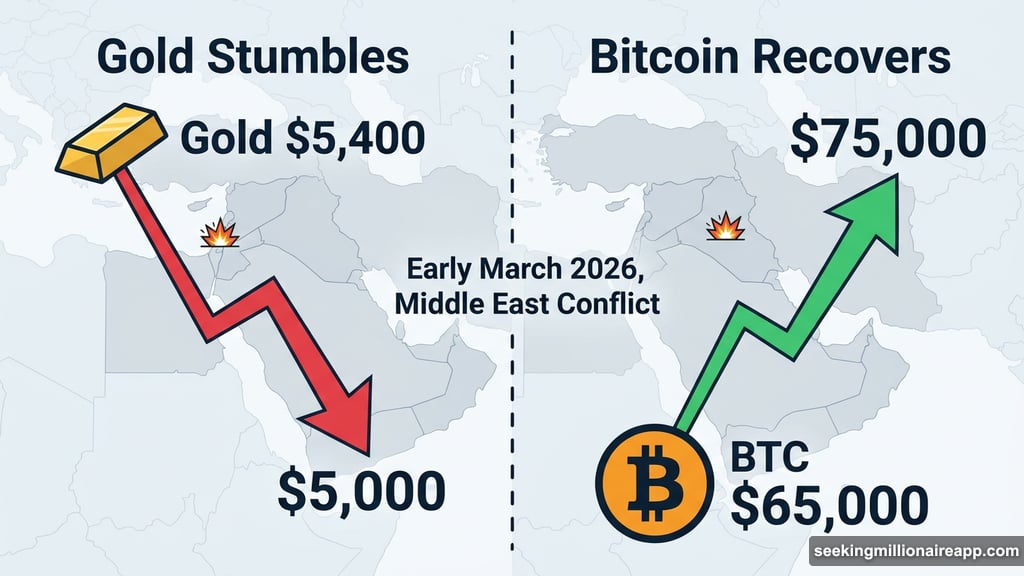
After Israel launched attacks on Iran in early March, gold did what gold usually does. It spiked. Then it fell hard, dropping from $5,400 all the way down to nearly $5,000.
Bitcoin did the opposite. It recovered from $65,000 to $75,000 during the same window.
André Dragosch, an analyst at Bitwise, flagged this divergence almost immediately. He noted that Bitcoin has been outperforming both US equities and gold since the start of March. And his conclusion is striking.
“This could signal the early stages of a rotation from stretched safe-haven assets into risk assets like BTC,” Dragosch said.
In other words, some investors may be cashing out of gold at peak prices and moving that capital into Bitcoin instead.
Capital Rotation and the Gold-Bitcoin Lag
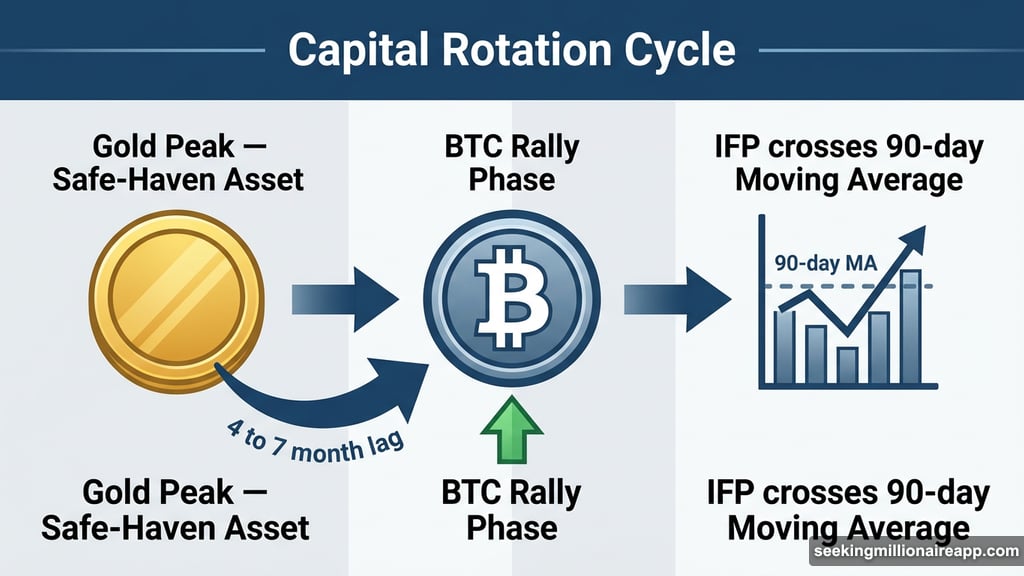
Bitwise’s research points to a pattern worth knowing about. Historically, gold tends to lead Bitcoin’s price moves by about four to seven months.
So if gold has already peaked, Bitcoin’s rally might have several months left to run before it forms its own top. That’s a long time for momentum to build.
Moreover, further escalation in the Middle East could actually accelerate this shift. Bernstein analyst Gautam Chhugani put it bluntly:
“Maybe it takes a physical conflict to realise Bitcoin remains the most portable, cross-border, digital and liquid asset with no counter-party risks.”
That framing matters. Bitcoin doesn’t depend on any government, central bank, or physical vault. In times of real geopolitical risk, that independence starts looking very attractive to sophisticated investors.
On-Chain Signals Show a Healthier Market
Beyond price action, Bitcoin’s internal market dynamics are improving. And that’s arguably more important than the headline numbers.
One key indicator is the Inter-Exchange Flow Pulse, or IFP. Think of the IFP as a measure of how actively Bitcoin is moving between major trading platforms. When the IFP climbs above its 90-day moving average, it signals that liquidity is returning to the market in a meaningful way.
That’s exactly what just happened. Bitcoin’s IFP has crossed back above its 90-day average and turned bullish. Historically, strong Bitcoin growth phases often begin right after this signal appears. It suggests the early stage of a market expansion cycle, not just a short-term bounce.
Long-Term Holders Are Holding Tight
At the same time, another on-chain metric is sending a quietly powerful signal.
The CDD Multiple, or Coin Days Destroyed Multiple, has dropped to its lowest level since 2022. This metric tracks how often older Bitcoin coins move. When it falls, it means long-term holders are sitting tight and not selling.
That matters because long-term holders represent some of the most convicted participants in the Bitcoin market. When they stop moving coins, selling pressure from older supply essentially disappears.
Alphractal, a crypto analytics platform, summed up the signal: “CDD Multiple signals strong long-term holder conviction. Historically, these periods often happen during consolidation phases before the next major move.”
Two signals pointing in the same direction. Liquidity flowing back in, and experienced holders refusing to sell.
What This Actually Means Right Now
Put it all together and a clear picture starts to emerge. Bitcoin is outperforming traditional safe-haven assets during active military conflict. On-chain liquidity flows are turning structurally positive. Long-term holders are showing unusual conviction. And gold’s historical lead over Bitcoin suggests the rally may have room to run.
None of this is guaranteed. Markets can reverse fast, and geopolitical situations are notoriously unpredictable. But the case being built here isn’t just speculative. It’s supported by both market data and historical pattern recognition.
2026 may be the year Bitcoin faces its most meaningful test as a store of value during real-world political turmoil. If it passes that test convincingly, the capital rotation story stops being a theory and starts being a trend.
That’s worth paying attention to, whether you hold Bitcoin or not.