
Active crypto traders in the United States have quietly made stablecoin yield a core part of their financial lives. And the numbers back that up in a big way.
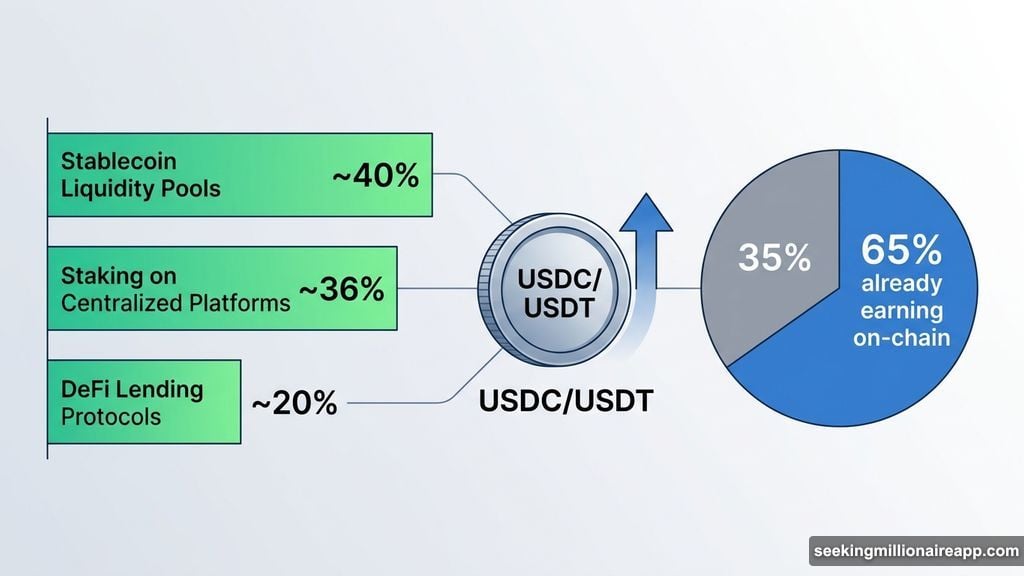
A new OKX survey of 1,000 active US crypto traders found that more than 65% have already used on-chain tools to earn yield on stablecoins. Over a quarter do it regularly. For this crowd, chasing yield on-chain isn’t an experiment anymore. It’s just how they manage their money.
So what does that actually look like in practice? And what’s still holding people back from going deeper?
Who These Traders Are
Nearly two-thirds of survey respondents started trading before 2023. That means they’ve lived through bear markets, crashes, and chaos. These aren’t newcomers chasing hype.
Their preferred strategies reflect that experience. Providing liquidity to stablecoin pools tops the list, drawing interest from nearly 40% of traders surveyed. Staking on centralized platforms comes in close behind at just over 36%. Lending through DeFi protocols appeals to roughly one in five users.
Put simply, stablecoin yield has become everyday portfolio infrastructure for serious traders. It’s less of a niche strategy and more of a standard practice.
Traders Want Control, but the Tools Aren’t Keeping Up
Here’s where things get interesting. An overwhelming 89% of respondents said they prefer to manage most of their trading themselves. Within that group, 51% want self-management paired with some automation. Another 38% want full, unassisted control over every single decision.
Only 2% are willing to hand everything over to a platform.
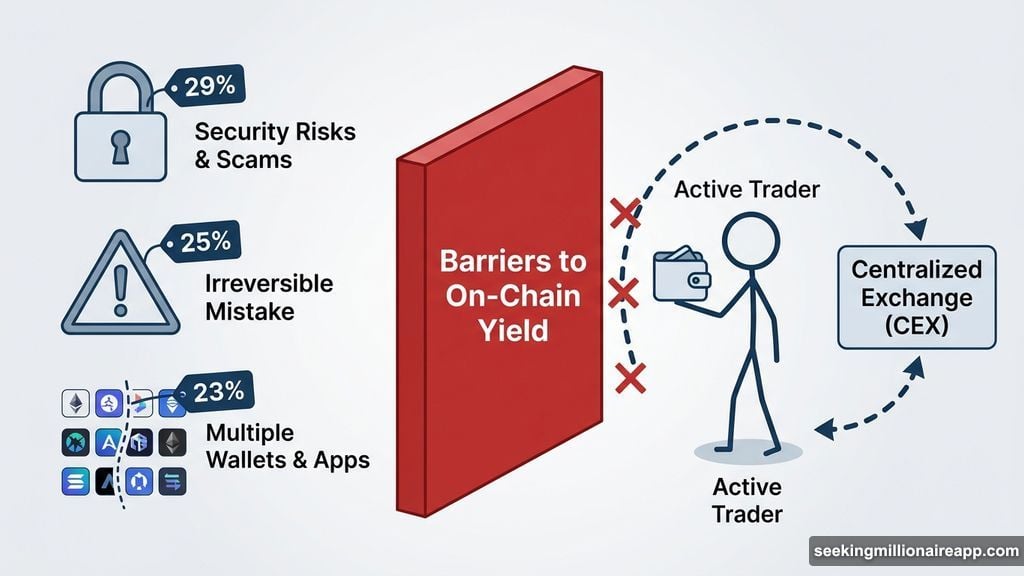
But the on-chain experience hasn’t caught up with that hunger for independence. Security risks and scams remain the single biggest barrier, cited by 29% of respondents. The fear of making an irreversible mistake follows at 25%. Juggling multiple wallets and fragmented apps frustrates another 23%.
These aren’t fringe complaints. Seed phrase anxiety, one-wrong-click finality, and scattered interfaces represent a very real ceiling on how far even motivated traders are willing to go.
DeFi Protocol Complexity Keeps Many on the Sidelines
Think about what it takes to earn yield on-chain today. You need a self-custody wallet, enough ETH or SOL for gas fees, and the confidence to navigate multiple protocols without clicking the wrong button.
For many traders, that friction is simply too high. And the stakes feel steep. One mistake can mean losing funds with no customer service line to call and no way to reverse the transaction.
That’s a fundamentally different experience from logging into a familiar centralized exchange. So even traders who want on-chain exposure often stick to what feels safe, even if it means lower returns.
What Traders Will and Won’t Delegate
When asked which tasks they’d happily offload to an exchange, respondents drew a clear line. Best-price routing topped the list at 24%, followed by scam detection at 21%. Execution timing optimization attracted 16%, and cross-chain bridging came in at 12%.
Only 1% said they wouldn’t delegate anything at all.
The pattern is consistent across the survey. Traders want to keep strategic decisions firmly in their own hands. But they’re very willing to let platforms absorb the operational headaches, especially the ones most likely to go wrong.
CEX Infrastructure With On-Chain Access
The survey also asked traders about a specific hybrid model: centralized exchange infrastructure combined with on-chain execution. A full 90% reacted positively to the idea.
That enthusiasm grew even stronger when clearer regulatory frameworks were part of the picture. More than one-third of respondents expect centralized exchanges to become their primary gateway into on-chain markets. Just 16% said they’d access decentralized protocols entirely on their own terms.
The demand for on-chain access is clearly there. What’s missing isn’t interest. It’s an experience that matches the safety and simplicity traders already expect from centralized platforms.
The Gap Between Desire and Experience
Stablecoin yield has already gone mainstream among active US traders. That much is clear from the data. But the path forward depends entirely on how well the tools can close the gap between what traders want and what currently exists.
Right now, the on-chain world asks too much of people. It demands technical confidence, extreme caution, and a tolerance for complexity that most traders, even experienced ones, find exhausting.
The traders are ready. The yield opportunity is real. What the space still needs is infrastructure that makes going on-chain feel as natural as logging into an app you already trust.