
Four weeks in a row. That’s how long US spot Bitcoin ETFs have been pulling in fresh money without a single week of outflows.
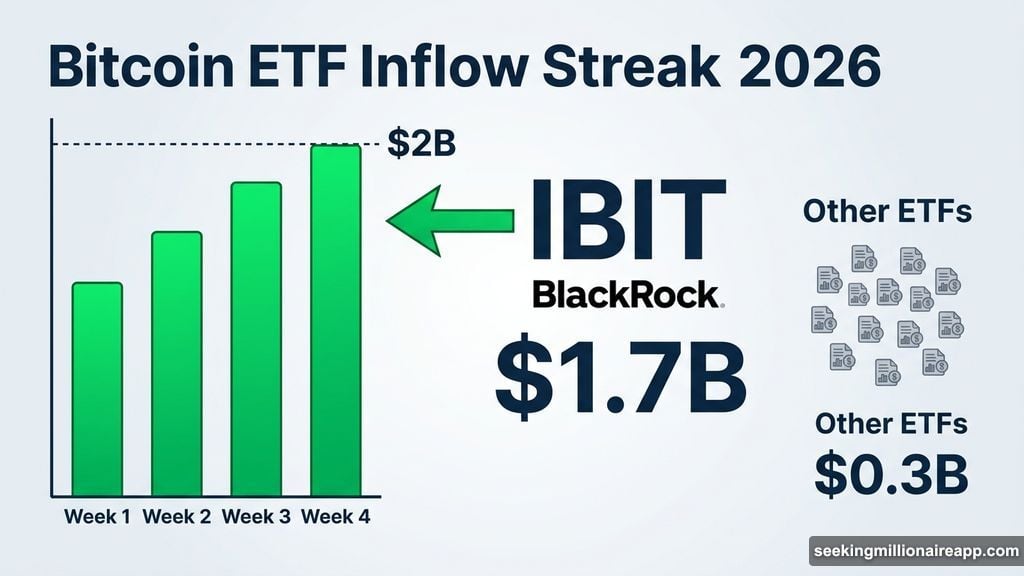
And the numbers are anything but small. About $2 billion has flowed into these funds over that stretch, marking the most sustained buying period of 2026 so far. For anyone watching institutional money move through the crypto space, this is a moment worth paying attention to.
BlackRock’s IBIT Dominates the Inflow Story
One fund is doing most of the heavy lifting here. BlackRock’s iShares Bitcoin Trust, better known as IBIT, accounted for roughly $1.7 billion of that $2 billion total.
That’s a staggering share for a single product. It cements IBIT’s position as the undisputed leader among the 12 US-listed spot Bitcoin ETF products currently trading. No other fund comes close in terms of raw capital attraction right now.
Data from SoSoValue confirms the trend. The chart tells a pretty clear story: IBIT is where institutional money wants to go when it wants Bitcoin exposure.
How This Streak Compares to Recent History
Four straight weeks of inflows sounds impressive. But let’s put it in context.
The last comparable run came during the August to September 2025 window. During that period, Bitcoin ETFs pulled in more than $3.8 billion in fresh capital. So the current pace is noticeably slower than that earlier surge.
Still, the streak matters for a different reason. It signals a shift in sentiment after a rocky start to 2026. Buyers are returning consistently, even if they’re not rushing in at record speed.
Since their landmark debut in January 2024, these 12 funds have now accumulated more than $56 billion in cumulative inflows. Combined, they oversee roughly $90 billion in net assets. That’s a lot of institutional firepower parked in Bitcoin.
Bitcoin Holds $70,000 Despite Macro Headwinds
Here’s where things get interesting. Bitcoin has been sitting close to the $70,000 mark, and that price stability is surprising given what’s happening in the world right now.
Geopolitical tensions in the Middle East are running high. Historically, that kind of global stress sends investors sprinting toward traditional safe-haven assets like gold or US Treasuries. Bitcoin usually struggles in those environments as risk appetite shrinks.
But this time, the ETF inflows appear to be building a support floor under the price. Consistent institutional buying seems to be offsetting the usual macro-driven selling pressure. That’s a meaningful sign of how much the market structure around Bitcoin has changed since these ETFs launched.
Don’t Expect a Moonshot Just Yet
Before anyone starts dreaming of $100,000 Bitcoin by next month, some caution is worth noting.

Macro-focused research platform Ecoinometrics weighed in on the current setup. Their assessment was measured and honest. “The direction is now unambiguous, but we are still far from a complete recovery,” the firm noted. “Even in bullish simulations, this kind of demand typically translates into a slow rebuilding phase.”
So what price target does Ecoinometrics consider realistic in the near term? They pointed to the $80,000 region as a 30-day target that fits the current demand profile better than a run at the symbolic $100,000 level.
That framing feels grounded. The inflows are real. But rebuilding phases take time, and the pace of accumulation right now simply doesn’t support the kind of explosive upside move that would push Bitcoin through major resistance in a single burst.
Why This Shift Actually Matters
The most important insight from Ecoinometrics isn’t the price target. It’s the structural observation underneath it.
ETF demand has moved from being a headwind to becoming a foundational support mechanism for Bitcoin’s price. That’s a significant change from earlier in 2026, when outflows were dragging on market confidence and adding pressure during already difficult stretches.
Now the dynamic is reversed. Consistent buying from these funds gives Bitcoin a base to work from, even when macro conditions aren’t cooperating. That kind of institutional bedrock didn’t exist in previous cycles.
For long-term believers in Bitcoin, this matters more than any single weekly flow number. It suggests the asset is entering the early stages of a new cyclical phase, one where institutional infrastructure plays a central stabilizing role rather than amplifying volatility.
The building phase is slow and sometimes frustrating to watch. But what’s being built looks increasingly durable.