
Ethereum is sitting at a crossroads right now. Prices have slipped to $2,135 — about 9% below the March peak of $2,370 — and two powerful forces are pulling in opposite directions.
On one side, whale wallets were quietly selling into the rally. On the other, buyers just yanked roughly 870,000 ETH off exchanges in a single 24-hour window. That’s about $1.8 billion in ETH moving away from immediate sale. So the big question is simple: which camp wins?
Whale Wallets Sold Into the March Rally Peak
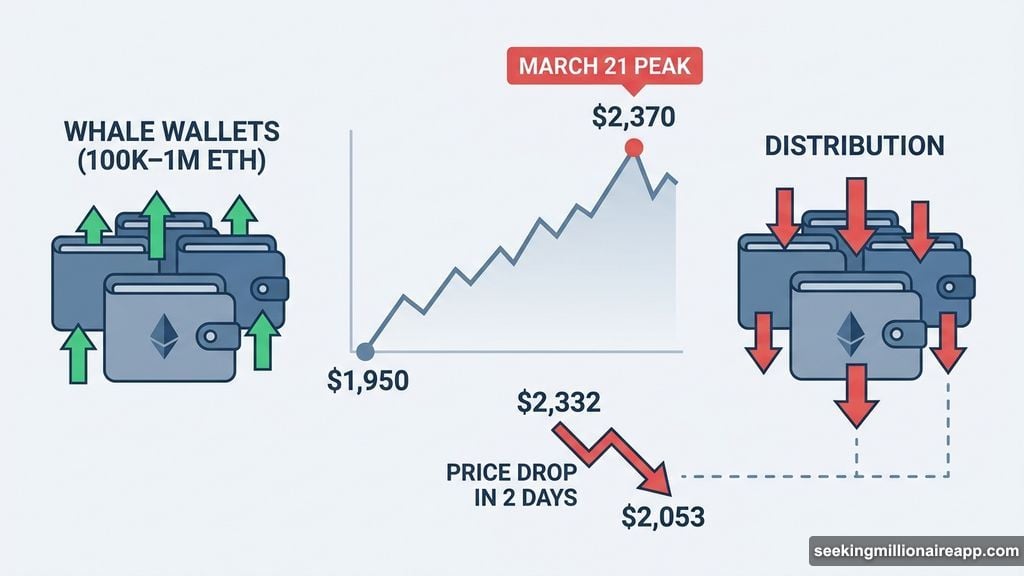
The March rally looked convincing on the surface. ETH climbed 21.44% from its March 9 low near $1,950, pushing all the way to $2,370 by mid-March. But Santiment data tells an uncomfortable story about who was doing the buying — and who was quietly heading for the exit.
Wallets holding between 100,000 and 1,000,000 ETH were steadily accumulating through the early stages of that climb. Their buying helped fuel the recovery rally. Then, around March 21, something shifted.
As the price peaked, those same whale balances dropped sharply. ETH fell from roughly $2,332 to $2,053 in just two days. The simultaneous drop in both whale holdings and price points to deliberate distribution — large holders selling into strength, not panic-selling into weakness.
This wasn’t a liquidation event. It was a calculated exit at elevated prices, and it directly caused the 13% correction we’re seeing play out this week.
Exchange Supply Withdrawal Signals $1.8 Billion in Buying Intent
Here’s where things get interesting. While whales were distributing, a separate group of buyers was doing something very different.
Between March 21 and 22, total ETH held on exchanges dropped from roughly 8.12 million to 7.29 million ETH. That 870,000 ETH withdrawal represents approximately $1.8 billion worth of Ethereum moving off exchanges and into self-custody wallets.
Why does this matter? When holders pull coins off exchanges, they’re typically not planning to sell anytime soon. Self-custody is a long-term signal. It removes immediate selling pressure from the market and suggests conviction buying at current levels.
So you had whales selling at the top while a separate cohort of buyers was simultaneously absorbing that supply and locking it away. The net effect on price depends entirely on which force carries more momentum in the days ahead.
Key Fibonacci Support and the $2,027 Floor
ETH is currently hovering just above the Fibonacci 0.786 retracement level at $2,027. This level has held on two prior tests, making it the most meaningful support zone before the next major floor at $1,928.
A daily close above $2,148 would signal that buyers have reclaimed enough ground to target a recovery toward $2,350. That level would represent a full reversal of the recent correction and align with the prior peak range.
The $1.8 billion in exchange withdrawals gives buyers the raw ammunition to push there. But timing matters. If the $2,027 floor holds on any further tests this week, the recovery thesis stays intact.
Glassnode Data Shows Largest Net Profit Spike in Six Weeks
Adding another piece to the bullish side of the argument, Glassnode’s Net Realized Profit/Loss data logged its largest positive reading of the entire period on March 23 — approximately +$380 million.
After six straight weeks of predominantly negative or flat readings, that spike means buyers entering at current prices are realizing gains. It suggests fresh demand is entering the market at these levels, not just holdovers from earlier positions.
That’s a meaningful shift in market structure. It doesn’t guarantee a bounce, but it does suggest the selling pressure that drove the correction may be losing momentum.
What Happens If Support Breaks
The bearish scenario deserves equal attention. If the buying pressure from the exchange withdrawal fades quickly and sellers regain control, ETH could lose the $2,027 Fibonacci floor.
Below that level, the next major support sits at $1,928. Losing $1,928 would effectively invalidate the bullish thesis and signal that the March rally was fully distributed — meaning the recovery from $1,950 was a selling opportunity for large holders, not the start of a new leg higher.
That outcome would suggest ETH needs a fresh catalyst and a longer base-building period before attempting another run at $2,370 or beyond.
Right now, the $1.8 billion in exchange withdrawals and the Glassnode profit spike represent genuine reasons for optimism. But Ethereum still needs that daily close above $2,148 to confirm buyers have won this week’s tug-of-war. Watch that level closely — it tells the whole story.