The crypto market was riding high early last week. Then the Federal Reserve spoke, and things got ugly fast.
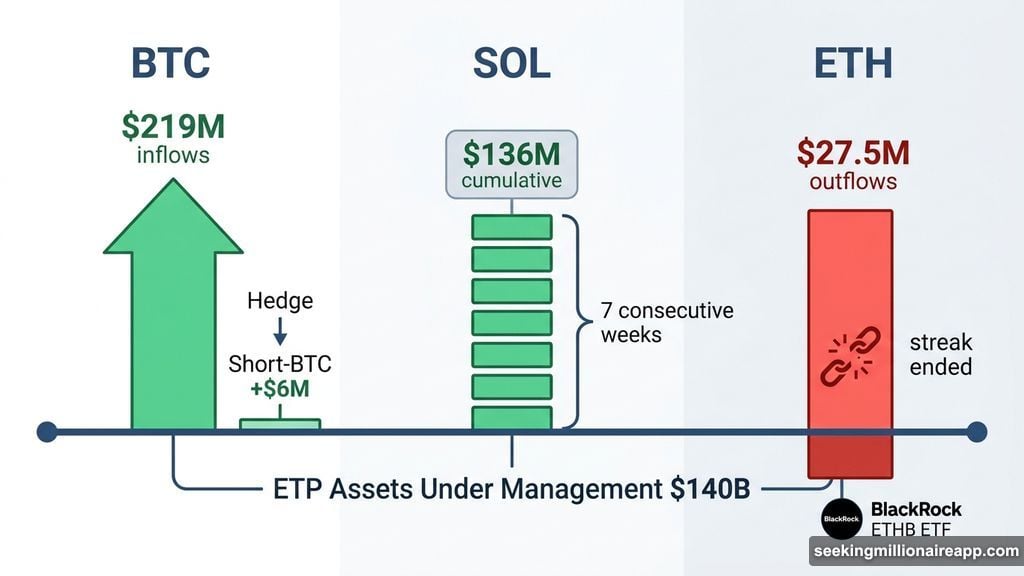
Weekly digital asset fund inflows dropped to just $230 million after a brutal $405 million in post-FOMC outflows wiped out $635 million in early-week gains. That’s a 78% week-over-week collapse from the $1.06 billion recorded the prior week — the third consecutive positive week at that point. Total exchange-traded product (ETP) assets under management stood at $140 billion heading into this stretch.
So what went wrong? One word: rates.
The Fed’s Hawkish Pause Spooked Institutional Money
The Federal Open Market Committee (FOMC) met last Wednesday and delivered what markets interpreted as a hawkish pause. No rate cut was announced, and signals pointed to only one cut remaining in 2026.
That’s a big deal for risk assets like crypto. When borrowing stays expensive, institutional investors tend to pull back from higher-risk positions. And the numbers confirm that’s exactly what happened here.
“We believe the more likely cause is the market’s ‘hawkish pause’ interpretation of the US Federal Reserve’s Wednesday meeting,” CoinShares noted in their latest weekly report.
Also worth noting: Bitcoin perpetual funding rates have been negative since early March. That reflects cautious positioning from traders, even as net inflows stayed positive overall.
Bitcoin Dominated What Little Came In
Of the $230 million that did flow in, Bitcoin (BTC) captured the lion’s share at $219 million. That’s nearly the entire weekly total concentrated in one asset.
Interestingly, short-BTC products also attracted $6 million in parallel inflows. Some investors are clearly hedging their bets, putting money into Bitcoin while simultaneously betting on a price drop. That kind of split positioning signals real uncertainty in the market.
Still, Bitcoin’s dominant share of inflows shows it remains the go-to defensive play when crypto sentiment cools. Investors aren’t abandoning the space entirely — they’re just retreating to the asset they trust most.
Solana Keeps Racking Up Wins
Solana (SOL) added $17 million last week, marking its seventh consecutive week of positive inflows. The cumulative total over that streak now sits at $136 million, according to CoinShares data.
That’s a quietly impressive run. While Bitcoin grabs headlines and Ethereum battles perception issues, Solana has been steadily building institutional interest week after week. Seven straight inflow weeks is no accident — it suggests growing conviction among fund managers, not just short-term speculation.
Ethereum’s Three-Week Streak Snapped
Ethereum (ETH) had a rough week, posting $27.5 million in outflows. That ended a three-week inflow streak that had been fueled largely by excitement around BlackRock’s ETHB ETF launch.
The ETF launch gave Ethereum a meaningful bump in institutional attention. But the hawkish Fed environment appears to have cooled that enthusiasm pretty quickly. When the macro backdrop turns unfavorable, newer narratives tend to fade faster than established ones.
![Chart showing crypto fund flow data for the week ending March 21, 2026, with Bitcoin inflows and Ethereum outflows highlighted]
Where the Money Came From
The United States led all regions with $153 million in inflows. Germany came in second at $30.2 million, followed by Switzerland at $27.5 million.
Among smaller assets, Chainlink (LINK) attracted $4.6 million and Hyperliquid (HYPE) drew $4.5 million. Neither is a massive number, but both signal that institutional interest is spreading beyond the two biggest names.
The Bigger Picture Still Looks Decent
Here’s some context worth keeping in mind. Despite last week’s sharp pullback, digital asset funds have posted four consecutive weeks of net inflows totaling roughly $2.5 billion since geopolitical tensions escalated around the Iran crisis on February 28.
So yes, $230 million is a significant step down from $1.06 billion. But it’s still positive. And the broader trend over the past month shows institutional investors treating crypto as a legitimate portfolio allocation, not just a speculative sideline.
The real question now is whether that conviction holds if the Fed stays hawkish deeper into 2026. One slow week doesn’t break a trend. But if rate-cut hopes keep fading, don’t be surprised to see more weeks like this one. Institutional crypto appetite, it turns out, is very much rate-sensitive.