
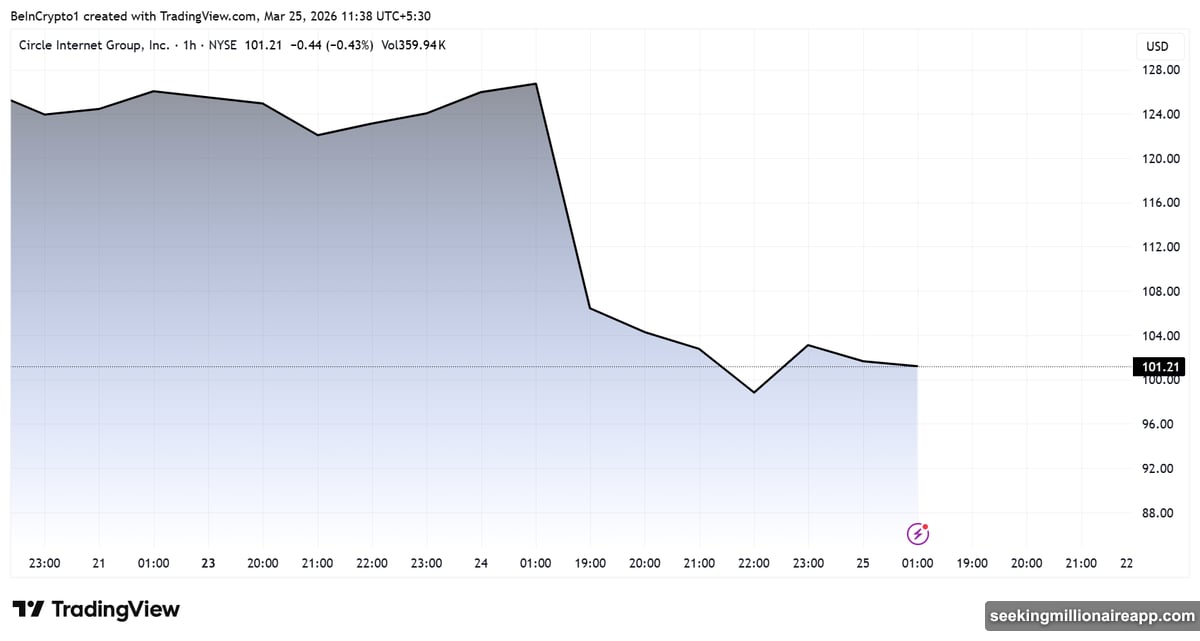
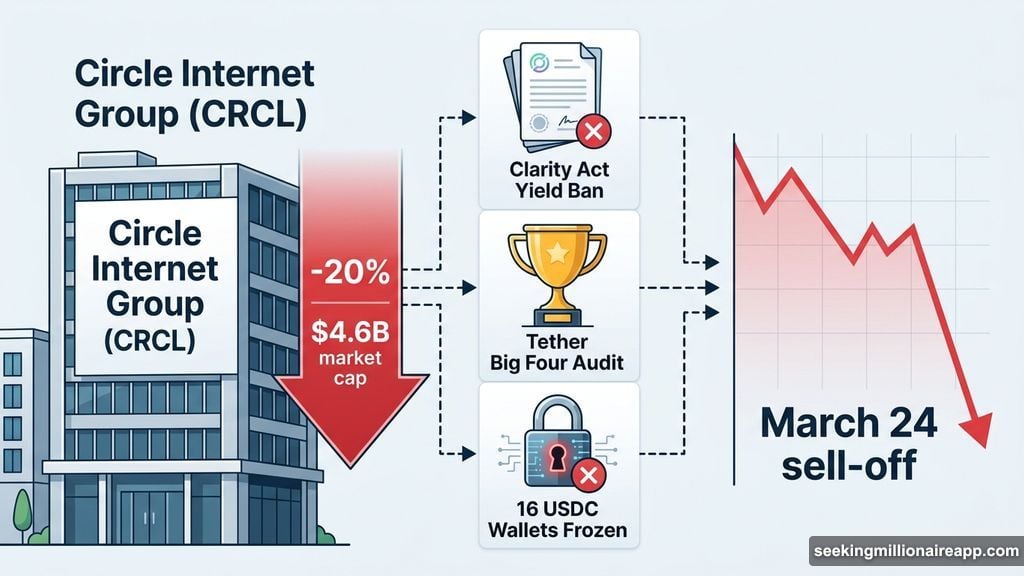
Circle Internet Group (CRCL) shed 20% of its value on March 24, wiping out an estimated $4.6 billion in market cap in a single session. The trigger? Leaked draft language from the Digital Asset Market Clarity Act banning passive stablecoin yield.
But here’s the thing most investors missed. The rule that spooked markets might actually protect Circle’s core business more than it threatens it.
Three separate events hit Circle at once that day. The yield ban leaked. Rival Tether announced its first Big Four audit. And 16 USDC business wallets were frozen. Together, they created a perfect storm of negative sentiment. Separately, none of them are quite as alarming as the market reaction suggested.
The Clarity Act Yield Ban Explained
The Digital Asset Market Clarity Act had been stuck in the Senate Banking Committee since January. The sticking point was one specific question: should stablecoin holders earn passive yield on their balances?
Senators Thom Tillis and Angela Alsobrooks reached an agreement with the White House on March 20. Draft language circulated to industry stakeholders by Monday. The text bans platforms, exchanges, and brokers from offering yield on stablecoin balances. Activity-based rewards tied to actual transactions or governance participation remain permitted. The SEC, CFTC, and Treasury get 12 months to write anti-evasion rules.
Banks pushed hard for exactly this outcome. The American Bankers Association argued stablecoin yield programs could trigger trillions in deposit flight from traditional banks. Mizuho analyst Dan Dolev warned the ban could reduce USDC’s near-term use case. Coinbase fell roughly 10% in sympathy, since stablecoin-related revenue accounts for about 20% of its total income.
So far, that sounds bad for Circle. But read the fine print.
Why the Yield Ban Might Help Circle More Than Hurt It
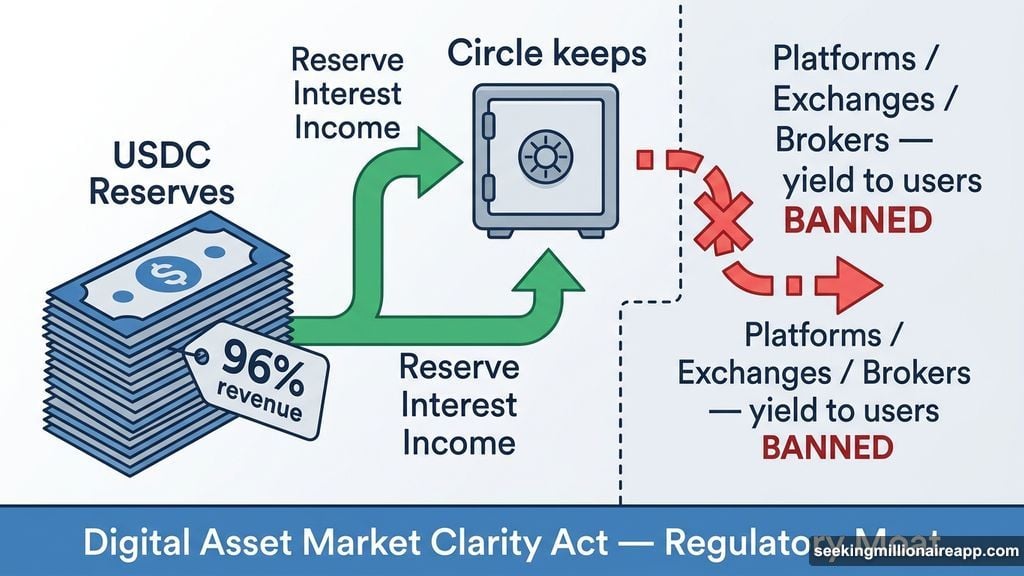
Circle earned 96% of its revenue from interest on USDC reserves as of Q3 2025. According to its S-1 filing, that concentration has ranged between 95% and 99% since 2022. Those reserves sit largely in US Treasury bills.
The Clarity Act does not touch that income stream at all.
What the act bans is platforms passing yield to users. Circle itself still collects every dollar of interest generated by its reserves. Before this draft, Circle faced mounting pressure to share that reserve income with USDC holders. DeFi protocols offering passive APY on USDC had intensified that expectation considerably.
The yield ban removes that pressure entirely. Circle keeps the yield. Full stop.
Analyst Simon Dedic made the contrarian case plainly. “This is massively bullish for Circle. Their entire business model is built on keeping the yield generated by their USDC supply. The Clarity Act essentially gives them a regulatory moat,” Dedic wrote. Former Fox journalist Eleanor Terrett noted the passive yield ban had been telegraphed publicly for months, making the violent stock reaction surprising to many observers.
Tether’s Big Four Audit Changes the Competitive Landscape
On the same day Circle crashed, Tether announced it had signed a Big Four accounting firm for its first full independent audit. The firm’s name was not disclosed. USDT’s market cap currently exceeds $184 billion.
For years, Circle positioned USDC as the more transparent, trustworthy stablecoin. Tether had relied only on quarterly attestations from BDO Italia, a smaller Italian firm. That credibility gap gave Circle a real competitive advantage with institutional clients and regulated platforms.
A completed Big Four audit would narrow that gap significantly. Tether CFO Simon McWilliams said the firm was selected through a competitive process and confirmed the audit will cover assets, liabilities, and internal controls.
This is the piece of March 24 that arguably matters most for Circle’s long-term positioning. The yield ban story has a bullish reading. The Tether audit story is a genuine competitive threat that deserves serious attention.
ARK’s Moves and the Frozen Wallets
Two additional storylines added noise to an already chaotic day. ARK Invest sold $5.9 million in CRCL shares on March 20, four days before the draft language leaked publicly. The timing raised eyebrows.
Then ARK bought $16.3 million in CRCL on March 24 after the crash. That reversal points toward portfolio rebalancing rather than any directional conviction about Circle’s future. Still, the optics of the pre-leak sale are awkward.
Separately, on-chain investigator ZachXBT reported Circle froze USDC balances across 16 hot wallets belonging to exchanges, casinos, and forex firms. The freeze stemmed from an undisclosed US civil case. ZachXBT criticized Circle for failing to verify the wallets before acting. The incident amplified negative sentiment and revived longstanding concerns about centralization in USDC’s design.
What Happens Next
The Clarity Act is not law yet. The Senate Banking Committee markup is targeted for late April. DeFi provisions remain unresolved. DeFi protocols are already redesigning rewards to align with compliant activity-based structures that would survive the ban.
The central question going forward is whether USDC can maintain demand without passive yield as an incentive. If it can, March 24 looks like a classic overreaction driven by surface-level reading of the draft language. If USDC adoption slows meaningfully, the repricing could have further to run.
The Tether audit timeline matters too. If Tether publishes a clean Big Four audit in the next six to twelve months, Circle loses its clearest differentiator with institutional buyers. That outcome is worth watching far more carefully than the yield ban headlines.
March 24 was a messy, complicated day for Circle. The market read it as a disaster. The full picture is considerably more nuanced than a 20% drop suggests.