The crypto market has a manipulation problem. And Binance just decided to put it in writing.
The world’s largest crypto exchange published a formal market-maker guidance framework this week. It names six specific behaviors that signal risky or manipulative activity. Plus, it sets hard rules for token projects working with liquidity providers. This matters right now because the framework arrives months after a devastating October flash crash that wiped out roughly $19 billion in leveraged positions across crypto markets.
So what exactly should traders watch for? Let’s walk through it.
The Six Market-Making Red Flags Binance Flagged
Binance didn’t leave things vague. The framework spells out six concrete warning signs that a market maker may be playing dirty.
First, watch for token sales that break from agreed unlock schedules. When a project starts selling tokens earlier than promised, something is wrong. That’s a direct breach of the terms traders rely on when making investment decisions.
Second, persistent one-sided sell orders without matching buy activity signal trouble. A healthy market needs both buyers and sellers. When the sell side dominates without any real buy support, liquidity is being drained, not provided.
Third, Binance flags repeated sell-side pressure with little corresponding buy activity. This is closely related but worth separating. It’s not just about one moment of imbalance. Consistent, repeated selling without recovery suggests intentional downward pressure.
Wash Trading and Thin Order Books
The next three red flags get into more sophisticated territory. But they’re just as important for traders to understand.
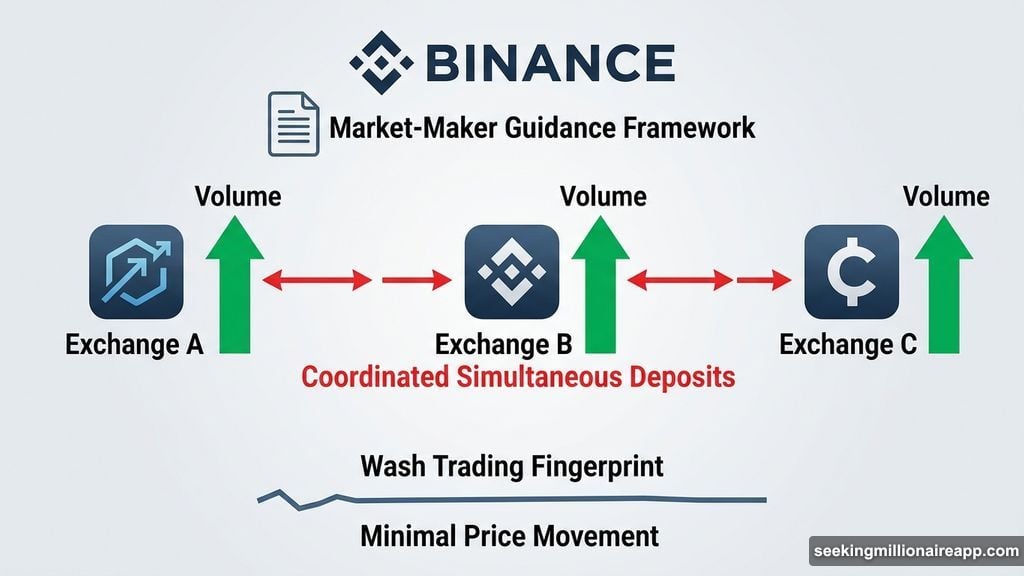
Simultaneous large-scale deposits or selling across multiple exchanges at once is a major warning sign. Coordinated moves across platforms suggest someone is trying to crash or manipulate a price across the entire market, not just one venue.
Then there’s high trading volume with minimal price movement. This is the classic fingerprint of wash trading, where a market maker essentially trades with itself to inflate volume numbers. The volume looks impressive. But nothing real is happening underneath.
Finally, sharp price swings caused by shallow order books reveal a different problem entirely. When a relatively small trade causes a huge price move, it means the order book is dangerously thin. Real liquidity simply isn’t there. And that makes the asset easy to manipulate.
What Binance Now Requires From Token Projects
Beyond red flags, the guidance framework sets clear expectations for token projects at the time of listing. These are real obligations, not suggestions.
Teams must report their market maker’s identity, legal entity, and full contract terms directly to Binance. Agreements with market makers must define roles, trading parameters, and compliance safeguards from the start. Token loan agreements need to specify exactly what those tokens can be used for.
Here’s the part that stands out most. Binance explicitly bans profit-sharing models and guaranteed profit arrangements between token projects and market makers. As the exchange stated directly: “Profit-sharing models and guaranteed profit models with MMs are prohibited, and token loan agreements should clearly define the permitted use of tokens.”
That’s a significant line to draw. Profit-sharing arrangements create obvious incentives for market makers to push prices in whatever direction benefits their cut, not the market.
Permanent Bans for Violations
Binance isn’t treating this as advisory guidance. The exchange made clear it continuously monitors market-making operations and will respond quickly and firmly to violations.
That includes permanently banning market makers found breaking its policies. Not suspending them. Permanently removing them. That’s a serious consequence, and it signals Binance wants this framework taken seriously.
Why This Framework Matters Right Now
The timing here is hard to ignore. Binance published this guidance just months after the October 10 flash crash that erased approximately $19 billion in leveraged positions in a single event. Many in the community accused the exchange of alleged manipulation following that crash.
Binance denied any wrongdoing. Former CEO Changpeng “CZ” Zhao publicly called those accusations “far-fetched.” But the pressure clearly prompted some kind of response.
Whether this framework genuinely changes how market makers operate on Binance remains to be seen. Rules only matter when they’re enforced. Still, publishing clear red flags publicly is a useful step. It gives retail traders a vocabulary for spotting suspicious behavior and puts token projects on notice about what the exchange expects.
If you’re trading smaller-cap tokens on any exchange, these six red flags are worth keeping in your back pocket. Thin order books, suspicious volume, and one-sided selling patterns aren’t always random. Sometimes they’re exactly what they look like.