
Big money is piling into Bitcoin right now. But one stubborn pattern keeps the breakout from happening.
Here’s the situation: the largest Bitcoin holders are quietly loading up, exchange supplies are shrinking fast, and on-chain signals look genuinely encouraging. Yet one persistent behavior from smaller investors keeps throwing a wrench into what could be a historic rally. Let’s break down exactly what’s happening and why it matters.
Whale Accumulation Hits Impressive Numbers
Over the past 30 days, something notable happened beneath the surface of Bitcoin’s choppy price action.
Wallets holding between 10 and 10,000 BTC, typically called whales and sharks, collectively added 61,568 BTC to their holdings. That’s a 0.45% increase in total holdings, according to data from Santiment. And they did it during one of the more turbulent stretches in recent memory.
Why does this matter? Because big players rarely accumulate heavily when they expect prices to drop. These aren’t panic buyers chasing a rally. They’re systematic accumulators building positions quietly, which historically signals confidence in higher prices ahead.
Santiment called this ongoing buying “a promising sign of an eventual breakout from this range.” That’s not a small statement from a firm known for measured, data-driven commentary.
Bitcoin Exchange Reserves Drop to 2019 Lows
Meanwhile, something equally significant is happening on centralized exchanges.
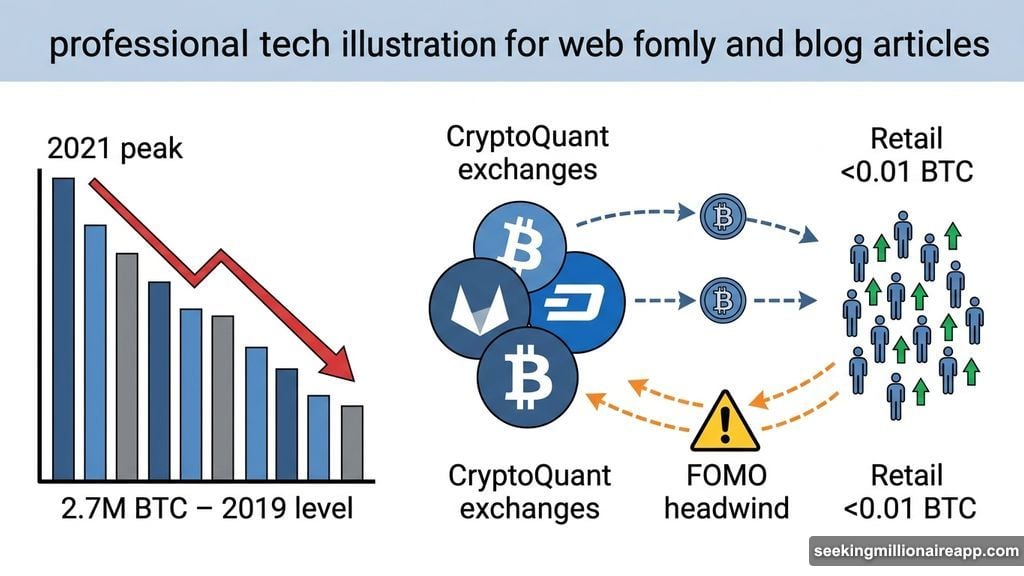
Bitcoin reserves held on major trading platforms have fallen to roughly 2.7 million BTC, the lowest level since 2019. Data from CryptoQuant confirms this steady decline, and the crypto community has noticed.
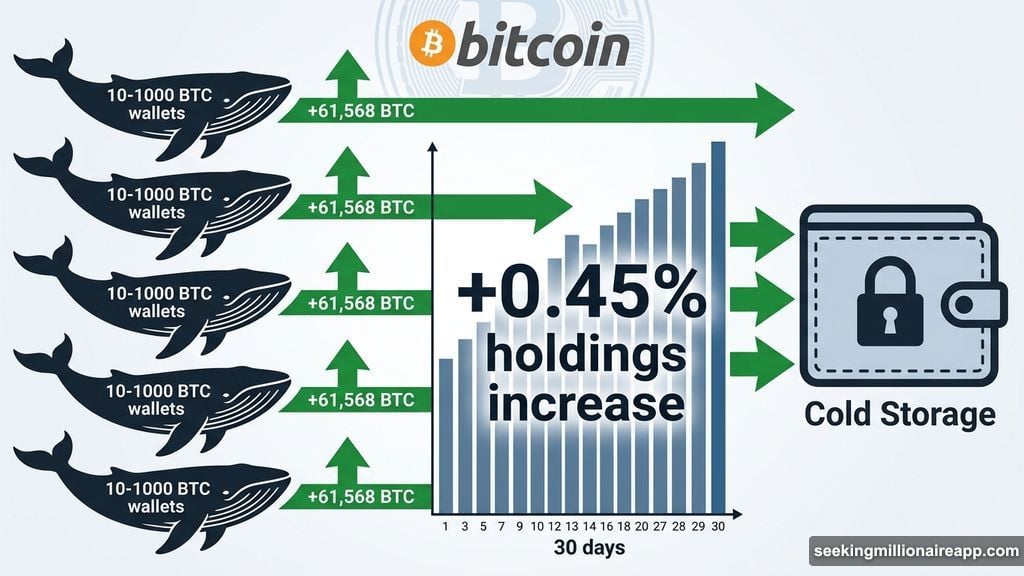
So why do shrinking exchange reserves matter? Think of it this way. When Bitcoin sits on an exchange, it’s available to sell at any moment. When holders move it off exchanges into cold storage, it signals they’re not planning to sell anytime soon.
Less Bitcoin sitting ready to sell means less downward pressure on price. Plus, if demand picks up while supply tightens, prices tend to move fast. That combination is exactly what long-term Bitcoin holders look for before major rallies. The 2019 comparison is meaningful, too, because that period preceded a substantial multi-month run-up in price.
![Bitcoin price chart showing whale accumulation trends and declining exchange reserves amid market volatility in 2026]
Retail FOMO Keeps Disrupting the Classic Breakout Pattern
Here’s where things get complicated. And honestly, a bit frustrating if you’re watching for a clean setup.
Wallets holding less than 0.01 BTC, essentially small retail buyers, have also been accumulating. Their collective balance grew by 0.42% over the same 30-day window. That nearly matches the whale accumulation rate, which sounds positive on the surface.
But Santiment flagged this as a headwind, not a tailwind. Their reasoning is rooted in how Bitcoin bull cycles have historically started.
“Ideally, the ranging pattern will break upwards when large wallets are accumulating while retail is dumping,” Santiment noted. “This has historically been a very reliable pattern to signal the start of bull cycles.”
In other words, the classic breakout setup requires a specific sentiment dynamic. Retail investors need to feel discouraged or disinterested enough to sell. Meanwhile, whales keep buying those discarded coins. That contrast creates the kind of capitulation that resets market sentiment and clears the path for a real rally.
Right now, both groups are buying simultaneously. That’s not the pattern. It suggests retail FOMO, the fear of missing out, remains alive and well. And markets tend to punish FOMO-driven behavior before rewarding patience.
![Diagram showing Bitcoin holder behavior split between whale accumulation and retail buying patterns, with exchange reserve data overlay]
Geopolitical Uncertainty Adds Another Layer
Beyond the behavioral patterns, broader macro conditions are also shaping Bitcoin’s current range-bound movement.
Escalating tensions in the Middle East initially provided some support for Bitcoin, as investors sought non-correlated assets during periods of uncertainty. However, as the conflict drags on without resolution, that initial tailwind has faded into general market anxiety that weighs on upside momentum.
So Bitcoin sits at an interesting crossroads. Fundamentals from the on-chain data look encouraging. Whale behavior looks encouraging. Exchange reserves paint a bullish picture. But sentiment and macro headwinds create enough friction to keep the breakout from triggering just yet.
What Would Change the Picture
The setup for a real breakout is actually pretty clear, even if the timing isn’t.
If small wallet holders shift from buying to selling while whales continue accumulating, that sentiment flip could create the conditions Santiment describes. Retail discouragement, combined with institutional patience, has historically preceded Bitcoin’s most significant moves upward.
Nobody can predict exactly when that shift happens. But the pieces are assembling. Exchange supplies are near multi-year lows. Serious money keeps flowing in. And the longer Bitcoin consolidates, the more potential energy builds beneath the surface.
The retail crowd keeping things interesting right now might ultimately end up selling into the very dip that launches the next leg higher. That’s not cynical, it’s just how these cycles tend to play out. When everyone who wanted to buy has already bought, there’s no one left to sell to. But we’re clearly not there yet.
Patience seems to be the name of the game right now, even as the underlying signals point toward something bigger on the horizon.