
Bitcoin looks weak right now. Prices have been stuck below $70,000 for most of Q1 2026, and plenty of traders have turned bearish on the short-term outlook. But a closer look at who’s actually buying and selling tells a very different story.
According to a new analysis from XWIN Research, published on CryptoQuant Insights, the Bitcoin market isn’t collapsing. It’s splitting into two camps moving in completely opposite directions at the same time.
Whale Selling Pressure Caps the Rally
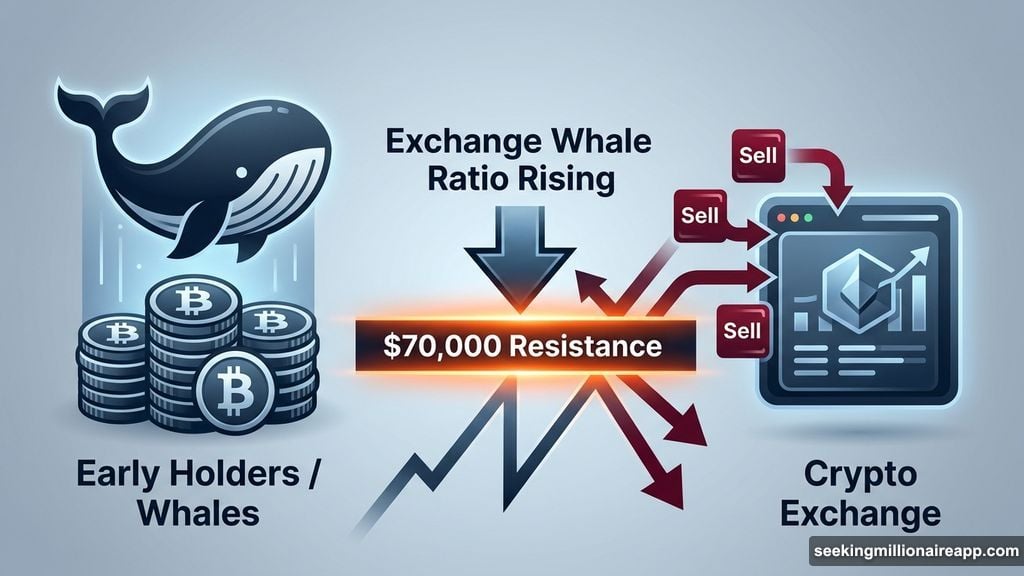
One key signal worth watching is the Exchange Whale Ratio. This metric tracks how much Bitcoin large holders are moving onto exchanges. When it rises, it usually means those big players are getting ready to sell.
That ratio has been climbing steadily throughout Q1 2026. And in a market with thin liquidity, that kind of pressure does one thing really well. It kills any attempted rally near resistance.
So every time Bitcoin nudged toward $70,000, selling from these large early holders pushed prices back down. The ceiling held firm, quarter after quarter.
Corporate Treasuries Step In as Buyers
Here’s where things get interesting. While whales were selling, corporations were buying everything they could get their hands on.
XWIN Research estimates that public companies added roughly 62,000 BTC on a net basis during Q1 alone. Strategy, the company formerly known as MicroStrategy, led that charge in a big way. They purchased over 88,000 BTC during the quarter and now hold approximately 762,000 BTC total, funded through convertible notes and share offerings according to SEC filings.
This isn’t speculative gambling on price direction. Strategy raises capital from traditional financial markets, then converts it into Bitcoin as a long-term treasury asset. That creates a steady, persistent demand that doesn’t care whether prices go up or down this week.
So while whales were hitting the exit, corporate balance sheets were quietly absorbing the supply.
ETF Rotation Masks the Real Picture
Spot Bitcoin ETF flows add another layer of complexity to this story. On the surface, ETF activity looks like strong institutional interest. But the details tell a more cautious tale.
BlackRock’s Bitcoin ETF has drawn solid inflows. Meanwhile, Grayscale’s GBTC continues to bleed assets. SoSoValue data shows March ETF flows swung wildly, jumping from a $458 million surge on March 2 to a $348 million outflow just four days later.
Total ETF assets under management barely budged. The figure ended March at $56.00 billion, up from $55.26 billion at the start of the month. That’s not fresh money flowing into Bitcoin. That’s existing investors rotating between products.
Until net inflows return with genuine conviction, ETFs will function as a neutral force rather than a bullish catalyst. The rotation between Grayscale and BlackRock looks impressive on a chart. But it doesn’t represent new capital entering the asset class.
Corporations Are Becoming the New Whales
The bigger picture here is a structural shift in who actually controls Bitcoin supply. And it’s playing out quietly beneath the price charts.
Strategy and other public companies now operate as persistent, leveraged buyers with direct access to capital markets. They can raise money, convert it to Bitcoin, and hold it indefinitely regardless of short-term price swings. That makes them fundamentally different from the crypto-native whale holders who once dominated supply dynamics.
For those early accumulator whales, this creates something resembling an IPO-style exit window. Long-term believers who bought Bitcoin at $5,000 or $10,000 now have a steady stream of institutional demand to sell into at much higher prices. The supply isn’t disappearing. It’s migrating from early adopters to corporate balance sheets on a large scale.
What Q2 2026 Actually Depends On
XWIN Research frames the core question for the next quarter simply. Can corporate accumulation outlast the whale selling pressure long enough for broader demand to catch up?
Strategy absorbed over 88,000 BTC in Q1 even as prices fell and sentiment soured. That’s a remarkable amount of buying under difficult conditions. But whale selling has kept the price pinned nonetheless, which shows just how much supply early holders still control.
The honest answer is that nobody knows which force wins in Q2. Corporate buyers have deep pockets and long time horizons. Early whales have enormous unrealized gains and plenty of motivation to distribute at current prices.
What’s clear is that the Bitcoin market in 2026 looks nothing like it did in previous cycles. The players have changed. The capital sources have changed. And the dynamics driving price action have changed too. Watching supply flows matters far more right now than watching price charts alone.