
For years, the Ethereum Foundation’s treasury management made crypto traders nervous. Every time the non-profit sold ETH to cover its bills, markets braced for impact. Now, something significant has shifted.
The Ethereum Foundation (EF) just staked nearly $100 million worth of ETH in a single 24-hour window. That’s not a minor portfolio adjustment. It’s a fundamental change in how the organization that stewards the world’s most-used blockchain actually manages its money.
A $93 Million Deposit Nobody Saw Coming
On April 3rd, on-chain data confirmed the Foundation deposited approximately 45,034 ETH into the Ethereum Beacon Deposit Contract. At current prices, that’s roughly $93 million moving in one day.
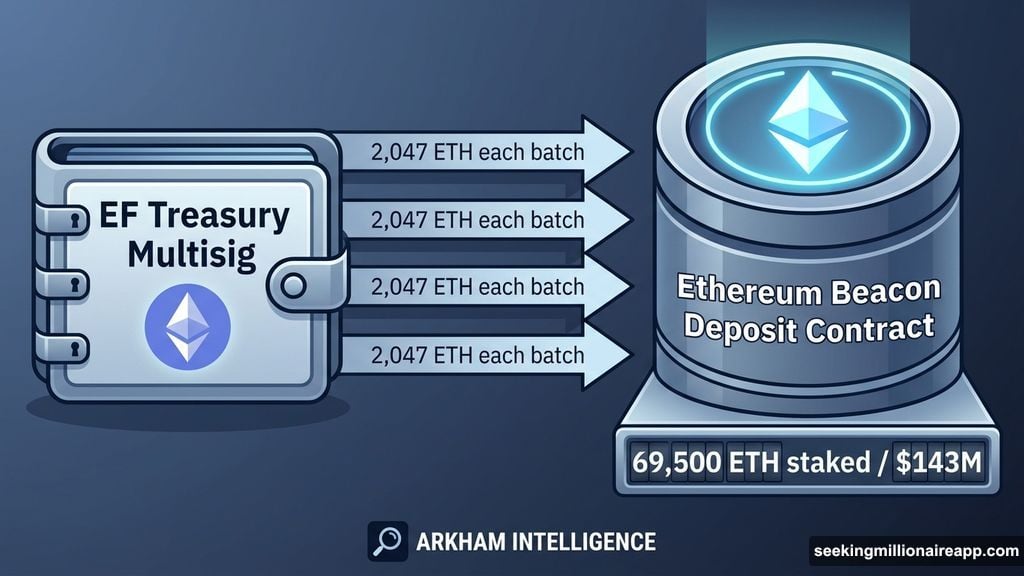
Blockchain analytics firm Arkham Intelligence tracked the transaction closely. The funds moved from the EF’s Treasury Multisig wallet in systematic batches of 2,047 ETH each. That’s not someone clicking around randomly. It’s a deliberate, structured operation.
This followed a smaller deposit of 22,500 ETH made earlier in the same week. Combined, these moves bring the Foundation’s total staked balance to 69,500 ETH, worth approximately $143 million. And yes, that’s sitting inside a $430 million Ether treasury total.
Why the Foundation’s Old Strategy Frustrated Everyone
To understand why this matters, you need to know what the Foundation was doing before.
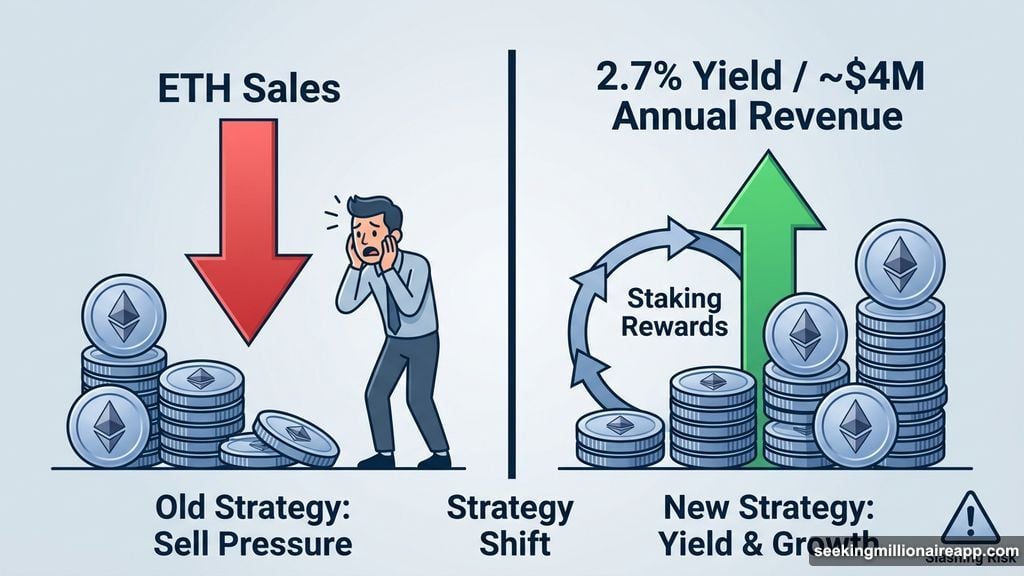
For most of the last decade, the EF funded its operations through periodic ETH sales. Research grants, developer salaries, ecosystem support — all of it came from liquidating tokens. These sales happened often enough that traders started treating them as a market signal. When the Foundation sold, many assumed prices had peaked nearby.
That created a messy dynamic. The organization meant to support Ethereum’s long-term success was simultaneously creating short-term sell pressure. Some critics even argued it showed a lack of conviction in the very network the Foundation championed. Fair or not, the narrative stuck.
Staking flips that script entirely.
Ethereum Beacon Chain Deposits Now Generate Real Yield
Instead of selling ETH to pay the bills, the Foundation can now earn passive income from its treasury. At current institutional staking yields of roughly 2.7%, the Foundation’s 69,500 staked ETH should generate approximately $4 million in recurring annual revenue.
That’s meaningful. Four million dollars covers a lot of research grants and developer salaries without requiring a single token sale. Plus, the underlying ETH stays intact and continues growing through staking rewards rather than shrinking through liquidation.
But this shift isn’t consequence-free. By staking, the Foundation now faces the same operational risks as any other validator on the network. That includes “slashing” — a penalty mechanism that punishes validators for certain types of misbehavior or technical failures. So the Foundation is now playing by the same rules as everyone else. That’s actually a good thing for credibility, even if it adds operational complexity.
Institutional Staking Trends Reshape the Ethereum Network
The Foundation isn’t moving in isolation here. Its decision mirrors a much broader institutional trend that’s been building for months.
Firms like BitMine have staked millions of tokens over the past year. Collectively, these commitments add up fast. Today, roughly 38.5 million ETH — about 30% of the entire circulating supply — is committed to securing the Ethereum network through staking. That’s a staggering amount of economic commitment baked directly into the blockchain’s security model.
When the organization that literally maintains and promotes Ethereum joins that validator set, it sends a message. The Foundation isn’t just advocating for staking as a concept. It’s now personally exposed to the system’s health and performance. That alignment matters.
What This Signals for ETH Holders
The practical implications reach further than treasury management. Consider what changes when the Foundation earns yield instead of selling tokens.
First, the chronic sell pressure disappears. ETH holders no longer need to watch Foundation wallet movements with anxiety, wondering if a dump is coming. That psychological overhang lifts. Second, the Foundation’s financial interests now align directly with the network’s health. A thriving, high-value ETH means more yield. That creates genuine incentive to push improvements that benefit token holders, not just grant recipients.
Third, this signals confidence. You don’t lock $143 million into a staking contract if you’re worried about the asset’s future. The Foundation is essentially betting on Ethereum for the long haul.
The shift from “Ethereum Foundation sold ETH again” to “Ethereum Foundation is staking ETH” represents more than an accounting change. It shows an organization rethinking its relationship with the network it helped build. For ETH holders who spent years frustrated by Foundation sell-offs, that’s worth paying attention to.