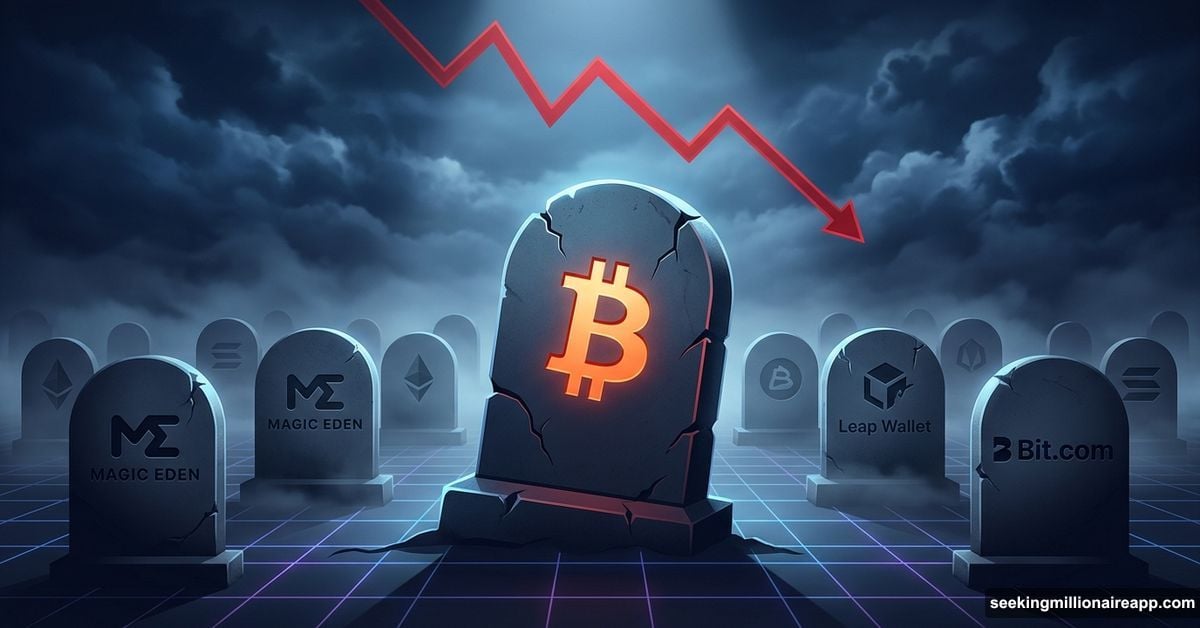
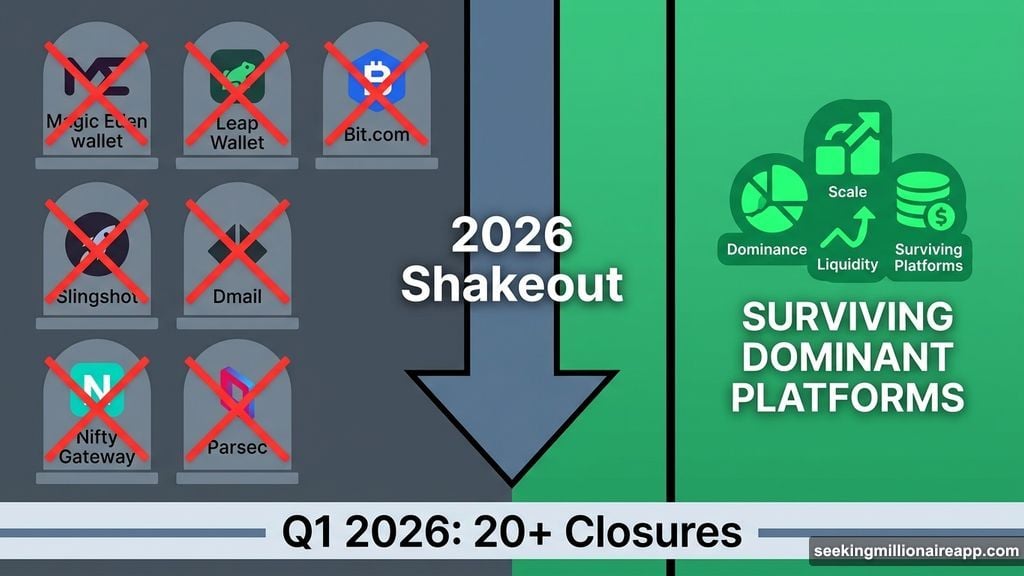
The crypto graveyard is filling up fast in 2026. More than 20 projects have already shut down in the first quarter alone, and the year isn’t even halfway done.
This isn’t just a handful of obscure startups disappearing quietly. Some recognizable names are on the list. And the pattern behind these closures tells a bigger story about where crypto is actually heading right now.
Magic Eden and Leap Wallet Join the Casualty List
The closures hitting hardest are the ones involving platforms people actually used. Magic Eden, one of the better-known NFT marketplaces, shut down its wallet and pulled back from multi-chain operations. The team is refocusing entirely on Solana, essentially retreating to their strongest ground.
Leap Wallet went further. Rather than pivoting or scaling back, the team confirmed a full shutdown by late May. No soft landing, no rebrand. Just a complete exit from the market.
And it doesn’t stop there. Derivatives exchange Bit.com wound down operations. DeFi aggregator Slingshot went dark. Web3 messaging platform Dmail closed its doors. Earlier in the quarter, NFT marketplace Nifty Gateway and analytics tool Parsec both ceased operations too.
That’s a wide spread of casualties across wallets, exchanges, NFT platforms, and DeFi tooling all at once.
Bull Market Hype Only Goes So Far
Here’s the honest truth behind most of these closures. Many of these projects launched during the 2021–2022 bull cycle, or caught a second wind during the early 2025 surge. Both periods shared the same conditions: capital was easy, users were excited, and growth looked inevitable.
But bull markets are forgiving in ways that bear markets absolutely are not. When token prices are climbing and venture money is flowing, a weak revenue model barely matters. Growth covers a lot of sins.
Now the environment has flipped. Trading volumes have cooled significantly. Funding rounds are harder to close. User activity has consolidated around a smaller group of dominant platforms. So the projects that never built real retention or sustainable income are finding out, brutally, that hype alone doesn’t pay the bills.
This is the DeFi equivalent of a startup that grew fast on subsidized pricing and never figured out how to make money once the subsidies ran out.
Crypto Market Consolidation Favors the Strong
What’s happening right now looks a lot like a normal market maturation cycle, just playing out in crypto time. The industry built fast and loose for years. Now it’s resetting.
Smaller and mid-tier projects are the most exposed in this environment. They often lack the user base, brand recognition, or financial runway to outlast a prolonged downturn. When activity consolidates around platforms like Coinbase, Binance, or Uniswap, the room for second-tier alternatives shrinks fast.
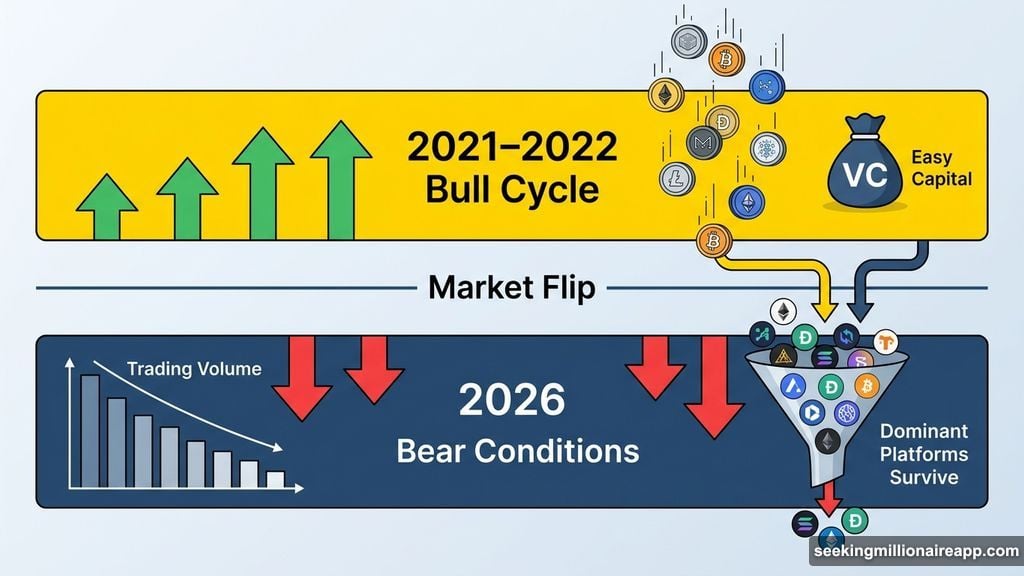
But this consolidation isn’t necessarily bad for the long-term health of the space. The projects surviving this shakeout tend to have actual users, real revenue, and a clear reason to exist. That’s a healthier foundation than a bull market-inflated ecosystem stuffed with platforms nobody really needed.
The NFT platform market is a good example. At its peak, dozens of competing marketplaces jostled for the same users. Now the field is thinning dramatically. Whatever emerges from this will likely be leaner and more defensible.
What This Means If You’re Still Building or Investing
For builders still in the space, the message from this wave of closures is pretty clear. Revenue model first, product second. Not the other way around. The projects shutting down right now largely skipped that step, betting on perpetual growth instead.
For investors and users, the practical takeaway is simpler. Diversifying across many mid-tier wallets, platforms, and DeFi tools carries more risk than it might have seemed 18 months ago. Concentrating on established, proven platforms with real usage metrics is just smarter right now.
The crypto industry has been through consolidation cycles before. The 2018 and 2022 bear markets both triggered similar waves of closures. What followed those downturns was a smaller, more focused industry that eventually rebuilt on stronger foundations.
This time around, the same logic probably applies. The projects shutting down in Q1 2026 won’t be the last. But the ones left standing when this shakeout ends will likely be far more resilient than anything the last bull cycle produced.