
Morgan Stanley made history this week. The bank became the first major US financial institution to issue its own spot Bitcoin exchange-traded fund, and analysts are already throwing around some eye-catching numbers.
The fund, called the Morgan Stanley Bitcoin Trust, trades on NYSE Arca under the ticker MSBT. And it launched into one of the roughest Bitcoin markets in recent memory.
MSBT Enters a Crowded Bitcoin ETF Market
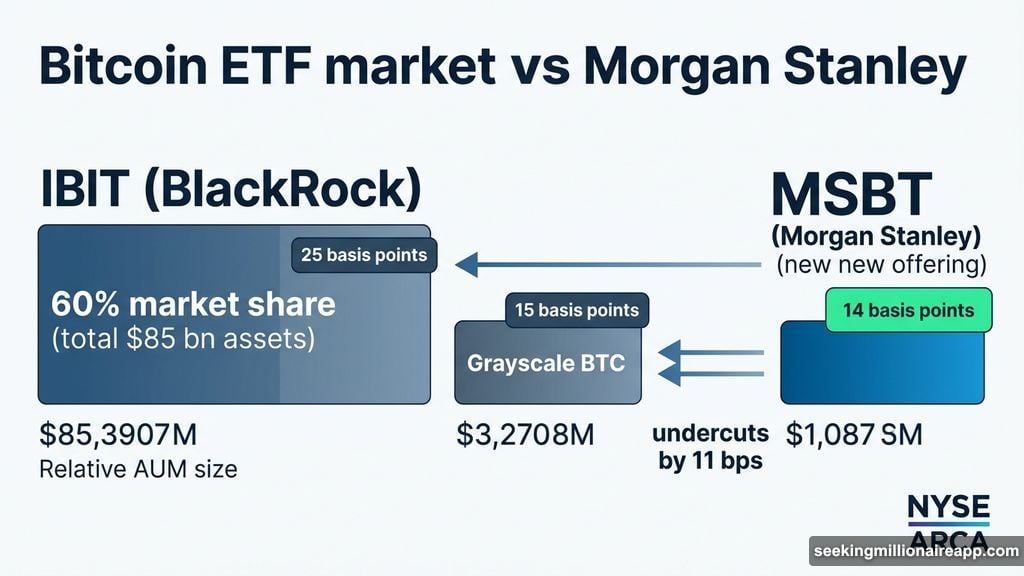
More than 10 spot Bitcoin ETFs already exist. Together, they hold over $85 billion in assets. So Morgan Stanley isn’t arriving to an empty room.
But the bank came in swinging on price. MSBT carries an expense ratio of just 14 basis points, making it the cheapest spot Bitcoin fund currently available. That undercuts Grayscale’s BTC product by one basis point and BlackRock’s dominant iShares Bitcoin Trust (IBIT) by 11 basis points.
BlackRock’s IBIT currently controls about 60% of total category assets. So beating it on cost is a deliberate move, not an accident.
“We really wanted to show our commitment by having that lower fee,” Allyson Wallace, Global Head of ETFs at Morgan Stanley Investment Management, told Bloomberg. “The demand, especially from high-net-worth investors, has been quite high. Viewed at the firm level, this is an asset class that is not going away.”
ETF Analyst Predicts $5 Billion in Year One
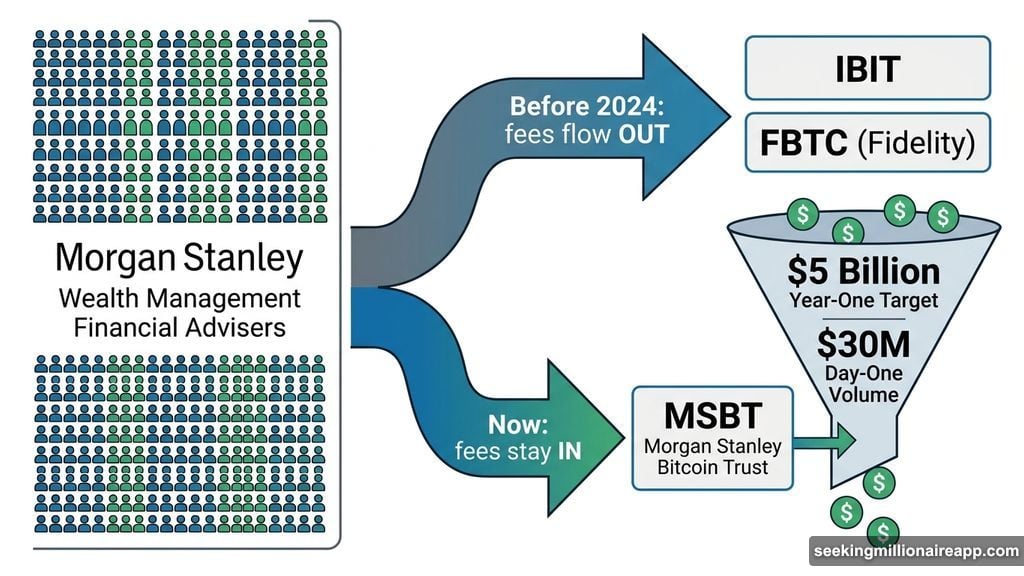
ETF analyst Eric Balchunas put a bold number on MSBT’s potential. He predicts the fund will gather $5 billion in assets under management within its first year and generate $30 million in day-one trading volume.
Those are significant targets. But the logic behind them makes sense when you understand Morgan Stanley’s distribution advantage.
Morgan Stanley Wealth Management oversees roughly 16,000 financial advisers and trillions in client assets. Since 2024, those advisers could already recommend third-party Bitcoin ETFs like IBIT and Fidelity’s FBTC. Now, with MSBT live, any management fees from those allocations stay inside Morgan Stanley instead of flowing to competitors.
Balchunas noted that the aggressive fee positioning signals strong demand from within the adviser network itself. When a bank prices its own product that competitively, it suggests internal pressure to capture those assets rather than let them flow elsewhere.
Launching Into a Bitcoin Downturn
The timing here is striking. Bitcoin has dropped more than 40% from its October peak near $126,199. On MSBT’s launch day, Bitcoin traded around $71,307.
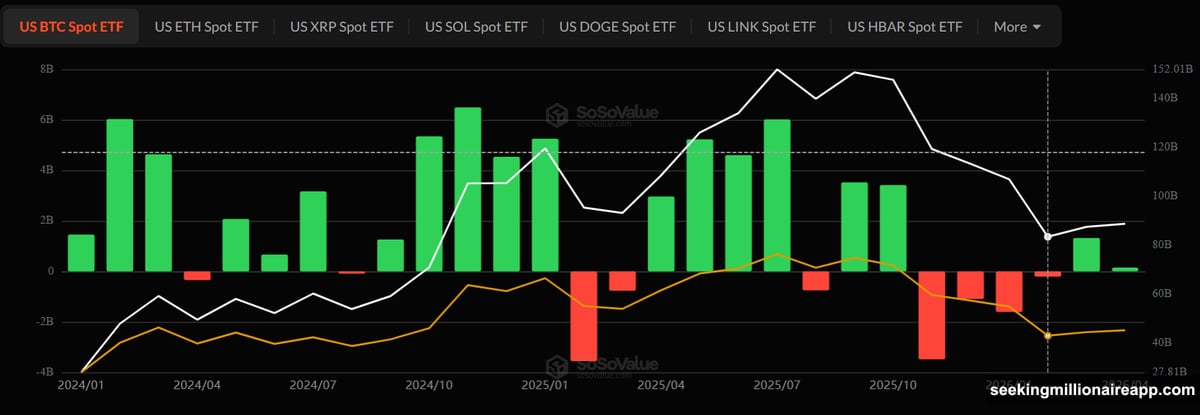
That’s not a comfortable entry point for most financial institutions. Spot Bitcoin ETFs saw four consecutive months of net outflows between November 2025 and February 2026, totaling roughly $6.3 billion. March reversed that streak with $1.32 billion in inflows, though the first quarter of 2026 still ended with a modest net outflow overall.
So why launch now? Morgan Stanley appears to view the current slump as a buying opportunity rather than a reason to pause. Launching during a downturn signals long-term conviction. It’s the kind of move that says the bank isn’t chasing momentum. Instead, it’s positioning for what comes next.
Not the Only New Bitcoin Product This Week
MSBT wasn’t alone in its debut. ETF analyst Nate Geraci highlighted another fund launching the same day: the Nicholas Bitcoin and Treasuries AfterDark ETF, which trades under the ticker NGHT.
NGHT takes an unusual approach. It holds Bitcoin exposure exclusively during overnight hours, then rotates into short-term US Treasuries during regular trading sessions. It’s a niche product, but it reflects just how creative the Bitcoin ETF space is getting as more providers try to carve out distinct positions.
Morgan Stanley’s Bigger Crypto Ambitions
MSBT is just the start. Morgan Stanley filed S-1 registrations in January for both an Ethereum trust and a Solana trust, signaling that the bank plans to build out a full suite of crypto investment products.
Beyond ETFs, the bank also plans to roll out retail crypto trading on E-Trade in the first half of 2026. That move would bring direct cryptocurrency access to millions of retail investors through a platform they already use.
For custody, MSBT relies on Coinbase Custody Trust Co. and Bank of New York Mellon. The fund launched with about $1 million in initial seed capital and 50,000 shares available for trading.
Can MSBT Hit That $5 Billion Target?
Whether Balchunas’ prediction holds depends on two things. First, how quickly Morgan Stanley’s adviser network starts redirecting client allocations toward MSBT. Second, whether Bitcoin can stabilize enough to bring hesitant investors back off the sidelines.
The distribution advantage is real. Sixteen thousand financial advisers recommending a product they can now earn management fees on is a powerful sales engine. The fee structure is already the most competitive in the category. And Morgan Stanley’s brand carries weight with the high-net-worth investors who make up its core client base.
But no ETF thrives in a falling market indefinitely. The $5 billion figure assumes a recovery narrative that hasn’t fully materialized yet. It’s an ambitious target, not a guaranteed one.
What Morgan Stanley has done, though, is cement its position as a serious player in institutional crypto. The bank didn’t wait for perfect conditions. It launched, priced aggressively, and planted a flag. That decision alone tells you something about where Wall Street thinks this market is heading.