
Ten crypto projects once valued in the billions now trade at a fraction of what investors paid. Some have lost more than 99% of their last private round valuations. And yes, backing from the biggest names in venture capital didn’t save them.
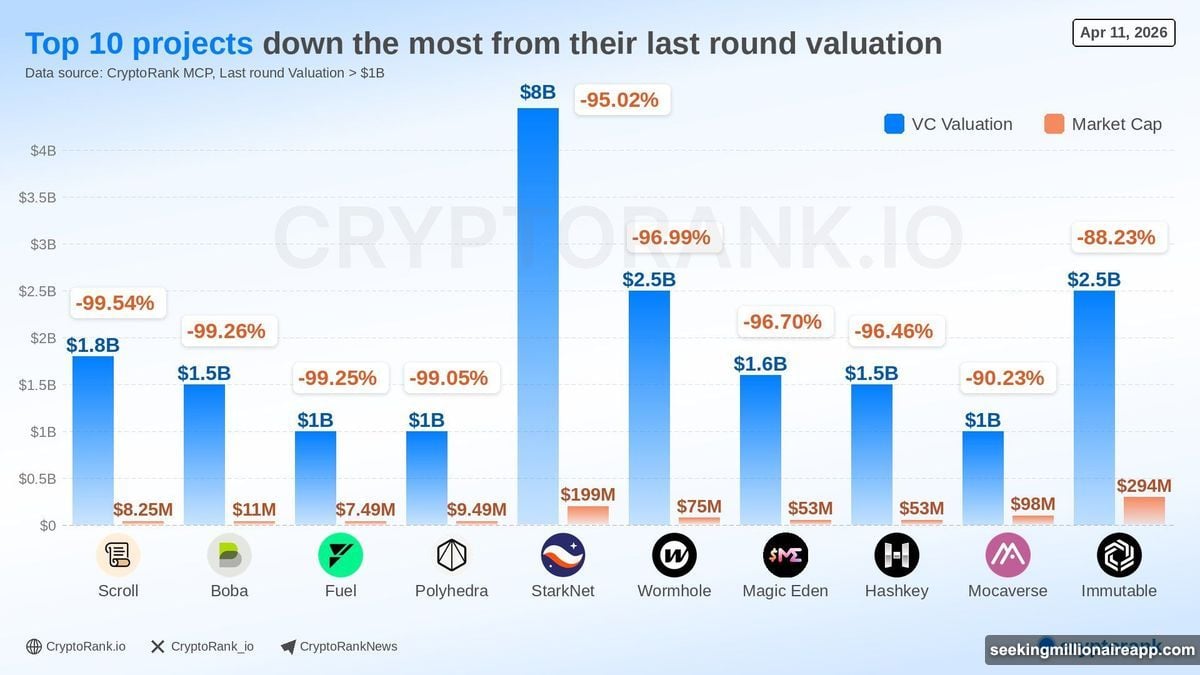
According to CryptoRank data, the gap between what VCs paid and what these tokens actually trade for today is staggering. Market caps now range from just $7 million to $294 million — projects that once commanded billion-dollar price tags.
Scroll and Boba Network Lead the Collapse
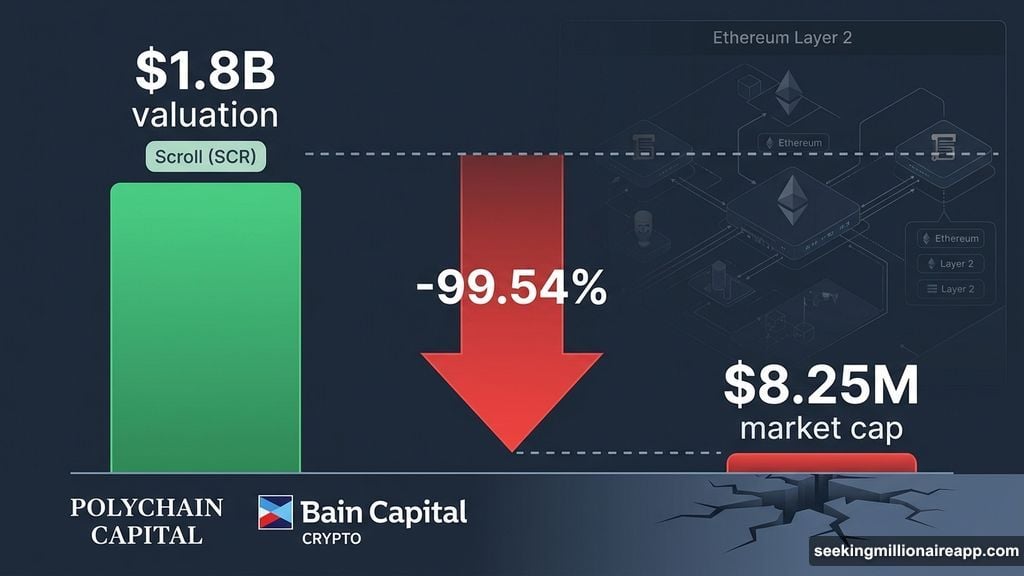
Scroll (SCR) tops the wreckage with a 99.54% drop. The Ethereum Layer 2 network raised $80 million across two funding rounds. Backers included Polychain Capital, Variant, and Bain Capital Crypto. Its last private valuation hit $1.8 billion. Today, Scroll’s entire market cap sits around $8.25 million.
Boba Network follows close behind at -99.26%. Fuel Network isn’t far off either, registering a 99.25% decline from a $1 billion valuation.
Four of the ten hardest-hit projects come from the zero-knowledge proof and Layer 2 space. That sector attracted enormous VC enthusiasm and capital over the past few years. So the concentration of losses there stings especially hard for investors who bet big on ZK technology.
Starknet Took the Biggest Absolute Hit
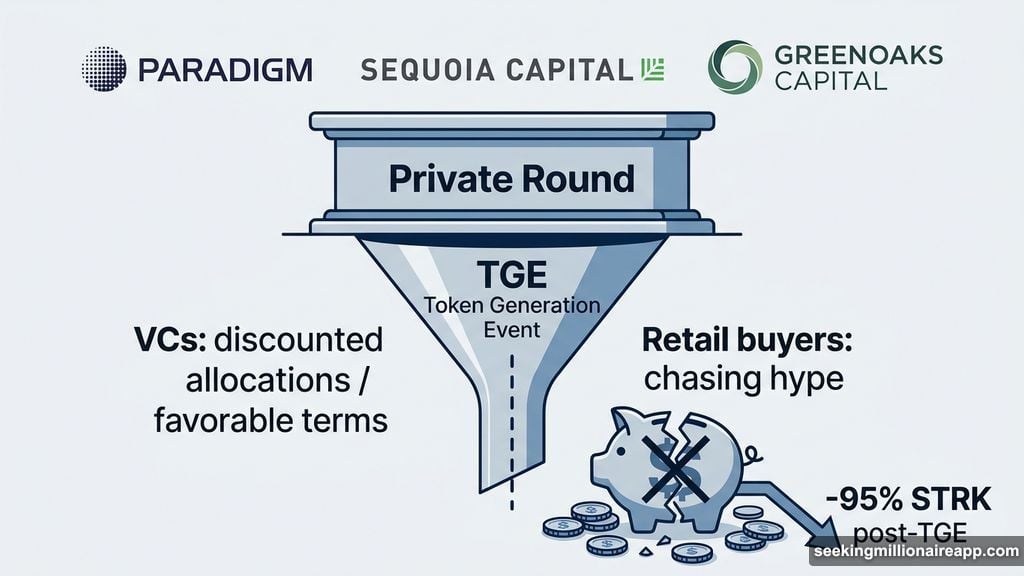
If Scroll leads on percentage decline, Starknet (STRK) wins the title for raw dollar destruction. The project raised $282.5 million from Paradigm, Sequoia Capital, and Greenoaks Capital at an $8 billion valuation.
Its current market cap? Around $199 million. That’s a 95% drop — and the largest absolute value loss among the ten projects tracked.
“These projects have fallen from billion-dollar valuations to nearly zero — a striking example of near-total value destruction. Even backing from Tier-1 VCs like Paradigm, Sequoia, Cbventures, and Multicoin wasn’t enough to protect post-TGE performance,” CryptoRank noted in their analysis.
The rest of the list tells a similar story. Polyhedra fell 99.05%, Wormhole dropped 96.99%, and Magic Eden shed 96.70%. HashKey Group recorded a 96.46% decline. Mocaverse and Immutable round out the ten with losses of 90.23% and 88.23% respectively.
Why Tier-1 VC Backing Didn’t Protect These Tokens
Here’s the uncomfortable truth about crypto venture funding. A prestigious investor name on a cap table says a lot about a project’s private fundraising ability. It says very little about what happens after a token generation event (TGE).
Private valuations and public market performance operate in completely different worlds. VCs negotiate favorable terms, get allocations at steep discounts, and often sell into retail demand after tokens launch publicly. The investors holding the bag when prices crash are frequently retail buyers who chased the hype.
Plus, the post-TGE period for many of these projects coincided with broader crypto market weakness. But the scale of these declines — 90% to 99% — goes well beyond a rough market cycle. These projects simply couldn’t sustain valuations that were built more on venture optimism than actual user demand or revenue.
VC Funding Hasn’t Slowed Down
Despite this wreckage, venture capital money keeps flowing into crypto. That might seem surprising. But the numbers back it up.
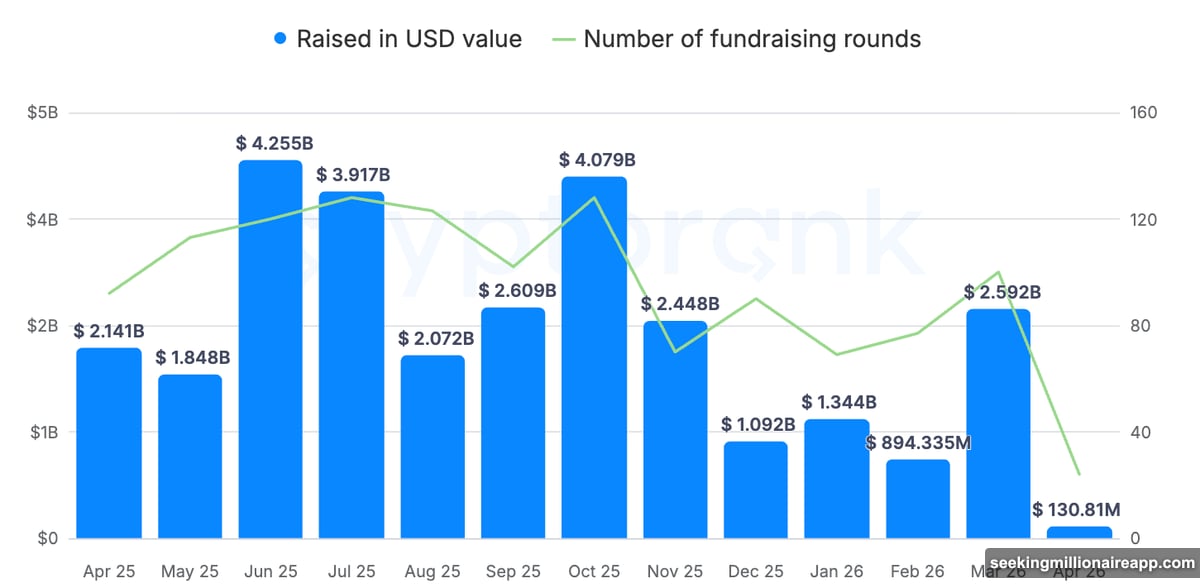
CryptoRank data shows March 2026 recorded roughly 100 funding rounds totaling $2.59 billion in new investment. That’s the highest number of rounds since October 2025. Coinbase Ventures and Animoca Brands led the most deals during the month.
Breaking it down by sector, blockchain services dominated with 39 rounds. Decentralized finance (DeFi) followed with 20 rounds. Centralized finance (CeFi) contributed 15 rounds.
So VCs aren’t walking away from crypto because some bets went sideways. If anything, the pace of new deals suggests institutional appetite remains strong. Whether those new investments avoid the same post-launch collapse will be the real test.
The Gap Between Private and Public Valuations
The core problem these projects expose is structural. Private rounds value projects on potential. Public markets value them on performance. That gap has historically been brutal in crypto, and 2025 and 2026 proved no different.
When a project raises at an $8 billion private valuation and eventually trades near $200 million, that’s not just a bad trade for late-stage investors. It signals a fundamental disconnect between what early capital says a project is worth and what real markets decide.
For retail investors, the lesson here is worth remembering. A project announcing a funding round led by Paradigm or Sequoia isn’t a buy signal for the public token. Those VCs got in at terms most people will never access. By the time a token trades publicly, the easy money has often already been made — or already lost by those who follow the hype.
The numbers from March 2026 suggest VC firms are placing fresh bets regardless. Some of those bets will work out. But so far, the track record of billion-dollar private valuations translating into sustainable public market caps remains pretty grim.