Quantum computing sounds like something out of a science fiction film. But for crypto holders, it’s becoming a very real concern worth paying attention to right now.
A recent analysis by an XRP Ledger (XRPL) validator has put some hard numbers on the table. And the findings are pretty striking. XRP appears far less exposed to potential quantum threats than Bitcoin, and the reason comes down to something surprisingly simple: how many wallets have ever revealed their public keys.
How Quantum Computing Actually Threatens Crypto Wallets
Before diving into the numbers, it helps to understand what we’re actually talking about here.
Quantum computers, in theory, could crack the cryptographic math that protects blockchain wallets. But here’s the catch. They can only do this if a wallet’s public key has already been exposed on-chain. That typically happens when you send funds from an address, because the transaction reveals the public key to the network.
So wallets that have never sent a transaction? Their public keys stay hidden. And hidden public keys mean no quantum attack vector, at least under current threat models.
This distinction is exactly why XRP looks so much safer than Bitcoin right now.
XRP’s Quantum Exposure Is Surprisingly Tiny
The XRPL validator’s analysis found that roughly 300,000 XRP accounts, holding a combined 2.4 billion XRP, have never conducted a single transaction. Because those public keys have never been revealed on-chain, these accounts sit safely outside the quantum risk window.
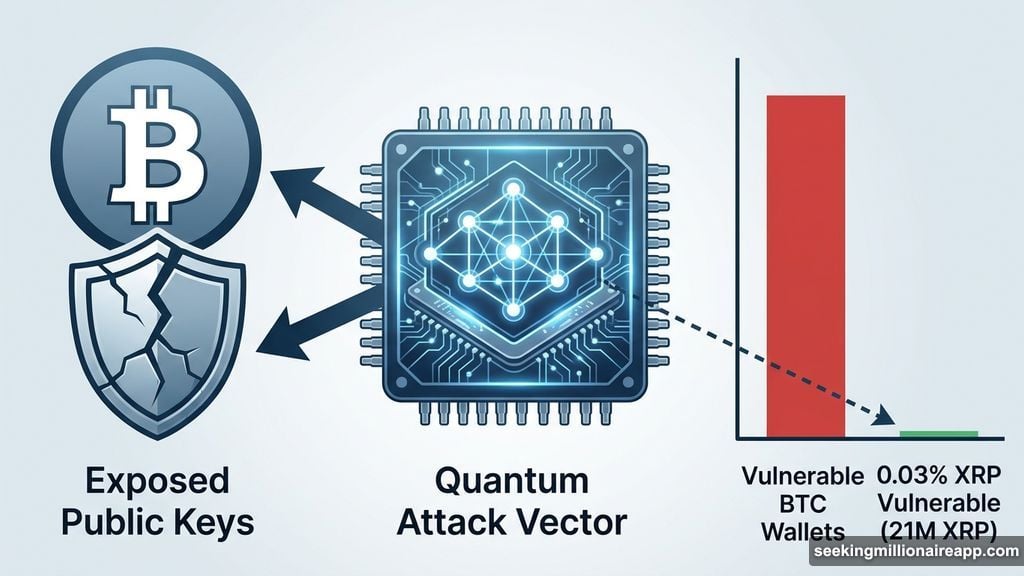
On the more vulnerable side, the validator identified just two dormant XRP whale wallets. Together they hold about 21 million XRP, and both have exposed public keys after sitting inactive for over five years. That works out to roughly 0.03% of XRP’s total supply sitting in genuinely quantum-vulnerable territory. That’s a remarkably small number.
The validator put it plainly: “Dormant, vulnerable XRP whales are almost nonexistent. The rest is active and has their public key exposed, but is also reasonable to expect to rotate keys if needed.”
XRPL’s Key Rotation Feature Adds an Extra Layer
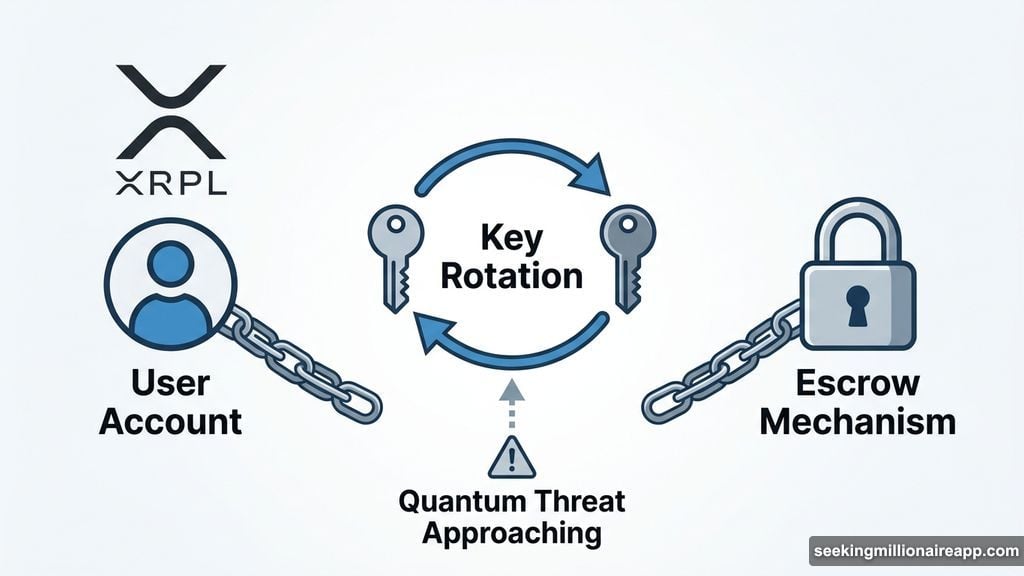
Here’s something that sets the XRP Ledger apart from Bitcoin in a practical way. XRPL supports signing key rotation, which means users can update the keys that sign transactions on behalf of an account without needing to switch accounts entirely.
So even if a quantum threat became more immediate, XRP users have a built-in path to respond. It’s not a perfect solution, as the validator freely admits. Actual quantum-resistant algorithms will eventually need to be adopted across the board. But it does provide meaningful flexibility that Bitcoin simply doesn’t offer in the same way.
Plus, XRP users can also take advantage of escrow mechanisms on the ledger, which adds yet another layer of protection for large holdings.
Bitcoin’s Quantum Problem Is a Much Bigger Story
Now compare that 0.03% figure to what Bitcoin is dealing with.
According to a recent paper by Google, approximately 6.7 million BTC currently sit in quantum-vulnerable addresses. That’s nearly 32% of Bitcoin’s entire circulating supply. To put that in perspective, we’re talking about roughly $400 billion worth of Bitcoin that could theoretically be targeted if quantum capabilities advance far enough.
Included in that figure is an estimated 1 million BTC widely believed to belong to Satoshi Nakamoto. Litecoin founder Charlie Lee recently flagged this directly in a conversation with BeInCrypto.
“The million Bitcoins that Satoshi has. Nobody knows who Satoshi is. Those coins are not well protected. They’re actually less safe than current coins in terms of quantum attacks. If quantum does happen, those will be the first coins that will be kind of broken into,” Lee explained.
That’s a significant concentration of exposure tied to a single, unknown actor with no clear mechanism to rotate or protect those keys.
Should XRP and Bitcoin Holders Actually Worry Right Now?
Here’s the important context that keeps this from becoming a full panic: no quantum computer currently exists that can break blockchain encryption. The threat is real in theory, but it remains a future-state problem rather than an immediate danger.
The validator’s analysis makes clear that monitoring the situation is smart, but today’s XRP holders have relatively little to worry about. The combination of mostly hidden public keys, built-in key rotation support, and a tiny fraction of vulnerable dormant accounts puts XRPL in a much more defensible position than most other networks.
That said, the broader crypto industry is clearly starting to take quantum-resistant cryptography seriously. And networks that act early will be better positioned than those that wait for the threat to become urgent.
For XRP specifically, the numbers suggest the foundation is solid. The work of hardening it further is already on the roadmap, and that’s reassuring. For Bitcoin’s 6.7 million exposed coins, the conversation is going to get louder as quantum hardware continues to improve.