
The April 29 FOMC meeting carries a 99% probability of a rate hold. Most traders are watching Powell. But on-chain data tells a different story — crypto whales already made their moves before the press conference even started.
BeInCrypto analysts spotted decisive accumulation across three tokens in the hours before the meeting. Each has a distinct logic driving it. One caught a fresh exchange listing wave. Another is tracking a textbook breakout pattern. The third sits at the center of a quiet supply shock building since mid-April.
Here’s what the data shows.
Onyxcoin Whales Reload After the Upbit Spike
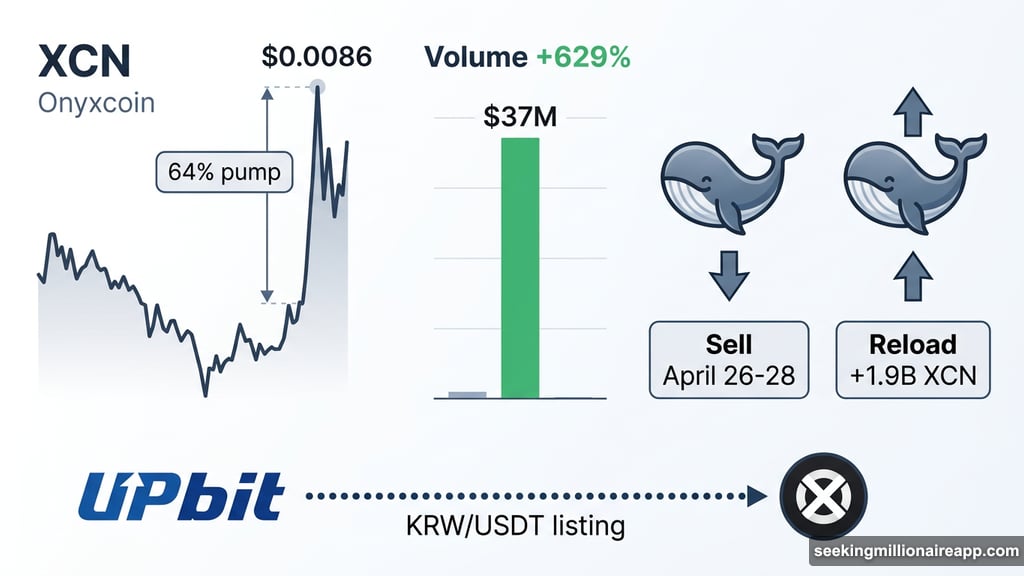
Onyxcoin (XCN) jumped 64% to $0.0086 on April 27, right after Upbit announced KRW and USDT trading pairs. Daily volume exploded 629% to $37 million. Classic listing pump behavior.
But what happened next is more interesting. Whale wallets, tracked through Santiment’s supply-held-by-whales metric, sold aggressively into that rally between April 26 and April 28. Smart money distributed right into the excitement.
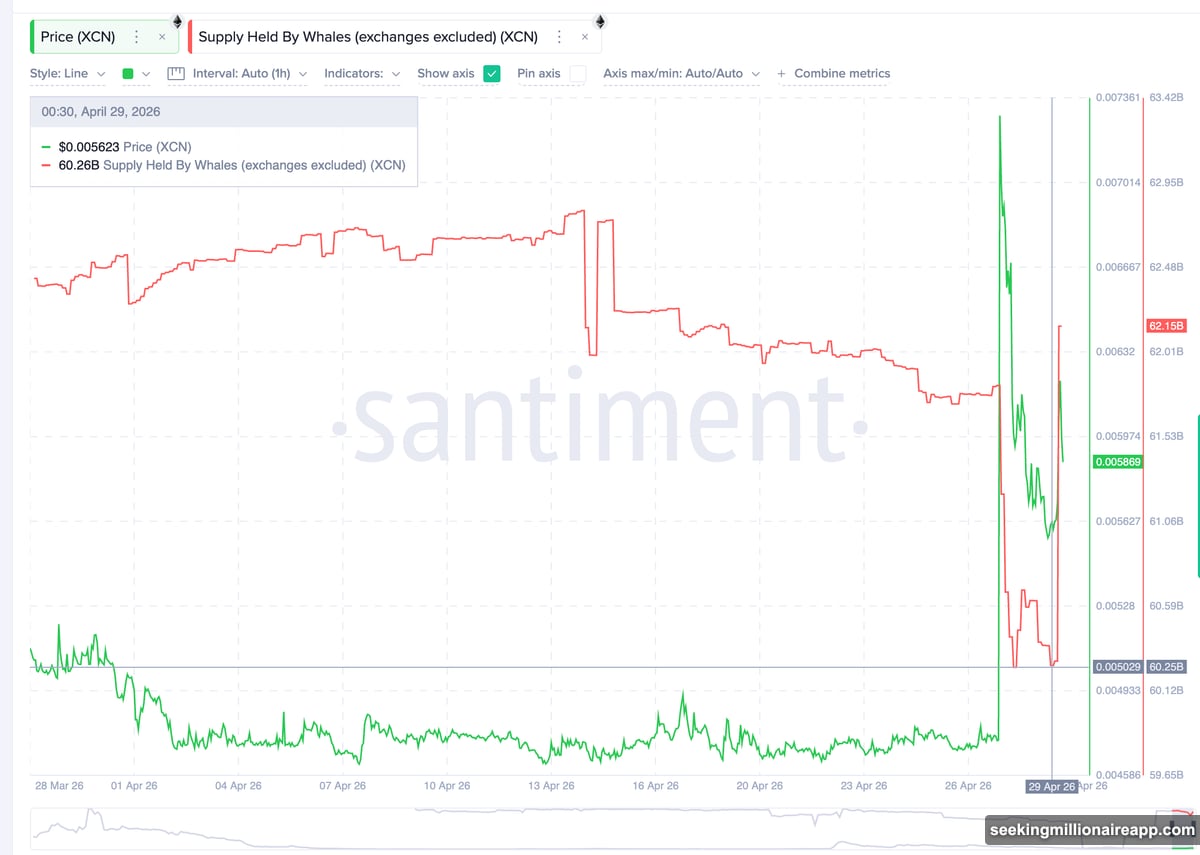
Then the reaccumulation started. Whale supply climbed back to 62.15 billion XCN in the hours leading up to the FOMC decision, recovering roughly 1.9 billion tokens. That’s a deliberate reload, not noise.
The timing lines up with broader market rotation. Crypto was trading higher as traders moved out of the S&P 500 ahead of Powell’s conference. Whales appear to be betting that pre-FOMC liquidity flows into altcoins, and XCN sits directly in that path thanks to its fresh Upbit exposure.
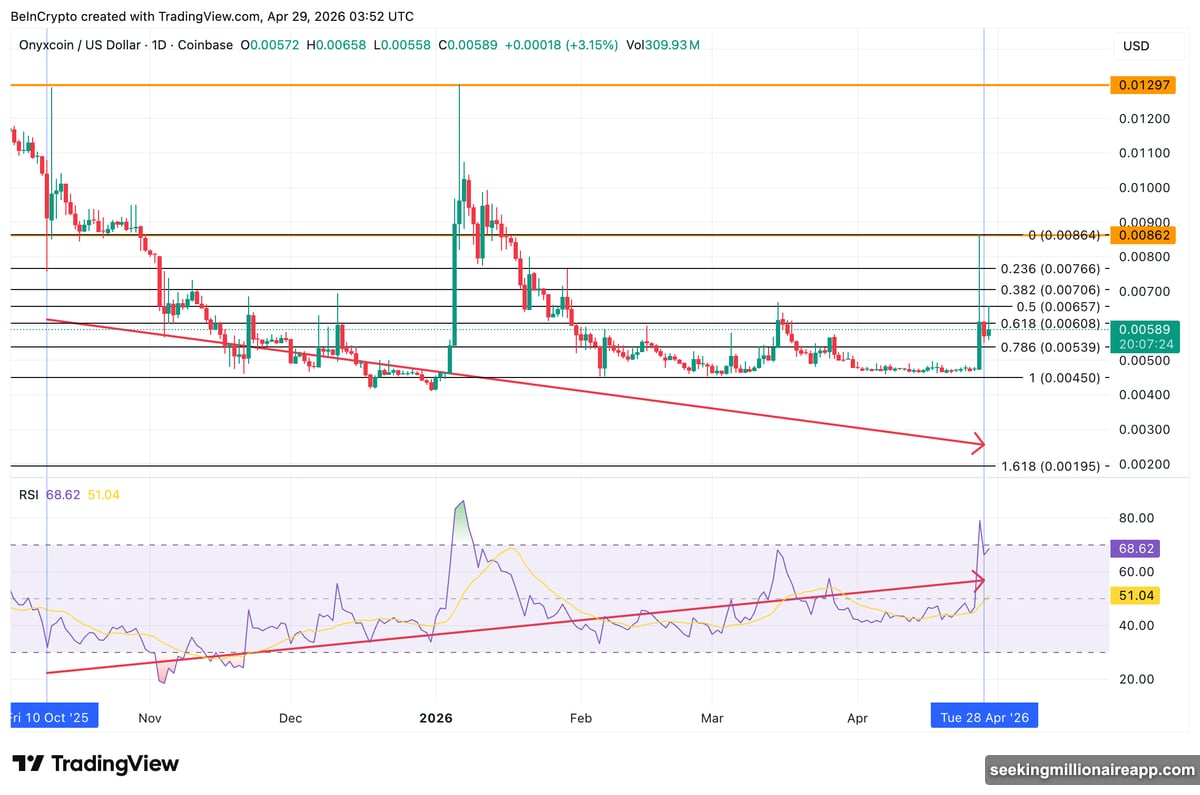
The technical setup backs this up. Between October 8 and April 28, the daily RSI (Relative Strength Index — a momentum indicator running on a 0-100 scale) printed a higher low while price printed a lower low. That’s a classic bullish divergence, meaning momentum is improving even as price hasn’t fully confirmed it yet.
For XCN to run, it needs a daily close above $0.0060, which is the 0.618 Fibonacci level. A confirmed close there targets the listing peak of $0.0086. Clear that, and the January resistance at $0.0129 comes back into play. However, a drop below $0.0053 invalidates the divergence entirely and puts $0.0045 back on the table.
Chainlink Whale Accumulation Hits $42.7 Million Over Six Days
Chainlink (LINK) tells the steadiest whale story of the three. No dramatic pumps. No reload after a flush. Just consistent, quiet accumulation over nearly a week.
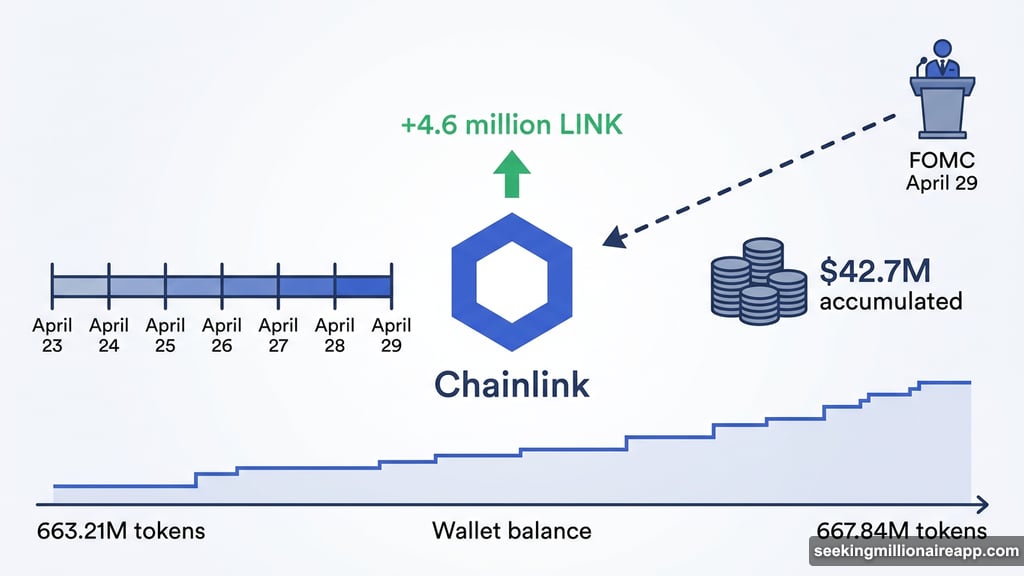
Santiment data shows LINK whale wallets — excluding exchange addresses — grew from 663.21 million tokens on April 23 to 667.84 million on April 29. That’s 4.6 million LINK added in six days, worth roughly $42.7 million at current prices of around $9.30.
That kind of steady flow during a macro uncertainty window typically signals conviction rather than opportunism. Whales aren’t chasing momentum here — they’re building a position ahead of a specific catalyst.
The chart shows what they’re positioning for. LINK has formed an inverse head and shoulders pattern, one of the most reliable bullish reversal structures in technical analysis. The head sits at $8.19. The right shoulder formed near $8.99. The neckline sits at $9.39, right where the token was trading heading into the FOMC meeting.
A daily close above $9.39 targets $10.02 first, a level that also aligns with the 0.618 Fibonacci zone. From there, a clean break unlocks a 17% measured move toward $11.69. On the downside, a failure at $9.39 followed by a drop below $8.99 weakens the structure. And a close under $8.19 kills the pattern completely.
Ethereum Whales Absorbed $2.49 Billion While Exchange Reserves Hit 2016 Lows
Ethereum (ETH) is the most patient play of the three. It’s also the most structurally interesting.
Whale wallets holding ETH, again excluding exchange addresses, grew from 123.35 million ETH on April 19 to 124.43 million ETH on April 29. That’s 1.08 million ETH accumulated over 10 days, worth approximately $2.49 billion at current prices around $2,309.
What separates the ETH story is the logic behind it. This isn’t about rate cut speculation — CME FedWatch shows zero probability of a cut at this meeting. Whales aren’t buying ETH hoping Powell pivots.
Instead, the accumulation lines up with structural on-chain demand building quietly beneath the surface. ETH exchange reserves just hit their lowest level since 2016. On top of that, 331,000 tokens were withdrawn from exchanges since April 19 alone. Corporate treasuries are adding to the pressure — BitMine added 101,901 ETH last week, worth roughly $233 million.
Put those pieces together and you get a supply shock setup. Less ETH sitting on exchanges means less available to sell. More institutional accumulation means sustained demand. Whales appear to be using the pre-FOMC consolidation as a discount window before the math gets fully priced in.
The chart reflects that patience. ETH has consolidated in a tight 5% range between $2,250 and $2,377 since mid-April. That’s whales absorbing supply without lifting price — exactly what you see before a structural move.
ETH currently holds above its 20-day Exponential Moving Average (EMA) at $2,294, a short-term trend indicator that weights recent price action more heavily. A daily close above $2,349 (the 100-day EMA) and then $2,377 sets up an 11.92% measured move toward $2,583. Below the range, $2,294 and $2,245 (the 50-day EMA) are the first support levels. A break below $2,250 opens the door to $1,936.90.
What Ties All Three Together
These aren’t random picks. Each token shows a specific, distinct reason for whale interest rather than general FOMC speculation.
XCN caught fresh exchange listing liquidity and now sits on a bullish RSI divergence. LINK shows the most textbook accumulation pattern, steady and conviction-driven ahead of a clear technical trigger. ETH carries the biggest structural story, built around supply disappearing from exchanges while institutional demand quietly grows.
What’s clear is that the biggest wallets weren’t waiting for Powell’s press conference to start moving. By the time the FOMC statement drops, the positioning is already done. The question is whether price follows.
This analysis is for informational purposes only and should not be considered financial or investment advice. Always conduct your own research and consult with a professional before making any financial decisions.