Crypto exchange rates change in seconds. And the cheapest-looking option isn’t always the best deal.
Hidden fees, reserve limits, and minimum transaction thresholds all add up fast. Comparing these variables manually across dozens of services takes serious time — and one missed detail can cost you real money. BestChange was built to solve exactly that problem. After 18 years of continuous operation, it’s grown from a simple rate-comparison website into a full multi-product ecosystem.
Here’s everything you need to know about how it works.
Why Exchange Rate Comparison Actually Costs You
Most people don’t compare rates every time they make a swap. They stick with the same service out of habit. That habit comes with a price.
Small inefficiencies rarely stand out in a single transaction. But they compound fast — especially if you move funds regularly. In a market valued at around $2.6 trillion in early 2026, even minor pricing differences can scale into meaningful losses across repeated transfers.
The problem isn’t access to better rates. It’s visibility. Without a clear view of alternatives, you simply accept whatever one platform offers.
What BestChange Is and How It Works
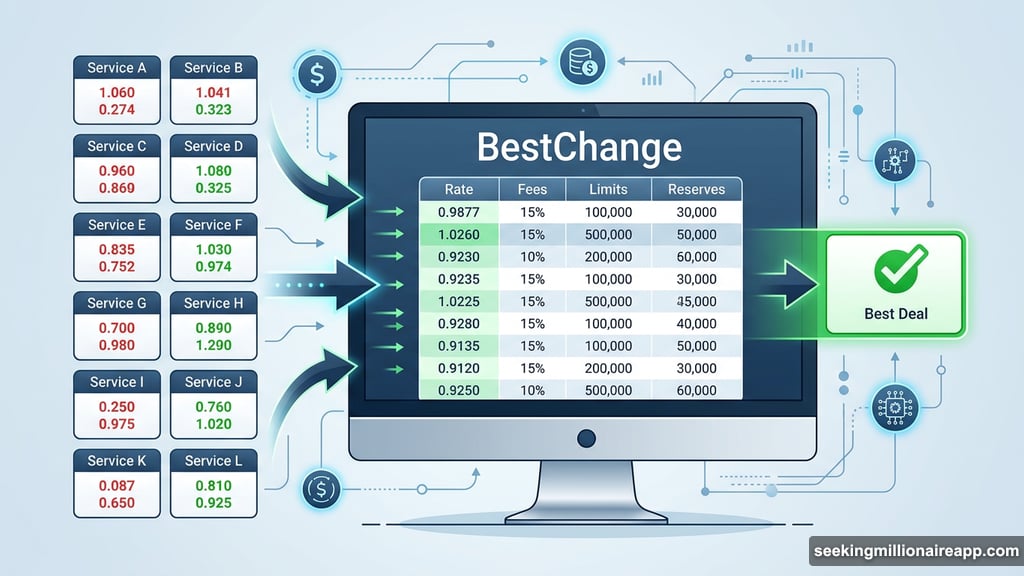
BestChange is a non-custodial exchange aggregator. It collects real-time data from hundreds of exchange services and displays key parameters for any selected exchange direction — rates, fees, limits, and reserves — all in one interface.
The platform doesn’t store your funds, perform exchanges, or process transactions. It works purely as an independent information source. Users compare options on BestChange, then complete transactions directly with whichever third-party service they choose.
As of April 2026, the platform tracks over one million exchange rates, supports 45,000+ currency pairs, and aggregates offers from 470 verified exchange services. Its database also includes more than 100,000 user reviews, adding practical context when comparing similar offers from different providers.
Cross-Market Comparison Sets BestChange Apart
Most crypto swap tools focus on token-to-token conversions. BestChange takes a broader approach.
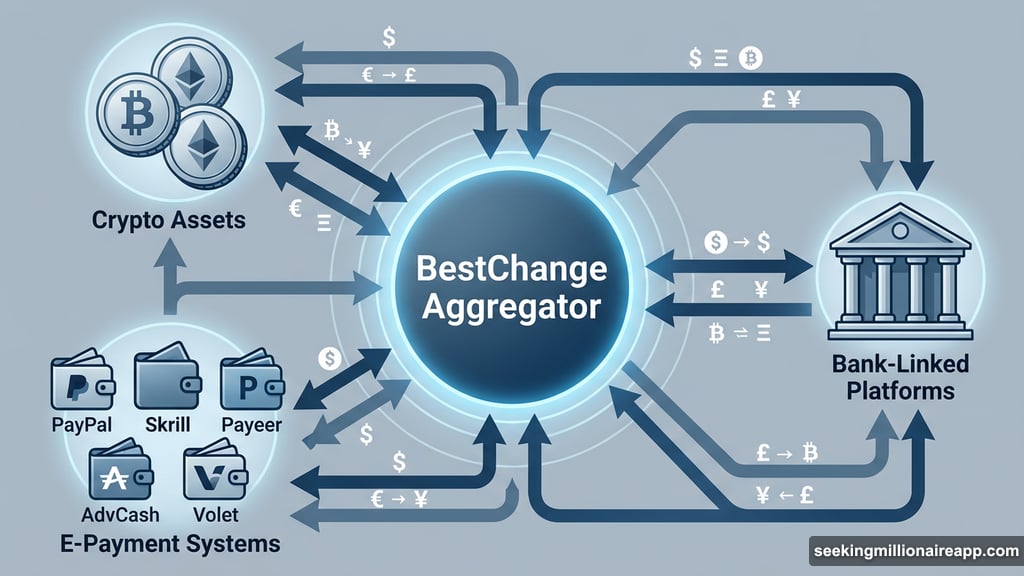
The platform covers both crypto assets and e-payment systems — PayPal, Skrill, Payeer, AdvCash, and Volet included. That matters because a large share of real-world transactions don’t stay within crypto. You might need to move funds between wallets, payment services, and bank-linked platforms, where direct trading pairs are limited or inconsistent.
Some platforms simply don’t support these transitions. Others offer limited options with unclear pricing. BestChange maps available exchange paths across both digital and traditional payment systems, letting users compare routes that would otherwise require multiple separate searches.
So its stronger use case is cross-market comparison: crypto to e-money, e-money to fiat-linked methods, and multi-step routes where direct pairs don’t exist.
The Full BestChange Product Ecosystem
BestChange started as a single website. Today it spans multiple platforms, each designed for a different use case.
| Product | Platform | Launch | Key Use Case |
|---|---|---|---|
| Classic Website | Desktop/Mobile browser | June 2007 | Full-featured rate comparison, reviews, complaints |
| Telegram Bot | Telegram | March–April 2025 | Fast rate checks with low bandwidth |
| Telegram Mini App | Telegram | March–April 2025 | App-like comparison inside Telegram |
| Mobile App | iOS, Android, Huawei | June 2025 | Rate comparison on the go, 170+ countries |
| Telegram Mini App V.2 | Telegram | October 2025 | Updated mobile-style interface inside Telegram |
| New Website V3.0 | Desktop/Mobile browser | November 2025 | User accounts, filters, blocklists, multistage exchange |
| Browser Extensions | Chrome, Edge, Firefox, Opera, Yandex | Ongoing | Quick rate checks without leaving your current tab |
Ecosystem PortalWebOngoingSingle entry point for all BestChange products
This progression reflects a clear design philosophy. BestChange expanded step by step — desktop first, then mobile access, then Telegram-based tools, then user personalization and advanced route discovery.
The newer products also show a visible shift in interface design. The mobile app, Telegram Mini App, and Version 3.0 website use a more visual, modern aesthetic. The classic site keeps its functional layout, which long-time users have relied on since 2007.
BestChange Tools That Reduce Real Transaction Risks
Each tool in the ecosystem targets a specific failure point in the exchange process. Here’s how the key ones work.
AML Analyzer: Check Wallet Risk Before You Send
Compliance risk isn’t just an institutional problem anymore. Many exchange services now screen wallet addresses before processing transactions, which can lead to delays or blocked funds if a risk flag appears.
BestChange’s AML Analyzer lets users check addresses in advance. The tool aggregates data from multiple compliance providers to estimate risk levels, highlight connections to flagged sources, and generate actionable recommendations. Bundle checks let you compare results across several databases at once, which improves reliability.
It supports BTC, ETH, LTC, TRX, and ERC20/TRC20/BEP20 tokens. One important caveat: it’s a risk-check tool, not legal or financial advice.
Multistage Exchange: Find Routes That Don’t Obviously Exist
Sometimes a direct exchange path simply doesn’t exist for your selected pair. BestChange’s double exchange tool identifies intermediate conversion routes automatically. It maps available services, builds conversion chains, and highlights viable paths that might not be obvious at first.
Version 3.0 of the website extends this further, supporting up to five conversion steps and showing potential gains compared to direct options.
Smart Filters, Blocklists, and Rate Alerts
The new website version introduces user accounts with persistent preferences. You can block specific exchange services from your results entirely, save favorite pairs and services, and apply advanced filters based on reserve size, payment method, or service type.
Rate alerts let you set thresholds for specific rates or reserve conditions and receive notifications by email or Telegram when your criteria are met. No more manually refreshing comparison pages.
Exchange Labels
BestChange uses visual labels to help users read exchange listings more carefully. These markers highlight important service conditions, operational notes, or extra context that might affect your decision. When comparing several exchangers at once, these cues reduce the chance of missing a relevant detail before you leave the platform.
What You Should Always Check Before Choosing an Exchanger
BestChange narrows the field. It doesn’t replace the due diligence you still need to do before committing to a third-party service.
Before sending funds, run through these checks:
- Confirm the final rate on the exchanger’s website. Rates can shift between comparison and checkout.
- Review reserves, minimums, and maximums. A great displayed rate means nothing if the exchanger lacks sufficient liquidity.
- Read recent reviews, not just totals. Fresh feedback reveals current service quality far better than an overall star rating.
- Check KYC and verification requirements. Some exchangers require manual approval or extra verification for certain payment methods.
- Use the AML Analyzer when wallet risk matters. But treat it as one input, not a guarantee.
This is where BestChange delivers its real value: it makes comparison faster and more complete. The final decision still belongs to you.
The Referral Program and Community Features
BestChange built several community features that grew from observed user behavior rather than top-down planning.
The referral program launched around 2011 and now has more than 1.3 million participants. It offers up to $5 per referred user, up to 30% from AML checks made by referrals, and up to 30% from referral earnings. Partners can promote through websites, blogs, YouTube, Telegram, or social media, with a dashboard providing analytics and ready-made promotional materials.
Founder Denis Malkov explained the thinking behind it: “BestChange was already quite popular at that point, but we noticed something interesting — users were actively recommending the service to friends on their own. So we thought: why not give them a way to earn from those recommendations as well?”
The Bitcoin faucet has been running since 2016 and has distributed more than 30 BTC over the years. Users can claim between 1 and 100 satoshi every 60 minutes. While individual payouts are small, the faucet served as an onboarding tool — giving newcomers their first hands-on experience with Bitcoin.
The review and complaints system was introduced before 2012. Users can read and submit reviews of exchange services, and a public claims mechanism allows complaints to be addressed transparently. Each listed service undergoes pre-listing verification and ongoing monitoring for review manipulation, rate discrepancies, and rule violations.
From Student Project to Global Ecosystem: 18 Years of BestChange
The platform’s history follows a consistent pattern: real user friction leads to a new practical tool. Every product addition responded to a gap users actually identified.
June 2007. Denis Malkov, then a university student, built the first version of BestChange in two weeks. It tracked exchange rates for electronic payment systems like WebMoney and E-gold. At launch, 25 exchangers were listed, and Malkov invested less than $1,000 while handling programming, partner recruitment, and marketing himself.
2012. Bitcoin joined the platform as the first crypto exchangers appeared on the market. The review and public claims system also launched that year.
2016. The Bitcoin faucet went live, coinciding with growing mainstream interest in cryptocurrency.
2016–2017. The first major crypto boom drove a surge in traffic. BestChange was among the more established comparison platforms available as millions of new users searched for where to buy Bitcoin.
March–April 2025. The Telegram bot and first Telegram Mini App launched, bringing rate comparison directly into the messaging platform.
June 2025. Mobile apps for Android, iOS, and Huawei became available in 170+ countries.
October 2025. Telegram Mini App V.2 rolled out with an improved interface modeled on the mobile app.
November 2025. Version 3.0 launched at Blockchain Life 2025 in Dubai, featuring a full redesign, user accounts, multi-step exchange tools, and expanded language support.
Malkov described the evolution simply: “Most of what we’ve built came from real user friction. As the market grew, it became harder to navigate — more exchangers, more variables, more risks. So we kept adding tools to simplify those decisions. That’s essentially how the product evolved into an ecosystem.”
The company relocated its headquarters to Dubai, UAE. BestChange has also faced regulatory restrictions in certain markets, including Russia. Malkov attributed these to broader regulatory shifts rather than platform-specific concerns, noting that access was fully restored as requirements were aligned with updated rules.
Who Should Use BestChange?
BestChange works best as a comparison layer. If you regularly move funds between crypto assets, e-payment systems, or fiat-linked methods, it gives you a faster, more complete view of your options before you commit to a service.
Its long operating history, broad currency coverage, AML Analyzer, user review system, public claims mechanism, and multi-platform access make it genuinely useful for anyone comparing exchange options often. The platform’s non-custodial approach means your funds never pass through it, which keeps the risk profile clean.
Just remember: the final transaction happens outside BestChange. Always review your chosen exchanger carefully before you send anything.