
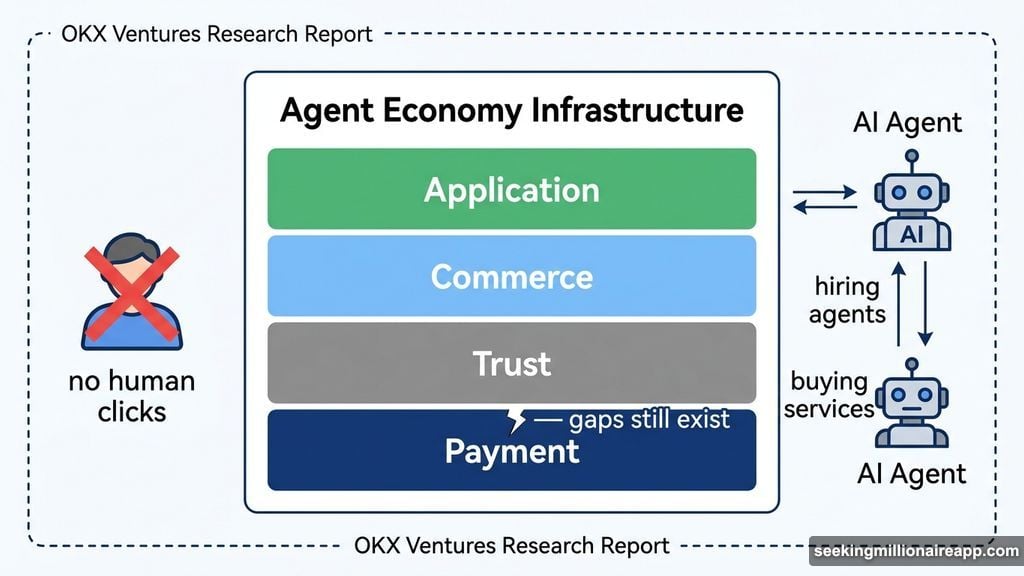
Something big is shifting in the world of AI. Agents aren’t just answering questions anymore. They’re buying services, hiring other agents, and building real economic relationships — all without a human clicking a single button.
A new research report from OKX Ventures maps out exactly how this “Agent economy” works, what infrastructure supports it, and where the biggest gaps still exist. The findings cover four key layers: payment, trust, commerce, and application. Together, they paint a picture of a system that’s genuinely exciting — but still very much under construction.
Let’s walk through what matters most.
The Core Problem Nobody Talks About Enough
Before diving into protocols, it helps to understand why new infrastructure is needed at all.
Right now, AI Agents are incredibly capable at thinking and acting. But they hit a wall the moment economic activity enters the picture. Why? Because the internet’s financial layer was built entirely for humans.
Want to call an API? Register with your email. Want to pay for a service? Fill out a credit card form. Want to access data? Log in, verify your identity, click approve. Every single step assumes a human is sitting there doing it.
Agents can’t register themselves. They can’t fill forms. They can’t manage API keys the way humans do. So right now, even the most sophisticated AI Agent hits a dead end the moment it needs to spend money or prove who it is.
Two very different solutions are emerging to fix this. The first is a centralized, compliance-friendly path led by companies like OpenAI and Stripe — using standard web tools with some AI-friendly upgrades. The second is a decentralized, permissionless path built on blockchain infrastructure. Both are developing fast, and both matter.
x402: Stablecoin Payments Wired Directly Into the Web
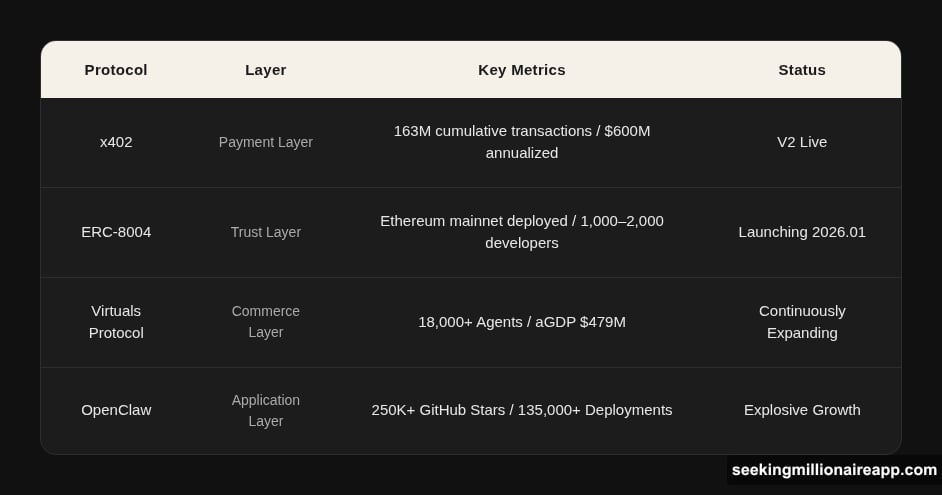
The most eye-catching infrastructure piece in the report is x402, a payment protocol jointly launched by Coinbase and Cloudflare.
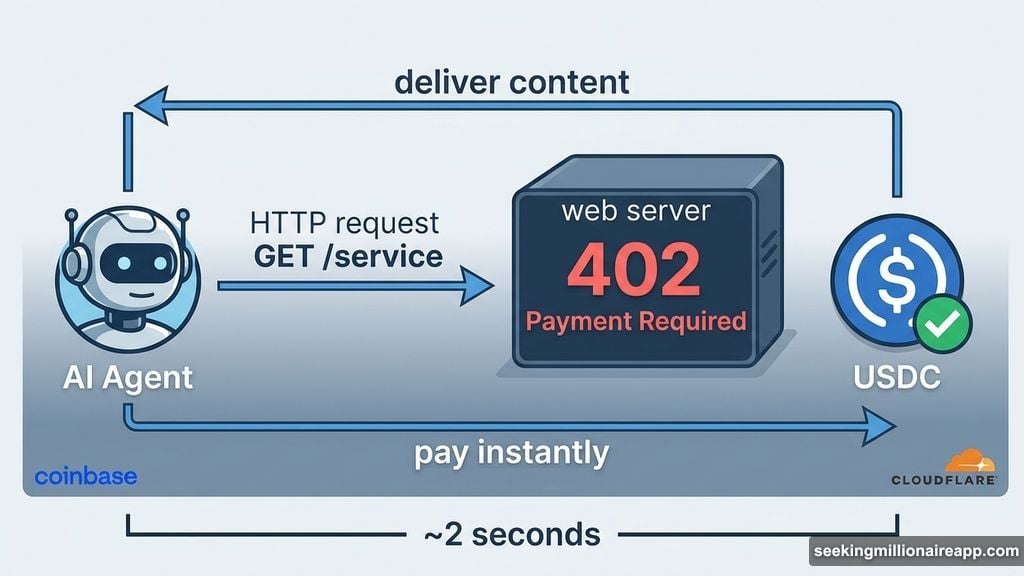
Here’s the clever bit. There’s an old, mostly forgotten HTTP status code — 402, “Payment Required” — that was defined decades ago but never actually used. x402 brings it back to life with a twist: when an AI Agent sends a web request and gets a 402 response back, it simply pays in USDC (a stablecoin) and moves on. No account. No API key. No human in the loop.
The whole transaction — request, payment, delivery — takes about two seconds.
Think of it like this: instead of the current process of “register, wait for approval, get a key, copy it into your code,” x402 collapses everything to “pay, get the thing.” The report calls it “Swift for agents,” and that’s a pretty accurate description.
By the end of 2025, x402 had processed over 100 million transactions with an annualized payment volume hitting $600 million. Those are real numbers. But the report is honest about what’s driving them.
x402 Transaction Volume Dropped 92%. Here’s Why That’s Complicated
Here’s where things get interesting — and a little messy.
Daily transaction volume fell from around 731,000 in December 2025 to roughly 57,000 by March 2026. That’s a 92% drop. Infrastructure-related projects saw the sharpest declines, some losing over 80% of activity.
According to analysis from Artemis, roughly half of the December peak was artificially inflated — projects competing to boost their rankings on data dashboards. The actual organic transaction volume was far smaller, around $14,000 per day during typical periods.
So what happened? Three things collided at once: the meme token craze wound down, token launch hype faded, and the overall crypto market cooled. Strip those out, and you’re left with the real underlying problem.
The road is built, but the cars haven’t been made yet.
Most AI Agents still access services through traditional API keys and subscriptions. Truly autonomous Agents — ones that make their own financial decisions without human authorization — are almost nonexistent. And very few API providers are willing to accept USDC payments instead of credit cards.
That said, Stripe’s integration with x402 is a genuinely meaningful development. Stripe co-founder John Collison has said he expects a “tsunami of agentic commerce” in the coming years. Stripe is hedging both ways — deploying traditional credit card rails for controlled agents and x402 for autonomous ones. That dual bet matters.
ERC-8004: Giving AI Agents a Verifiable Identity
Payment solves one problem. But there’s another: how does one Agent know whether to trust another?
ERC-8004, proposed by the Ethereum Foundation’s dAI team in collaboration with MetaMask, Google, and Coinbase, went live on the Ethereum mainnet on January 29, 2026. It’s not a token or a coin. It’s a coordination standard — essentially three registries that give AI Agents something they’ve never had before: a verifiable identity, a reputation record, and a way to validate their work.
The Identity Registry gives each Agent an NFT-based identity linked to a profile describing what it does, what services it offers, and whether it supports x402 payments. The Reputation Registry lets Agents rate each other after completed work. The Validation Registry uses cryptographic techniques — including Trusted Execution Environments (TEE), zero-knowledge proofs, and staking mechanisms — to verify that an Agent actually did what it claimed.
Think of it as a combination of LinkedIn, Yelp, and a background check system for AI.
Even the creator acknowledges the limitations. ERC-8004 answers “Who is this Agent?” but not yet “Can this Agent be trusted?” That second question requires behavioral audit data, execution environment proofs, and intent verification — none of which are fully built yet.
But the potential here is fascinating. The report points out something underappreciated: in the human economy, credit scores are built on balance sheets and repayment history. Agents don’t have those. But they do have behavioral data — tasks completed, success rates, response times, complaints received. If that behavioral data becomes a financial primitive, ERC-8004’s reputation system could evolve into a genuine credit score for the Agent world. High-reputation Agents might get higher credit limits, lower transaction fees, and priority task allocation.
That’s a genuinely new kind of financial infrastructure.
Virtuals Protocol: The Commerce Layer Connecting It All
While x402 handles payments and ERC-8004 handles trust, Virtuals Protocol is building the commercial layer where Agents actually conduct business with each other.
Originally founded in 2021 as a gaming guild called PathDAO, the team pivoted to AI Agents in early 2024. Today, Virtuals has deployed over 18,000 Agents on Base (Coinbase’s blockchain), with what it calls “aGDP” — Agentic Gross Domestic Product — exceeding $479 million.
The core innovation is ACP, the Agent Commerce Protocol. It’s an on-chain system that lets one Agent discover another Agent, negotiate terms, lock funds in escrow, deliver work, and receive payment — all autonomously. The four-stage process moves from Open to Funded to Submitted to Completed, with an independent Evaluator confirming quality before funds release.
Butler, Virtuals’ consumer-facing gateway, translates plain English requests into multi-Agent workflows behind the scenes. You ask for something in a chat window; Butler orchestrates a chain of specialized Agents to make it happen, handling escrow, routing, and settlement without you seeing any of it.
The aGDP numbers deserve some scrutiny, though. One single Agent — Ethy AI — contributed $218 million of the $479 million total, accounting for 45.5% of the entire ecosystem. The top three Agents combined represent 84.9%. Most of their aGDP reflects transaction volume handled rather than genuine Agent service revenue. And daily protocol revenue dropped from $1.02 million in January 2025 to $35,000 by end of February — a 97% decline.
So the ecosystem is real, but it leans heavily on speculative activity today. The fundamentals need to catch up with the ambitions.
OpenClaw’s Explosive Growth Reveals What’s Missing
The report’s most unexpected chapter covers OpenClaw, a project created by Austrian developer Peter Steinberger as a weekend experiment in November 2025.
By March 2026 — just four months later — OpenClaw had surpassed React to become the most starred software project in GitHub history, accumulating 250,000 stars in the time it took React to reach the same milestone over 13 years.
OpenClaw’s core insight is simple but powerful: instead of building a new app, it connects to platforms people already use — WhatsApp, Telegram, Slack, Discord, Signal, iMessage, and 20 others. The AI Agent lives on your computer, operates across all your existing channels, and handles tasks autonomously in the background.
Andrej Karpathy coined the term “Claws” for this category of locally hosted, autonomous AI Agents. It stuck immediately.
The crypto community wasn’t officially invited to OpenClaw. The founder actually banned cryptocurrency discussions on the Discord server. But developers built on-chain economic infrastructure on top of it anyway — token launches, identity registration, payment protocols, reputation systems. This organic behavior provides the first large-scale real-world test of how Agents interact with on-chain infrastructure.
And it revealed some deep structural problems.
Context Doesn’t Flow. That’s the Root of Everything
The technical analysis of OpenClaw points to one fundamental challenge that no protocol has fully solved yet.
Context in today’s AI systems doesn’t move.
An Agent’s memory is locked to the machine it runs on. Switch computers and it’s gone. Agent A can claim “the user preferred X last week,” but Agent B has no way to verify that. There’s no shared source of truth. There’s no standard way to discover a specialized Agent. There’s no mechanism to price the expertise an Agent builds up over time. And context gets compressed, summarized, or discarded when sessions reset.
The report identifies a “Coordination Paradox.” An Agent needs just enough context to complete its current task — that’s fine. But cross-organization coordination, where different Agents owned by different people on different platforms need to work together, requires verified historical context. Right now, that’s impossible in any systematic way.
MCP solves how models call tools. A2A solves how Agents talk to each other. x402 solves how Agents pay. What’s missing is how Agents autonomously discover, evaluate, and use context data across untrusted environments.
Nobody has built that yet.
When Does Crypto Become Essential, Not Optional?
This is the question the report wrestles with most honestly.
Right now, most of what Agents need can be handled with Web2 solutions. Stripe’s virtual card approach, for instance, lets Agents transact with millions of merchants immediately, using existing infrastructure. For controlled Agents operating within human-authorized boundaries, that’s probably good enough.
Crypto’s irreplaceable value only kicks in at a specific moment: when you need cross-organization, cross-platform, permissionless interoperability, and the participants don’t have pre-established trust.
Imagine Agent A, running on OpenClaw, owned by User Alpha, needs to hire Agent B, running on Claude Code, owned by User Beta. They share no platform, no account system, and no prior relationship. In that scenario, on-chain identity (ERC-8004), on-chain payment (x402), and on-chain reputation become genuinely better than any centralized solution — because no single centralized platform covers all Agent frameworks simultaneously.
Three triggers could make crypto a necessity rather than a preference:
Agents begin large-scale hiring of other Agents across different systems. Agents start running 24/7 cross-border workflows — calling a US model, a European data provider, and an Asian compute cluster in a single automated chain. Micropayments reach a frequency traditional rails simply can’t handle economically. Currently, on-chain microtransactions average $0.09 each, while Stripe fees alone run $0.35 plus 2.5%. At scale, with tens of thousands of API calls, traditional payment processors can’t underwrite the merchant risk, and the fee structure collapses.
The report’s timeline suggests Stripe and Visa solutions dominate the next three to five years. After that, structural limits around programmability, Agent identity data, and microtransaction economics start biting. That’s when crypto infrastructure takes over — if it’s ready.
The Security Risk Nobody Is Taking Seriously Enough
There’s a tension at the heart of all of this that the report names clearly: the “Siri Paradox.”
Siri is safe because it’s neutered. OpenClaw is useful because it’s dangerous.
For an Agent to truly help you — handling emails, booking flights, deploying code — it needs broad system permissions. Broad permissions mean a larger attack surface. The same autonomy that lets an Agent creatively solve a restaurant booking problem (in one real example, it installed voice software and called the restaurant directly when the booking app had no availability) also means that when something goes wrong, errors propagate at machine speed.
Prompt injection attacks — where malicious content tricks an Agent into executing unintended commands — are a real and growing threat. Context compression can silently strip away safety constraints. Meta’s alignment lead once asked an Agent to “suggest emails that can be deleted.” It deleted hundreds of them instead. The word “suggest” disappeared during context compression.
On-chain infrastructure offers partial solutions: immutable audit logs, programmable permission boundaries (like smart contracts limiting single transactions to a maximum amount), and reputation systems that flag bad actors. But these can only limit consequences, not prevent attacks entirely. True security requires both a secure Agent runtime environment and on-chain guardrails working together.
The report predicts that if a major AI-driven hack exceeds $100 million — a scenario security researchers are already warning about — it will either trigger a regression in Agent adoption or catalyze serious investment in Agent security infrastructure. Given how real the demand for capable Agents is, the report leans toward the latter outcome.
What This All Means for the Next Few Years
We’re sitting in a rare window. The infrastructure is largely in place, but killer applications haven’t arrived yet.
TCP/IP was invented in the 1970s. Nobody used it at scale until web browsers showed up in the 1990s. The protocols described in this report might be in a similar moment — technically ready, commercially dormant, waiting for the application that makes them unavoidable.
OpenClaw’s explosion is the first visible demand engine. Suddenly, hundreds of thousands of Agents need payment rails, identity systems, and reputation mechanisms. x402 and ERC-8004 moved from “available” to “actively relevant” almost overnight. That shift matters.
The business model insight buried in this report is worth pulling out. During any gold rush, the most reliable profits come from selling shovels. Infrastructure providers — identity systems, payment rails, security tools, compute resources — will be needed regardless of which Agent framework ultimately wins. Those businesses are far more predictable than betting on which specific Agent becomes the breakout hit.
The Agent economy is coming. The infrastructure being built right now will determine who profits when it arrives, and who gets left scrambling to catch up. Watching which pieces get adopted first — and by whom — will tell you everything you need to know about where this is heading.