
Everyone’s talking about AI crypto trading bots. Viral threads promise million-dollar profits. Traders are building automated Polymarket bots using Anthropic’s Claude and posting wild returns online.
But here’s the thing. Not a single major AI company has endorsed crypto trading bots. No frontier lab is actively training models for it. And the experts who understand this space best want nothing to do with it.
So what’s really going on?
The Liability Trap Nobody Mentions
Haseeb Qureshi, managing partner at Dragonfly Capital, recently broke this down in a Bankless interview. His take is worth paying attention to.
First, building AI for blockchain tasks isn’t technically hard. An EVM simulator can test token swaps and looped lending with ease. The models are capable. They just aren’t being pointed at crypto.
The reason isn’t technical. It’s institutional.
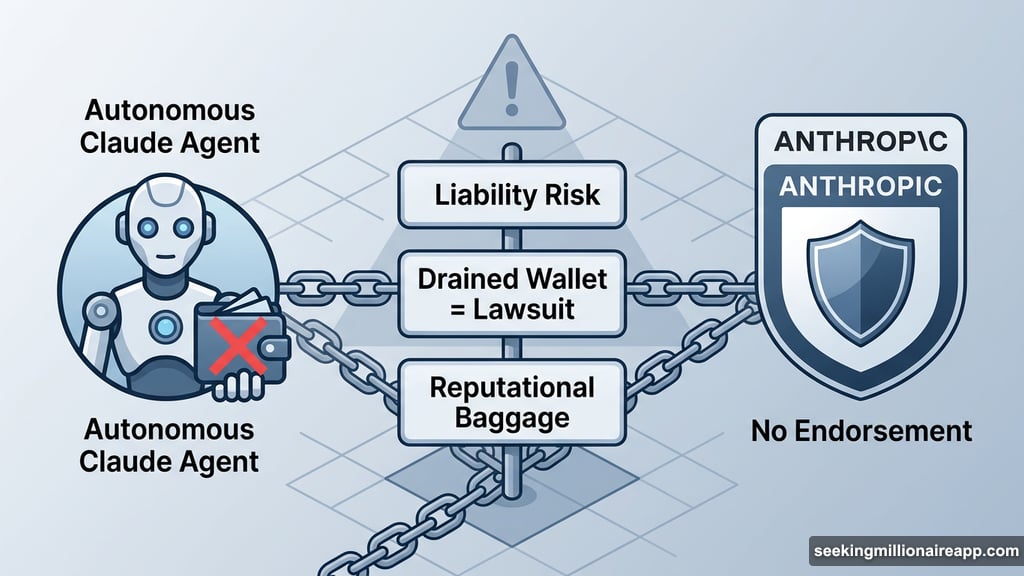
Crypto carries serious reputational baggage that AI labs simply don’t want. But beyond that, the liability risk is enormous. Imagine Claude botches a leveraged trade and wipes out $2 million. Or accidentally sends $10,000 to the wrong address.
“It will 100% happen,” Qureshi said. “Anybody who has a bad experience, it’s going to go super viral.”
He compared letting an AI manage a crypto wallet to injecting unregulated peptides. The downside completely swamps any revenue upside. Coding advice gone wrong is embarrassing. A drained wallet is a lawsuit.
Anthropic has published research on AI and blockchain, notably its SCONE-bench study on smart contract vulnerabilities. But that’s cybersecurity research, not a product roadmap. There’s a big difference between the two.
The Jane Street Problem Every Retail Trader Ignores
Even if you build a bot that actually works, you face a bigger structural problem. Any strategy built on a publicly available model is available to everyone, including institutional quant firms with vastly more resources.
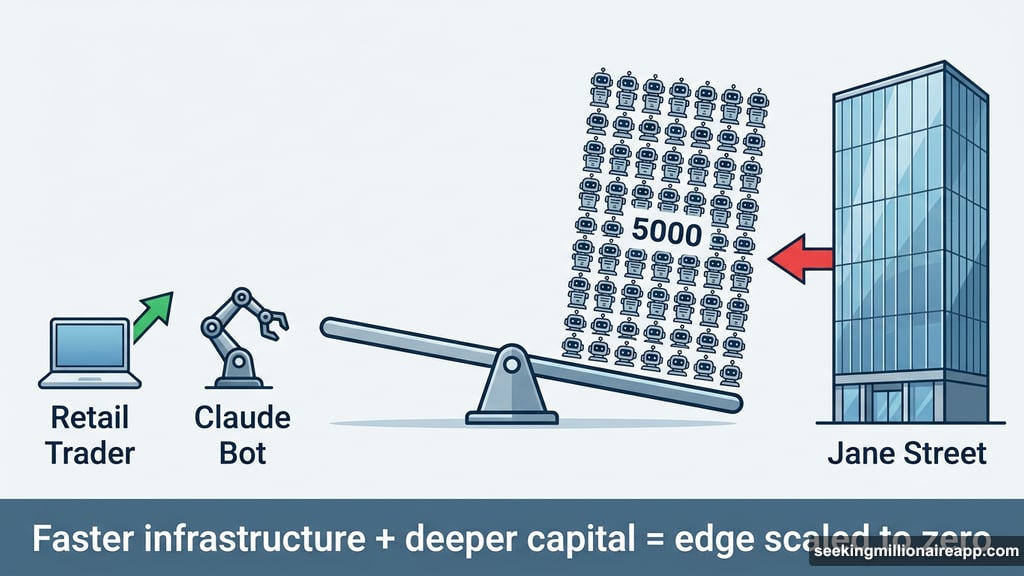
Qureshi put it plainly. If a basic Claude bot finds profitable trades on Polymarket, Jane Street can run 5,000 of those bots simultaneously. They have faster infrastructure, deeper capital, and the ability to scale any profitable edge to zero before a retail trader even logs in.
“If it’s in the raw model, Jane Street is doing it right now,” he said.
The only way a retail bot wins long-term is with novel signals that aren’t baked into the base model. A Claude instance pointed at a public API is definitely not that.
Why AI Agents Can’t Just Go Make Money
Qureshi extended his argument beyond trading to tackle the broader fantasy: autonomous AI agents earning independent income.
The logic breaks down fast.
First option is getting hired. But millions of identical Claude instances exist. None has a unique skill set or location advantage over another. Hiring an AI agent is basically just buying Anthropic compute with extra steps. No rational buyer pays above Anthropic’s API price for the exact same output.
Second option is starting a business. This sounds more promising. But every AI agent draws ideas from the same pool of training data. Ask ten Claude instances for a startup idea and you get ten variations of the same generic pitch.
Real entrepreneurship, Qureshi argued, requires what Peter Thiel calls “earned secrets.” These are insights that come from specific experiences in specific places at specific times. Bankless built its brand because its founders combined deep crypto knowledge, storytelling ability, and community instinct at exactly the right moment. A freshly spun-up AI has none of that history.
So AI agents can’t win at trading. They can’t get hired above cost. They can’t generate truly original business ideas. Where does that leave them?
Qureshi’s answer was deliberately uncomfortable. He suggested crime may be where AI agents find their first genuine comparative advantage. Not because he welcomes that outcome. Because that’s where the logic points when every other door is closed.
So What Does This Mean for You?
The traders building Polymarket bots are real. Some profits may be real too, at least for now. But the window is narrow and closing fast.
Institutional quant firms will arbitrage away any alpha sitting in a public base model. Big tech won’t train seriously on crypto until competitive pressure forces them to. And the autonomous AI agent economy may find its first stable foothold well beyond where regulators are looking.
If you’re reading viral headlines about AI bots printing millions, it’s worth remembering something simple. The house always wins. In AI trading, the house runs 5,000 bots with sub-millisecond latency and nearly unlimited capital. A retail trader with a Claude API key is not the house. Not even close.