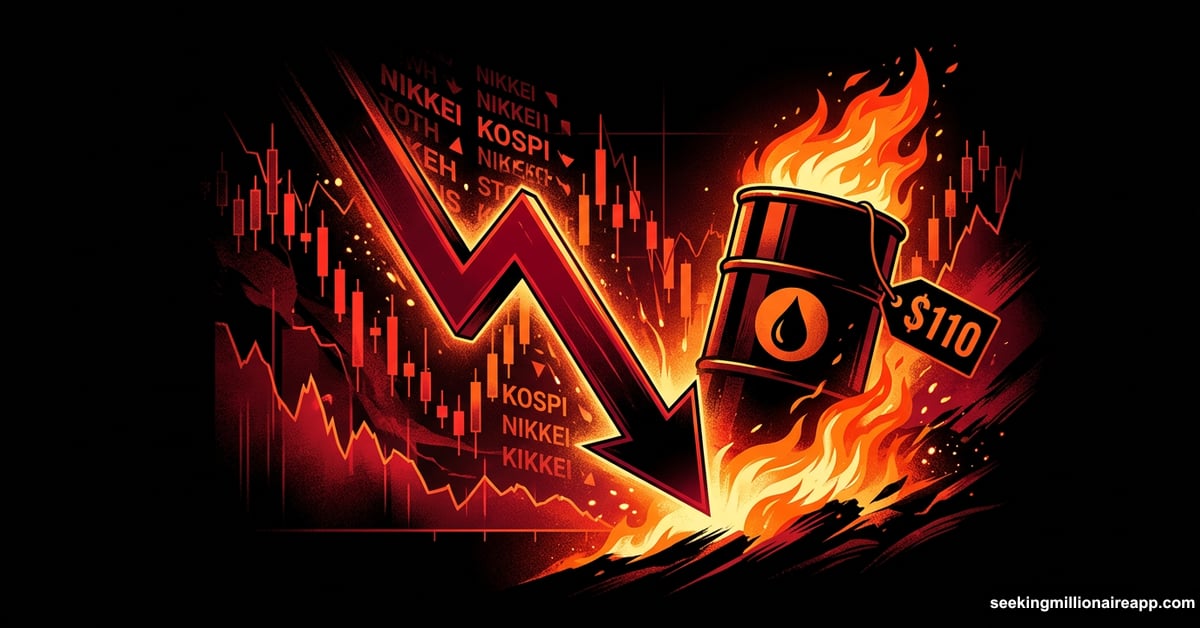
The war just got a lot more expensive for global markets.
Monday brought some of the steepest single-session losses Asian stock markets have seen in years. Oil blasted past $100 a barrel for the first time since 2022. And investors sprinted toward the dollar, leaving riskier assets — including crypto — behind.
This isn’t a panic sell driven by rumor. Markets are now pricing in something much more serious: a prolonged conflict with no clear end in sight.
Nikkei and Kospi Post Brutal Single-Day Drops
Japan’s Nikkei 225 plunged 6.2% to 52,166 in the opening minutes of trade. That’s one of its worst single-session performances in years. The broader Topix wasn’t spared either, falling 4.3%.
South Korea took an equally hard hit. The Kospi sank 6.3%, dragged down by two of its biggest names. Samsung Electronics and SK Hynix each dropped around 7%, hammering the tech-heavy index.
Australia’s S&P/ASX 200 fell 3.3%. And the pain didn’t stop there. S&P 500 futures dropped 1.6% before US markets even opened, with Nasdaq 100 futures falling as much as 2%. So American investors were already bracing for more trouble before their trading day began.
Oil Surges as the Strait of Hormuz Stays Shut
The fuel driving all of this? Oil. Literally.

WTI crude surged as high as $111 per barrel at the Asian open. Brent crude traded near $110. Both hit their highest levels since early 2022. The catalyst is clear: the Strait of Hormuz remains effectively closed, and Gulf producers have started curbing output as the conflict spreads.
For context, the Strait of Hormuz is one of the world’s most critical energy chokepoints. About 20% of global oil passes through it daily. So when that route shuts down, energy prices don’t just rise. They spike hard and fast.
The Geopolitical Picture Gets Darker
The conflict entered its ninth day Monday, and the situation escalated further over the weekend.
On Sunday, Iran pressed attacks on neighboring Gulf states. Qatar, Kuwait, and Bahrain all reported missile and drone strikes. The US ordered non-emergency embassy staff to leave Saudi Arabia — a significant diplomatic signal.
Then Monday brought a major development. Iran fired its first missiles toward Israel under newly appointed Supreme Leader Ayatollah Mojtaba Khamenei. US President Donald Trump responded by stating attacks would continue “until they surrender or, more likely, completely collapse.”
Analysts warn that current asset prices may not yet reflect the full scope of what’s unfolding. That’s a sobering thought given how sharp Monday’s moves already were.
Dollar Climbs. Gold Falls. Crypto Follows Risk Assets Down.
Safe-haven dynamics played out in textbook fashion — with one notable twist.
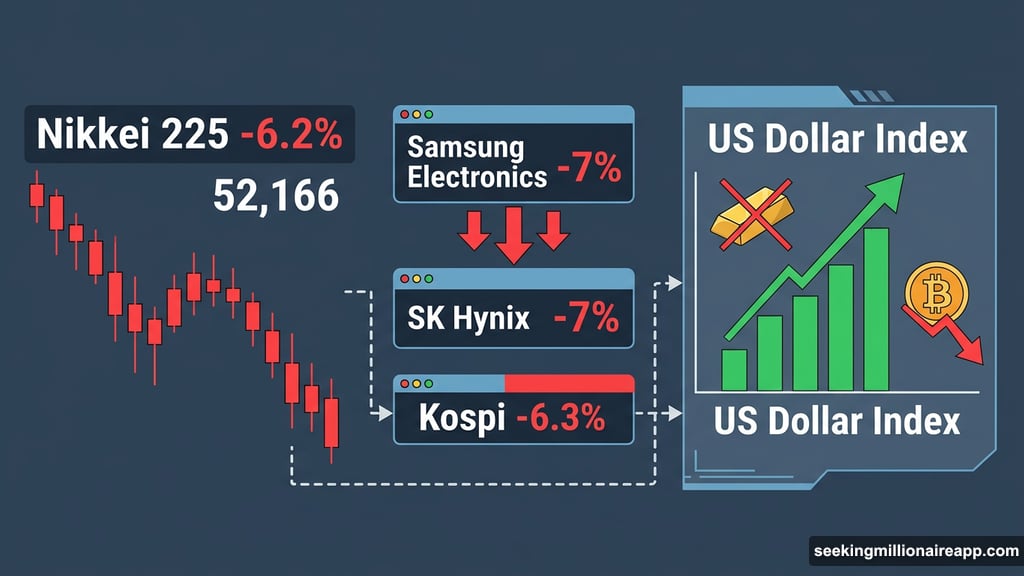
The US Dollar Index (DXY) rose 0.69% to 99.67, extending its rally as investors sought shelter from both inflation risk and prolonged energy disruption. The dollar’s position is uniquely strong here. The US holds safe-haven status and is actually a net energy exporter, meaning higher oil prices hurt it less than most other major economies.
Gold, surprisingly, fell 2.2% to $5,056 an ounce. Higher-for-longer interest rate expectations weighed on the non-yielding metal. The 10-year Treasury yield ticked up five basis points to 4.19%, adding further pressure.
Crypto tracked the broader risk-off move without much resistance. Bitcoin fell 1.4% to $66,249, while Ether dropped between 0.7% and 1.1% to around $1,945–$1,950. Neither asset found buyers looking for shelter. Instead, investors rotated into the dollar.
A Stagflation Warning Lurking in the Background
Here’s a piece of the picture that makes everything more complicated.
US nonfarm payrolls fell by 92,000 last month. That’s one of the largest single-month declines since the pandemic. Combined with surging oil prices driving inflation higher, the US economy now faces a genuine stagflation risk — slow growth and rising prices at the same time.
That’s an uncomfortable combination for policymakers. Rate cuts become harder to justify when inflation is climbing. But keeping rates high while the job market weakens creates its own set of problems.
So the macro backdrop was already fragile before oil hit $110. The conflict has now layered serious energy disruption on top of an economy showing clear cracks.
Markets have absorbed the first shock. The harder question is what week two, three, and beyond look like if there’s no resolution in sight. Analysts say the worst may not yet be in asset prices. That alone is reason to watch this situation closely in the days ahead.