
Last October, the crypto market had one of its worst days ever. Now Binance wants to make sure it never happens again.
The exchange just announced something called the Spot Price Range Execution Rule, or PRER. It’s a new protective mechanism designed to stop trades from filling at wildly abnormal prices. The rule starts rolling out on April 14, 2026, and it targets exactly the kind of chaos that played out on October 10, 2025.
The October Flash Crash Was Brutal
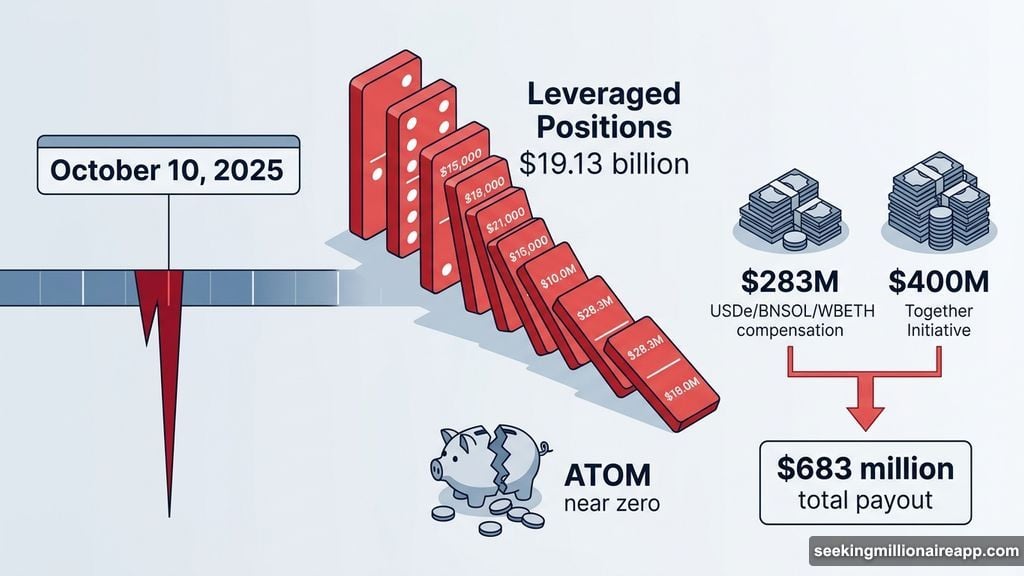
Here’s what happened. On October 10, 2025, President Trump announced 100% tariffs on Chinese imports. That single announcement triggered the largest single-day liquidation cascade in crypto history.
Over $19.13 billion in leveraged positions got wiped out in just 24 hours. More than 1.6 million traders were affected. And on Binance specifically, coins like Cosmos (ATOM) briefly traded near zero as margin collateral got dumped all at once.
Part of what made it so devastating? Stale limit orders. Some of these orders had been sitting on the books for years. When liquidity dried up completely, those old orders filled against one-sided markets at extreme, nonsensical prices.
Binance ended up paying $283 million to compensate users affected by the de-pegging of USDe, BNSOL, and WBETH. Then came a separate $400 million “Together Initiative” to cover forced liquidation losses. Total bill? $683 million. That’s a very expensive lesson in market structure.
How PRER Actually Works
Think of PRER like a guardrail on a mountain road. The guardrail doesn’t stop you from driving fast. But it does stop you from flying off a cliff.
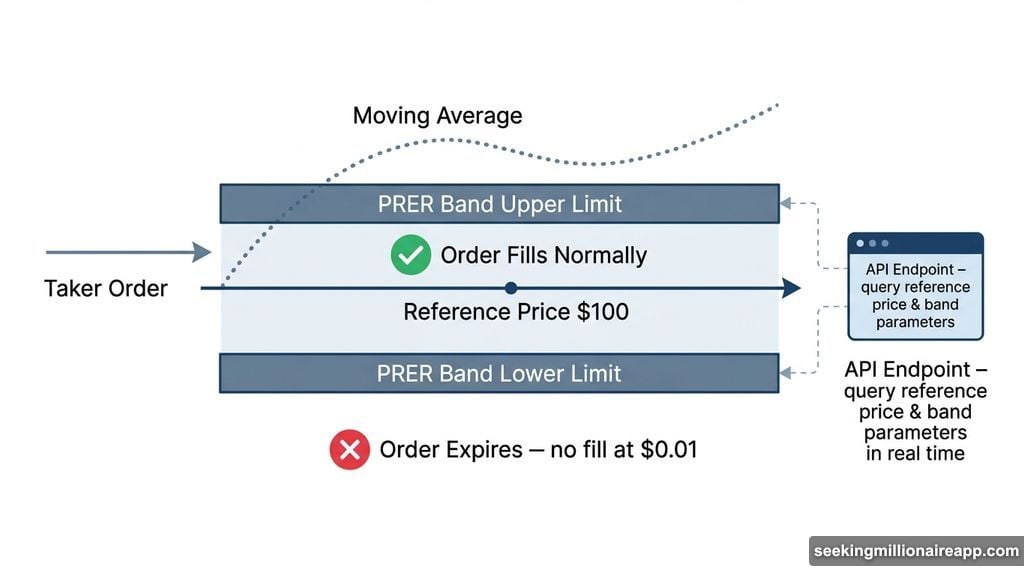
Here’s the basic idea. PRER constantly calculates a dynamic reference price for each trading pair using a moving average of recent trades. Then it sets a configurable band above and below that reference price. If a taker order would fill outside that band, the unfilled portion simply expires instead of executing at a crazy price.
So if something is trading around $100 and a liquidity gap suddenly pushes the execution price to $0.01, PRER steps in. The order doesn’t fill at that nightmare price. It just cancels cleanly.
Maker orders sitting on the order book stay completely unaffected. Under normal market conditions, Binance says traders won’t notice any difference in their daily activity. The rule only kicks in when prices go truly haywire.
Also worth noting for anyone using the API. Binance is adding dedicated endpoints where you can query reference prices and band parameters in real time. That’s a nice touch for algorithmic traders who want to build PRER awareness into their systems.
Rolling Out Pair by Pair
Binance isn’t flipping this switch all at once. Instead, PRER activates on a pair-by-pair basis starting April 14. New trading pairs won’t get PRER coverage immediately either. They need to build up enough trading history first so the system can calculate a reliable reference price.
That’s a sensible approach. A reference price built from a handful of trades isn’t very useful. But one calculated from weeks or months of consistent activity gives the algorithm something solid to work with.
If you have open orders on Binance, now is a good time to review your strategies before April 14 arrives. Especially if you’re running automated systems or orders you set up a while back and maybe forgot about.
This Helps, But It’s Not a Complete Fix
PRER is a smart, targeted response to a real problem. Stale orders filling at absurd prices during a liquidity crisis? That’s exactly the kind of preventable damage this rule addresses.
But it’s worth being clear about what PRER doesn’t do. It won’t stop crypto from being volatile. It won’t protect you from bad trades at prices that are merely unfavorable rather than catastrophically broken. And it definitely won’t shield leveraged positions from the broader risks that come with trading on margin in a notoriously wild asset class.
The October crash happened because of a combination of extreme market conditions, leverage, and structural gaps in how orders were handled. PRER patches one of those gaps. The others still exist.
Still, $683 million in compensation later, Binance clearly decided that doing nothing wasn’t an option. And honestly, a rule that quietly expires orders instead of letting them fill at near-zero prices sounds like exactly the kind of boring, sensible infrastructure that crypto markets have desperately needed.