
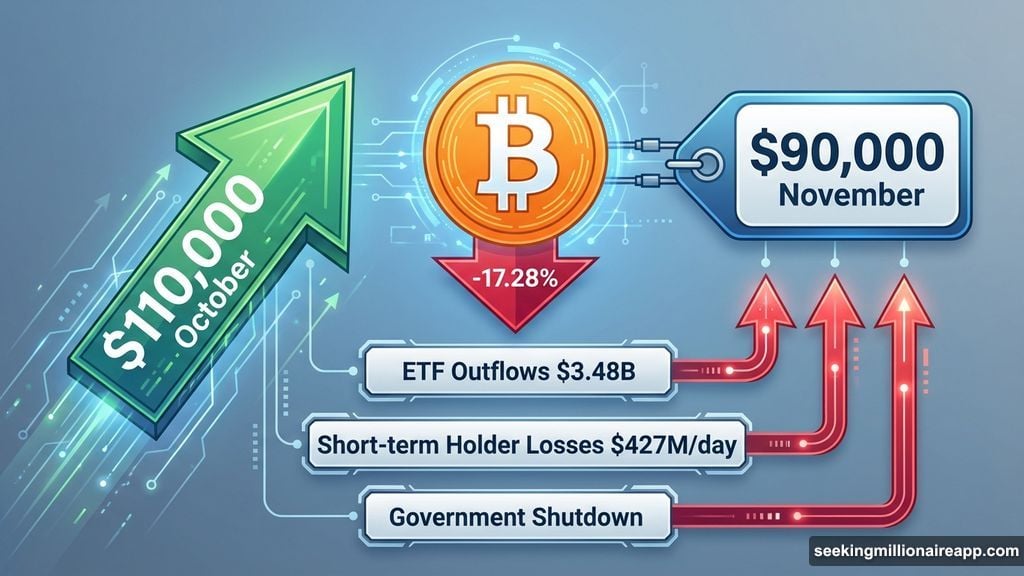
Bitcoin wrapped up November with a brutal 17.28% loss. That makes it the second-worst month this year, trailing only February’s 17.39% decline.
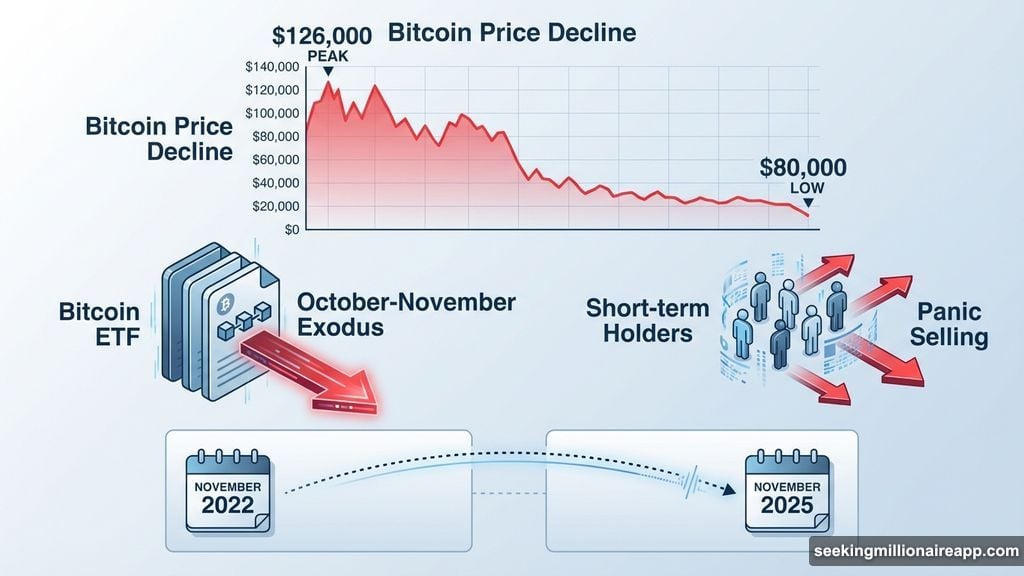
For context, November also marks Bitcoin’s steepest drop in that month since 2022. Back then, BTC shed 16.23% amid the FTX collapse. This time, the damage came from a different set of pressures.
The month started with promise. Bitcoin opened near $110,000 after hitting a record high of $126,000 in October. But that momentum evaporated fast. By mid-November, the asset briefly touched a seven-month low under $80,000 before climbing back above $90,000.
So what triggered this mess? Three major forces converged at once.
Institutional Money Walked Away
Bitcoin ETFs bled $3.48 billion in November. That’s the second-largest monthly outflow since these products launched in 2024, according to SoSo Value data.
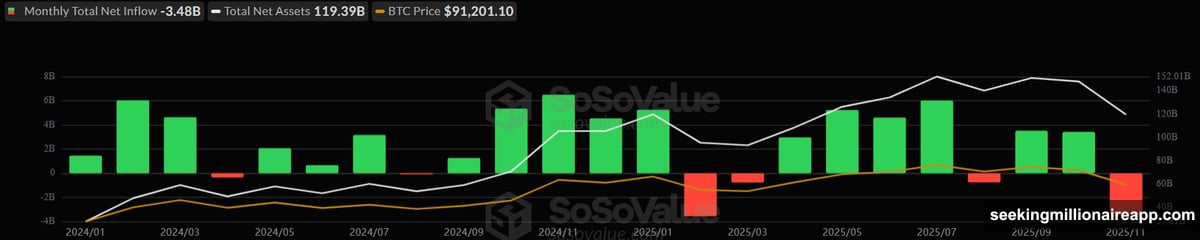
The exodus began quietly in late October. Then it accelerated throughout November as market conditions deteriorated. These ETFs had been a reliable demand driver for months. When that support disappeared, Bitcoin felt the impact immediately.
Plus, the timing couldn’t have been worse. Traditional markets were already tightening up due to a record US government shutdown. That combination squeezed liquidity across all risk assets, including crypto.
Short-Term Holders Panicked Hard
Panic selling dominated the month. Glassnode data shows short-term holder losses hit $427 million per day on a seven-day average. That’s the highest level recorded since November 2022.
This wasn’t gradual distribution. Instead, newer investors dumped holdings reactively as prices fell. The selling pressure mirrored the capitulation seen at the previous two major cycle lows.
Moreover, these losses exceeded typical correction levels. Short-term holders who bought near recent highs faced steep unrealized losses. Many chose to exit rather than wait for recovery.
The data reveals a clear pattern. When BTC dropped below $90,000, panic intensified. Each leg down triggered more reactive selling, creating a feedback loop that pushed prices even lower.
Macro Conditions Made Everything Worse
The macroeconomic backdrop amplified Bitcoin’s struggles. Donald Trump expanded tariffs on China on October 10. Global markets immediately reassessed risk exposure.
That volatility carried straight into November. Bitcoin had already shed about $20 billion in market value during October’s chaos. The uncertainty never fully cleared.
Then the US government shutdown hit. Liquidity dried up across traditional markets. When that happens, risk assets suffer first and hardest. Bitcoin was no exception.
The combination of trade tensions and reduced liquidity created a hostile environment for speculative assets. Institutional investors pulled back. Retail traders grew cautious. Meanwhile, the ETF outflows reflected this broader shift in sentiment.
Recovery Looks Fragile
Bitcoin closed November around $90,773. That’s a recovery from the sub-$80,000 lows, but far from the $110,000 levels seen at the start of the month.
The rebound suggests some buying interest returned as prices fell. However, the structural pressures that drove November’s decline haven’t fully resolved. ETF flows remain weak. Short-term holder confidence stays shaken. Macro uncertainty persists.
December will test whether this recovery has legs or if the selling pressure returns. Market stress can fade quickly or linger for months. Right now, Bitcoin sits in an uncomfortable middle ground.
One thing’s certain. November’s 17.28% drop ranks among the worst monthly performances in Bitcoin’s 2025 trading history. Only February was worse. That tells you something about how intense this selloff became.
The question now is whether Bitcoin can rebuild momentum or if more pain lies ahead. The answer depends on institutional flows returning, short-term holders stabilizing, and macro conditions improving. None of those are guaranteed.