
The crypto market has had a rough 2026. But one major Wall Street voice thinks the worst might finally be behind us.
Jan van Eck, CEO of asset management giant VanEck, went on CNBC’s Power Lunch recently and made a clear-eyed case that Bitcoin is forming a market bottom. His reasoning? The same two things that have always driven Bitcoin’s price story: its hard-coded 21 million supply cap and the four-year halving cycle.
So what does that actually mean for investors watching from the sidelines right now?
The Four-Year Cycle Is Doing Its Thing Again
Van Eck didn’t mince words on CNBC. “There’s been an investing cycle,” he said. “Bitcoin goes up three years in a row, goes down pretty massively in that fourth year. 2026 is that fourth year.”
He leads a $181.4 billion asset management firm, so this isn’t casual speculation. His view is grounded in Bitcoin’s structural mechanics. The halving cuts miner rewards in half roughly every four years, tightening supply. Historically, that supply shock has driven a predictable boom-and-bust rhythm across multiple cycles.
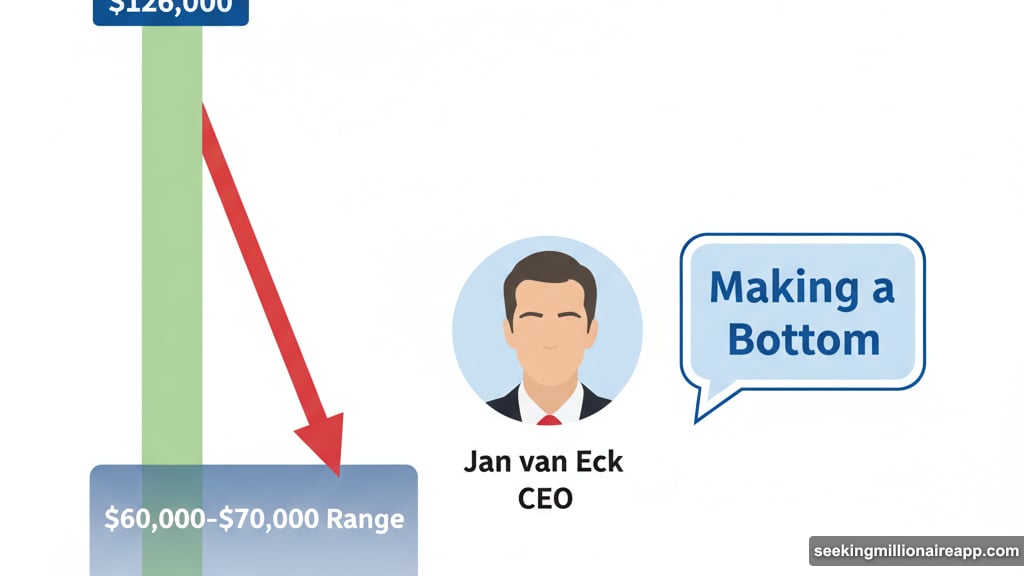
And 2026 fits the pattern. Bitcoin pulled back sharply from its peak of around $126,000 into the $60,000–$70,000 range. Research firm Kaiko noted that this drawdown aligns closely with corrections seen during previous bear phases, and that the timing falls squarely within the historical window for cycle peaks. That window typically runs 12 to 18 months after a halving event.
Van Eck’s conclusion? “Now I think we are making a bottom.”
When Does the Bottom Actually Arrive?
Here’s where things get more nuanced. Calling a bottom and timing a bottom are two very different things.
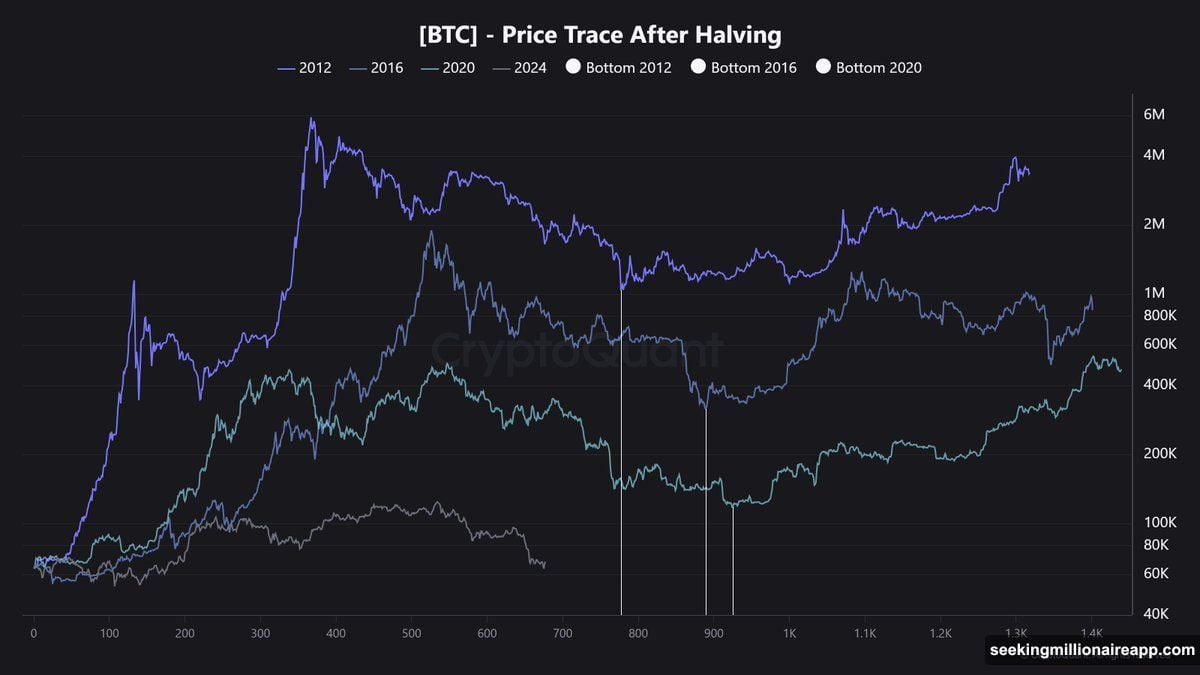
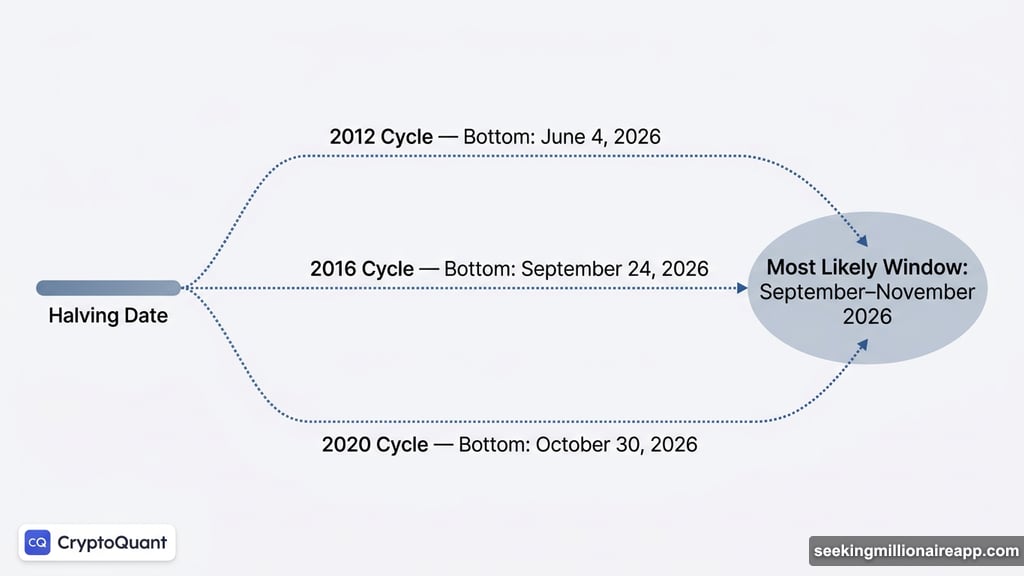
CryptoQuant ran a detailed comparison of Bitcoin’s current cycle against three prior ones, each traced from their respective halving dates. The results pointed to a bottom somewhere between June and December 2026, with September through November being the most likely window.
Their analysis mapped it out like this:
- Tracing the 2012 cycle structure: bottom around June 4, 2026
- Tracing the 2016 cycle structure: bottom around September 24, 2026
- Tracing the 2020 cycle structure: bottom around October 30, 2026
CryptoQuant was also careful to note that market bottoms don’t happen overnight. They take time to form, often featuring several failed recovery rallies before prices stabilize for real. That’s an important warning for anyone trying to call the exact turn.
Bitwise CIO Matt Hougan added another voice to the “forming a bottom” camp, pointing to the four-year cycle as one of three key forces that pushed holders to reduce exposure this year. Like van Eck, he believes a bottom is taking shape.
Not Everyone Agrees on the Cycle Theory
The four-year halving narrative is compelling. But a meaningful chunk of analysts think it’s losing its grip on Bitcoin’s price action.
Their argument? Bitcoin has grown up. Institutional capital, exchange-traded funds, and global liquidity conditions now drive price far more than mining reward mechanics. When the Federal Reserve tightens, Bitcoin falls. When global liquidity expands, Bitcoin rallies. That correlation, they say, has become more reliable than any halving schedule.
It’s a fair debate. Both forces are probably real. The question is which one dominates in any given cycle, and right now that’s genuinely unclear.
For investors trying to navigate 2026’s choppy waters, the disagreement matters. If the halving cycle is still in charge, a bottom between now and November makes intuitive sense. But if macro liquidity calls the shots, Bitcoin’s recovery timeline depends more on central bank policy than on miner reward schedules.
Where Bitcoin Stands Right Now
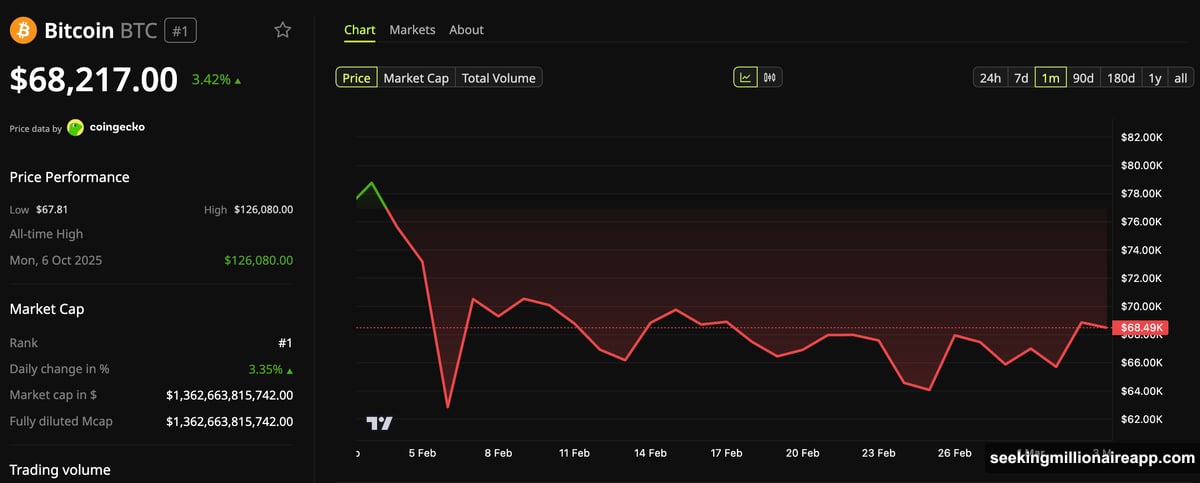
At the time of writing, Bitcoin was trading at $68,217, up 3.4% over the previous day. That modest recovery came alongside rising geopolitical tensions, which have historically pushed some investors toward hard assets.
It’s not a breakout. But it suggests the selling pressure may be easing.
The setup van Eck describes is consistent with what long-time Bitcoin observers have seen before: a brutal fourth year that shakes out weak hands, followed by a slow accumulation phase that most people miss while waiting for certainty that never comes.
Whether September or November ends up marking the exact low, the broader thesis from VanEck and CryptoQuant is worth taking seriously. Cycle history, institutional positioning, and the structural mechanics of Bitcoin’s supply all point in the same direction right now.
The bottom may not be a single moment. It may be a window. And according to the data, that window is opening.