
Bitcoin never moves in a straight line. It surges, corrects, and surges again, sometimes all within the same cycle. That makes timing incredibly hard for most traders.
Geoff Kendrick, Global Head of Digital Asset Research at Standard Chartered, put it plainly in a BeInCrypto Expert Council discussion. He said dips below $60,000 look attractive as buying opportunities. But he also warned Bitcoin could slide toward $50,000 before any real recovery begins. That’s a $10,000 range of uncertainty. For traders, that kind of ambiguity is brutal.
So how do you actually know when to buy? AI trading bots are stepping in to answer that question, not by predicting bottoms, but by waiting for the market to show its hand first.
Note: This analysis covers BeInCrypto’s Accumulation Cycle bot for educational purposes. It does not constitute financial advice. Always conduct your own research before making any trading decisions.
How the Accumulation Cycle Bot Spots Real Strength
BeInCrypto built its own AI trading bot called Accumulation Cycle, written in Pine Script for TradingView. The core idea is refreshingly simple: stop guessing where the bottom is, and wait for confirmation that buying strength has actually returned.
The bot combines two standard technical tools with proprietary logic. First, the Exponential Moving Average (EMA), which shows the overall trend direction. Second, the Relative Strength Index (RSI), which measures buying momentum.
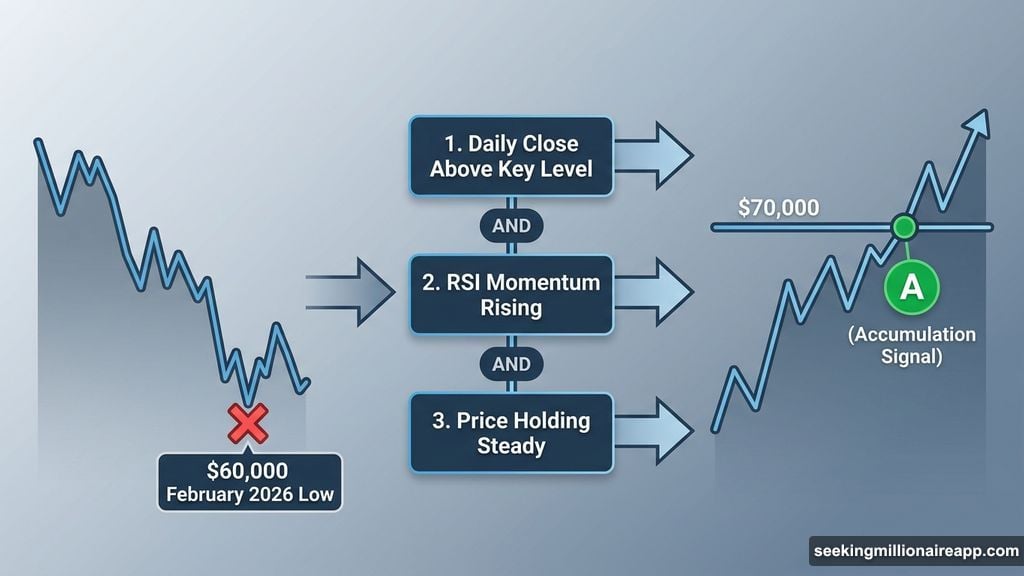
Three conditions must all line up before the bot fires a signal. Bitcoin’s price must close above a key level on the daily chart. Momentum must start rising, not just stabilize. And the price must hold steady rather than breaking lower again. Only when all three align does an accumulation signal, marked as “A,” actually appear.
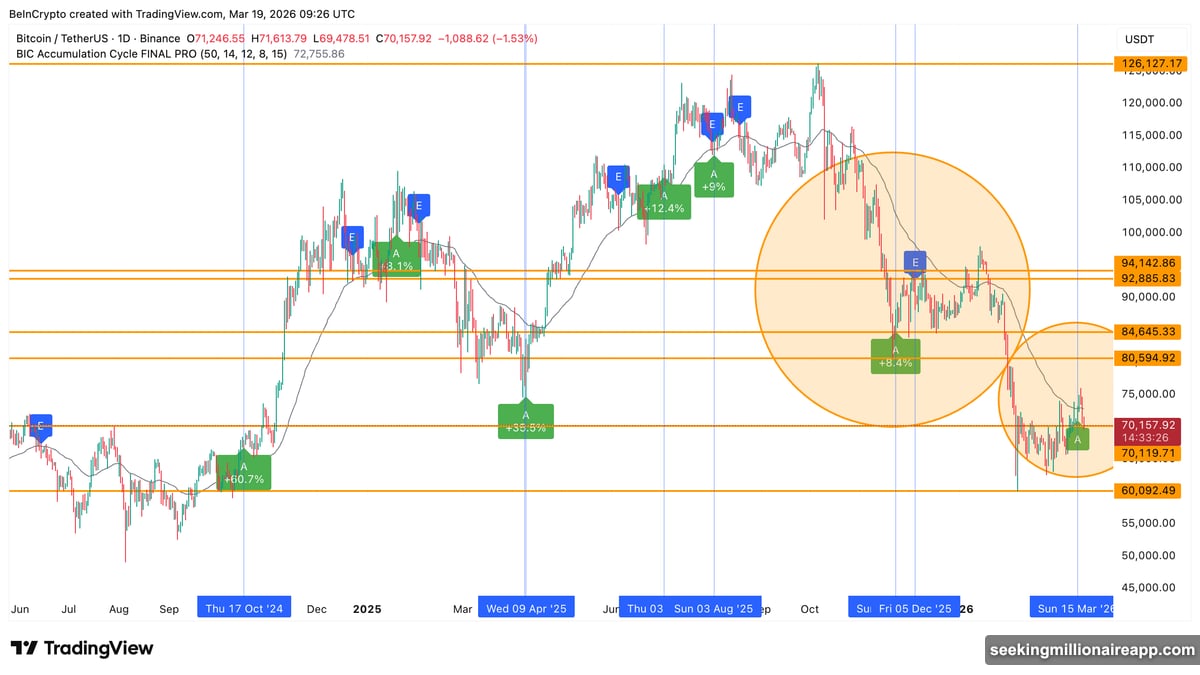
This is why the February 2026 low near $60,000 generated no signal at all. The market was still weak. Selling pressure remained active. The bot stayed silent and waited.
Why $70,000, Not $60,000, Was the Real Entry Signal
The bot’s first signal in the current cycle appeared in mid-March 2026, after Bitcoin reclaimed the $70,000 level with a confirmed daily close. That was the first genuine sign of strength returning to the market.
The same logic played out in November 2025. Bitcoin bottomed near $80,500, but the model ignored it completely. The signal only triggered after the price reclaimed $84,600 on a daily close. From there, Bitcoin moved toward $92,800, where the bot marked cycle end with an “E” signal, capturing roughly an 8% move. It missed the exact top near $94,100, but that’s by design.
Most of the bot’s signals land in the 8% to 12% return range. Those are the moves that tend to be stable and sustainable, not the speculative spikes that reverse quickly.
The Bigger Wins This Bot Has Already Captured
Looking back further makes the track record clearer. In October 2024, the bot caught a move of around 60%. In April 2025, it identified an accumulation phase that led to a 35% rally. Both signals came with confirmed entries and clean exits.
More recent cycles, including the November 2025 and early 2026 setups, delivered the more modest 8% to 12% returns mentioned above. The current accumulation signal, triggered in mid-March after the $70,000 reclaim, remains active. No exit signal has appeared yet, so the cycle is technically still open.
On-Chain Data Backs Up the Bot’s Logic
Technical signals alone tell only part of the story. On-chain data from Glassnode adds an important layer of confirmation, specifically the Long-Term Holder Net Position Change metric. This tracks the buying and selling behavior of Bitcoin holders who have held for 365 days or more.
During the November 2025 cycle, long-term holder selling peaked near 75,000 BTC. But selling pressure started easing before the bot’s accumulation signal even appeared. The signal flashed on November 23. The cycle ended around December 5. During that window, long-term holders were quietly reducing their selling, a bullish confirmation that matched the bot’s technical read.
Shortly after the exit signal, long-term holder activity briefly turned positive before selling picked back up again. The timing aligned almost perfectly with the model’s logic.
In the current cycle, the long-term holder net position change has turned positive and is rising, even as price has pulled back. That’s why no exit signal has appeared yet. The holders are still accumulating, and the bot is still holding its signal open.
Setting Up TradingView Alerts for This Bot
Using the bot in real time is straightforward on TradingView. Search for the indicator called BIC Accumulation Cycle Final Pro and add it to your chart. Then create two separate alerts.
The first alert should trigger on the Accumulation Start signal (A), which marks your potential entry zone. The second should trigger on the Accumulation End signal (E), which marks your potential exit zone. Set both alerts to fire “once per bar close” so signals only confirm on completed candles, not mid-bar noise.
Set your alert expiry at least one to three months out, and extend it as needed. Notifications can come through the TradingView app, email, or audio alerts depending on your preference.
What This Means for Bitcoin’s Next Move
If Kendrick’s scenario plays out and Bitcoin oscillates between $50,000 and $100,000, the path won’t be clean. Expect multiple swings. Bitcoin could rally from $60,000 to $75,000, pull back sharply, and still be in the same broader bullish cycle.
That’s exactly where a bot like this earns its value. Instead of holding through the entire volatile round trip and giving back gains, traders can identify where strength begins and where it starts fading. Acting within individual swings rather than sitting through every dip makes a meaningful difference over time.
Bottoms are almost impossible to call with confidence. Strength, on the other hand, is measurable. And that’s what this kind of AI-powered approach tracks.