
Something quietly shifted in the Bitcoin derivatives market. And if you know what to look for, it’s actually pretty telling.
Bitcoin’s Estimated Leverage Ratio (ELR) on Binance dropped from 0.198 to 0.152 since February. That’s not a minor fluctuation. It’s a meaningful reset that analysts say signals a broader deleveraging across the entire futures market.
So what does that mean for regular people watching Bitcoin’s price? A lot, actually. Let’s break it down.
What the Estimated Leverage Ratio Measures
Think of the ELR like a stress test for the derivatives market. It compares total futures open interest to the amount of Bitcoin held on exchanges. The higher the number, the more borrowed capital traders are using to place bets on price direction.
When that ratio drops sharply, it means traders are pulling back. Either they’re voluntarily closing leveraged positions, or they’re getting liquidated and forced out. Both outcomes shrink the ratio fast.
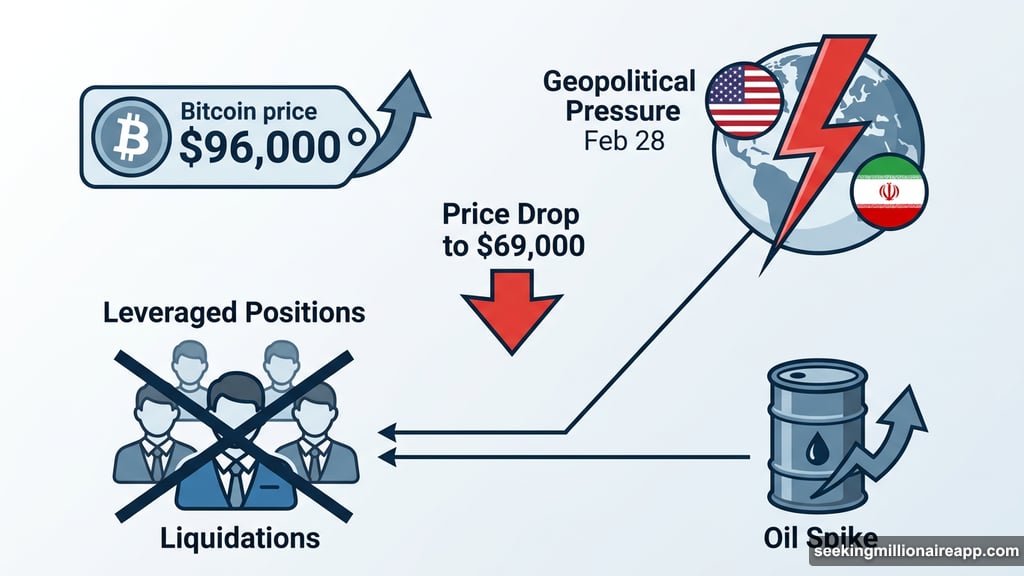
CryptoQuant analyst Darkfost flagged this shift and noted that drops of this scale usually follow intense volatility and large price swings. In this case, Bitcoin fell from roughly $96,000 to about $69,000 during the same period. That kind of move creates real fear among leveraged traders.
Geopolitical Pressure Is Driving Risk-Off Behavior
The timing matters here. Rising tensions between the United States and Iran, following joint US-Israeli strikes on February 28, rattled global markets. Oil prices spiked. Risk assets faced fresh volatility. Investors across markets moved into a more defensive stance.
Bitcoin traders responded the same way. When the macro environment turns uncertain, traders tend to reduce exposure to borrowed capital. The ELR data reflects exactly that kind of behavior shift.
As Darkfost put it, this process leads to a “sharp decline in Open Interest and reflects a broader deleveraging across the derivatives market.” That sounds technical, but the practical meaning is straightforward. Fewer people are gambling with borrowed money on Bitcoin’s next move.

Why Deleveraging Can Actually Be Healthy
Here’s something that surprises a lot of people. A falling leverage ratio isn’t necessarily bad news for Bitcoin’s long-term price.
When leverage is high, price swings get amplified. One sharp move in either direction can trigger a cascade of liquidations, which creates even bigger price swings. It’s a feedback loop that makes markets unstable and unpredictable.
When leverage drops, that feedback loop weakens. Price movements start reflecting genuine buying and selling rather than forced liquidations. Markets become more stable. And stability creates a better foundation for the next directional move.
Darkfost described this as the market resetting on “healthier foundations.” That framing is worth taking seriously.
![Bitcoin Estimated Leverage Ratio chart showing decline from 0.198 to 0.152 on Binance, with futures open interest data from CryptoQuant]
Bitcoin Reserves on Derivative Exchanges Are Also Shrinking
The deleveraging story goes deeper than just the ELR. Bitcoin reserves on derivative exchanges have also fallen to their lowest level since late January 2026. That reinforces the same trend from a different angle.
When traders move Bitcoin off derivative exchanges, it signals a preference for spot holdings or self-custody. Both are more conservative approaches. Neither involves borrowed capital or amplified risk.
Lower reserves also limit the immediate capacity to open new leveraged positions. So even if sentiment flips bullish quickly, the infrastructure for a rapid leverage rebuild isn’t fully in place yet. That’s a natural brake on speculative excess.
Whale Accumulation Adds an Optimistic Layer
Not everything in the data points to caution. On-chain analyst CW89 shared data on X showing that large Bitcoin holders, often called whales, are rebuilding their positions. These are the same wallets that sold during the correction from $123,000 down to $86,000.
Now they’re buying again.
That combination of signals is interesting. Reduced leverage, shrinking derivative reserves, and whale accumulation happening at the same time suggests the market is transitioning, not collapsing. The smart money appears to be positioning, not panicking.
What Needs to Happen Next for a Real Rally
Here’s the honest caveat. All of this structural improvement only translates into a sustained price rally if spot demand shows up at scale.
Darkfost made this point clearly. If the ELR stays low while Bitcoin consolidates, it may indicate that the spot market is taking over as the main driver of price action. Spot-driven markets are healthier and more sustainable than leverage-driven ones. But spot demand has to actually materialize.
At the time of reporting, Bitcoin was trading at $71,064, up over 4% in 24 hours. Some of that recovery came after comments from President Trump eased immediate selling pressure in crypto markets. Whether that momentum holds depends on whether genuine buyers step in at these levels.
Reading the Signals Without Getting Carried Away
The data paints a nuanced picture. Bitcoin’s leverage reset is real and meaningful. Whale accumulation is a positive signal. Derivative reserves shrinking suggests traders are moving toward more conservative positions.
But none of these signals guarantee a price surge. They suggest the market is clearing out excess risk and potentially building a more stable base. That’s a necessary precondition for the next leg up. It isn’t the same thing as a confirmation that the next leg up is coming.
Watch the ELR closely over the next few weeks. If it starts rising again while Bitcoin’s price climbs, it will suggest leverage is being reintroduced into an already-moving market. That’s a very different setup than what we’re seeing right now.
The structure is improving. The rest depends on whether real demand follows.