Bitcoin dropped nearly 15% in February. Now everyone’s wondering if March brings the rebound.
Honestly? Not so fast. Three separate on-chain signals suggest the market is getting closer to a bottom, but hasn’t quite reached it yet. Here’s what experienced analysts are watching — and why rushing in right now could still cost you.
Bitcoin’s Sharpe Ratio Hits Cycle Lows
Data from Alphractal shows Bitcoin’s Sharpe Ratio has fallen to levels last seen at the bottom of previous market cycles. If you’re not familiar with the Sharpe Ratio, think of it as a scorecard for risk versus reward. A lower number means you’re getting less return for the risk you’re taking on.
So when the Sharpe Ratio drops to cycle-bottom territory, it signals that buying conditions are improving relative to earlier in the cycle. That’s the good news.
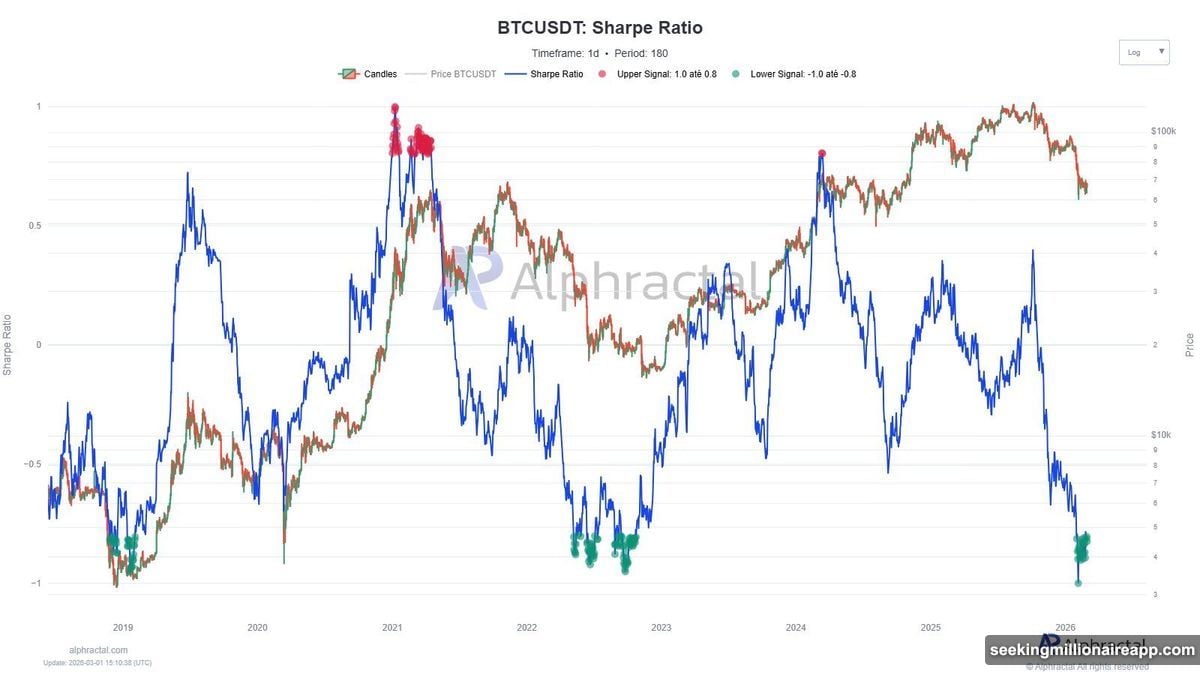
But here’s the catch. In both 2019 and 2020, this indicator stayed at low levels for a while before recovering. It didn’t snap back immediately.
Joao Wedson, founder of Alphractal, put it plainly: “Buying BTC now means you are purchasing with moderate risk, yet still at a better level than most people who bought over the past six months.”
His advice? Wait for the annual Sharpe Ratio signal to appear at least five to seven times on the chart before acting. During that waiting period, Bitcoin could fall further — potentially into the $48,000 to $52,000 range. Wedson considers this a realistic bearish scenario, and also an excellent accumulation opportunity if it plays out.
Unrealized Loss Ratio Signals Incomplete Capitulation
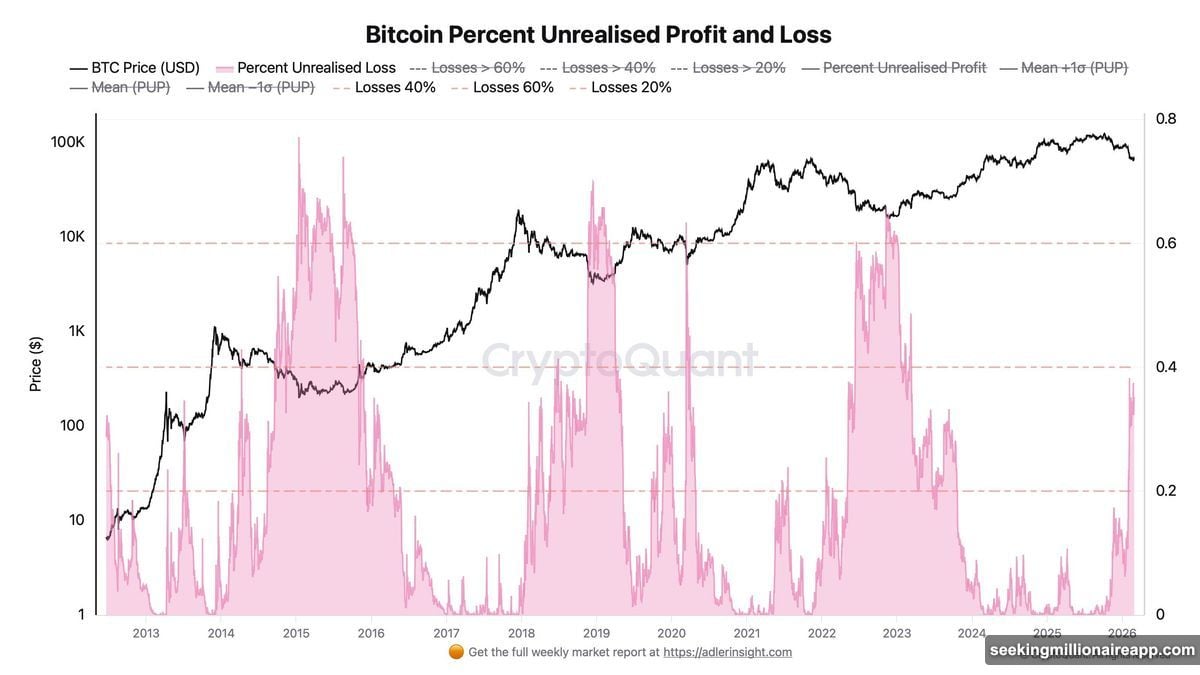
Analyst Axel Adler Jr from CryptoQuant adds important context. Bitcoin’s Unrealized Loss ratio has now exceeded 39%. In plain terms, most investors holding Bitcoin right now are sitting on losses.
That sounds bad — and for those investors, it is. But from a market structure standpoint, rising unrealized losses often precede a bottom.
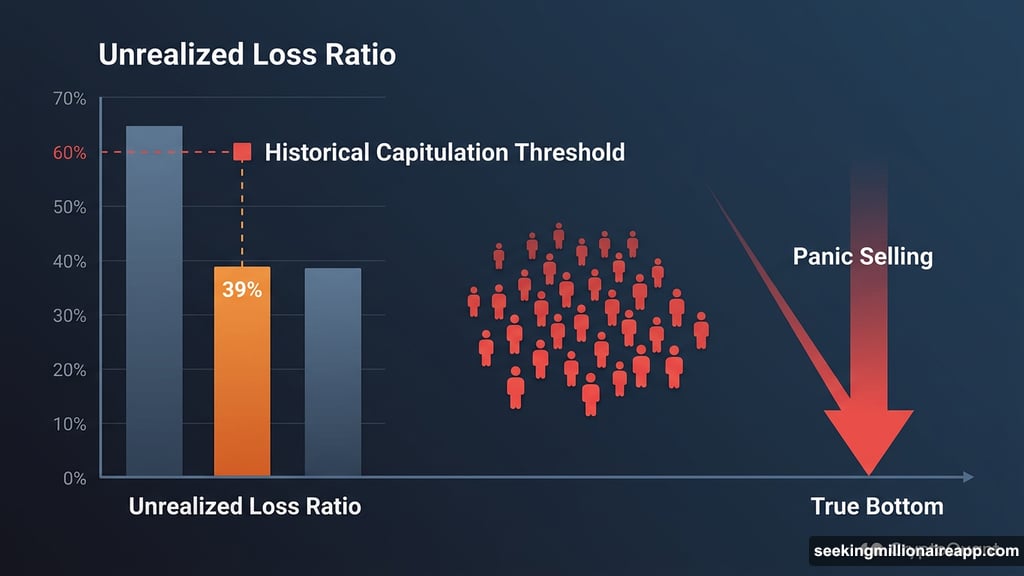
However, Adler is clear that we’re not there yet. “There is still room before a full-scale capitulation stage,” he said.
The historical data backs this up. In previous cycles, this ratio climbed past 60% before Bitcoin truly bottomed. At 39%, there’s meaningful room for more pain. More investors could fall into deeper losses and sell in panic before the real bottom forms. That panic selling is precisely what tends to mark the final flush before a recovery begins.
Exchange Whale Ratio Reaches All-Time High
Meanwhile, analyst CW highlighted a striking development: the Bitcoin whale ratio on exchanges has hit an all-time high. This tells us something important about who’s left in the market.
The recent decline pushed retail investors to the sidelines. The people still actively participating are the larger, more sophisticated players — the whales. CW noted the whale ratio now sits near its September 2024 level, right before Bitcoin staged a strong rally from those levels.
Historically, a sharp spike in the whale ratio suggests price is approaching a bottom. Whales tend to accumulate when retail investors are too scared or too wiped out to compete. That dynamic can set up the conditions for the next upward move.
Why March Still Looks Tricky for Retail Investors
So the three signals together — a depressed Sharpe Ratio, rising unrealized losses approaching (but not yet at) capitulation territory, and dominant whale activity — all point toward a potential bottom forming in March.
But potential isn’t the same as confirmed.
The geopolitical picture is making things messier. Escalating tensions involving the United States, Israel, and Iran are injecting extra volatility into markets that already have plenty. Macro shocks can delay or distort normal market cycle patterns, making timing even harder than usual.
For retail investors especially, this environment is punishing. Whales have deep pockets and can wait. Most individual investors are working with tighter capital and tighter nerves.
The signals are encouraging for patient buyers who can stomach more downside. But if you’re thinking about jumping in expecting an immediate recovery because February hurt, the data suggests waiting might serve you better. The $48,000 to $52,000 range could still come before the real bounce does. Staying patient here isn’t weakness — it’s exactly what the cycle data recommends.