Web3 developers are discovering something unsettling. The code they spent months writing? AI can now generate it in hours.
This isn’t theoretical. It’s happening right now. And it fundamentally changes what makes crypto projects succeed or fail.
AI Just Killed the Engineering Moat
Former OpenAI co-founder Andrej Karpathy calls it “vibe coding.” You describe what you want in plain English. AI writes production-ready code. No keyboard required.
Collins Dictionary named it Word of the Year for 2025. That tells you how fast this shift happened.
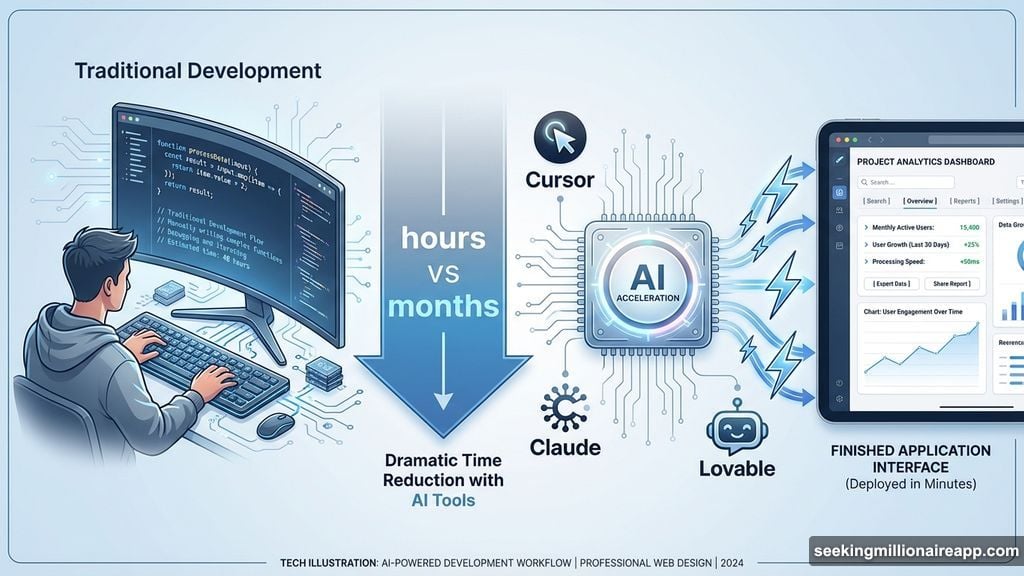
Tools like Cursor, Claude, and Lovable turn ideas into working applications almost instantly. Web3 investor Simon Kim built an Ethereum valuation dashboard with 12 different models in four hours. He also created a tourism prototype for Abu Dhabi during a single flight.
Previously, both projects would’ve taken weeks and required multiple developers. Now one person can ship them before lunch.
The numbers back this up. At Y Combinator’s Winter 2025 batch, 25% of startups had codebases that were over 95% AI-generated. Lovable, a natural-language app builder launched in 2024, hit $100 million in annual revenue within eight months. It raised $330 million at a $6.6 billion valuation in late 2025.
“You don’t need teams of 50 or 100 engineers anymore,” Kim explained, quoting YC CEO Garry Tan. “You can raise less capital and make it last much longer.”
Web3 Was Already Built for This
Blockchain infrastructure lets small teams operate globally without traditional middleware. So vibe coding hits crypto harder and faster than other sectors.
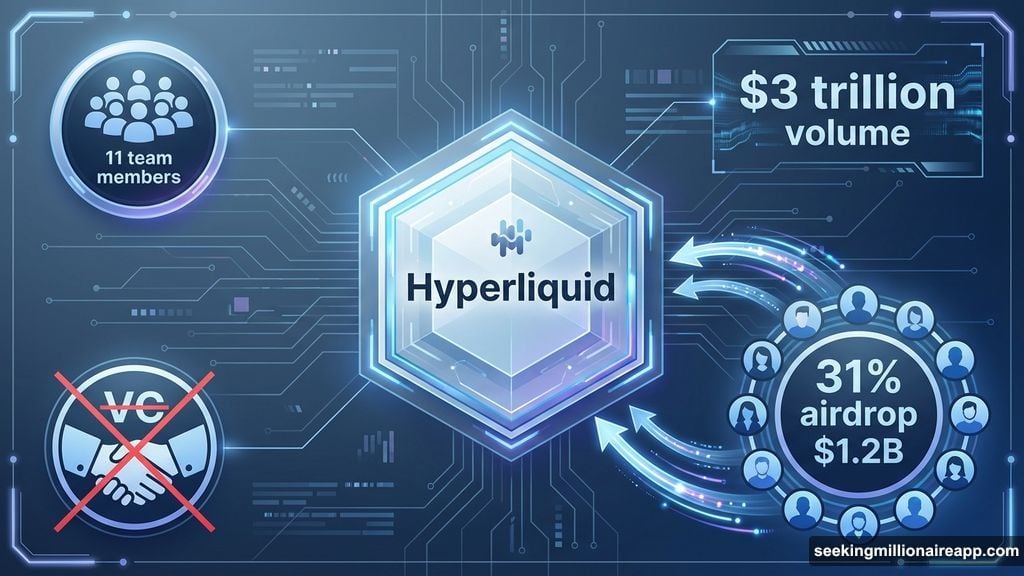
Take Hyperliquid. The decentralized derivatives exchange runs with just 11 core team members. Yet in 2025, it processed roughly $3 trillion in trading volume and generated an estimated $844 million in revenue.
Hyperliquid raised zero venture capital. They ignored every VC pitch. Instead, they built efficiently, distributed tokens widely through a 31% airdrop worth $1.2 billion at genesis, and let the product speak for itself.
That’s the new template. Replace bloated infrastructure with smart contracts. Use AI to accelerate development. Focus your human energy on what actually differentiates you.
Because here’s the hard truth: code no longer differentiates anyone.
What Actually Can’t Be Copied
If AI can write your code, competitors can clone your features within weeks. Technical advantages evaporate almost immediately.
So what’s left? Community. Culture. Trust. Distribution networks.
“Technology can be forked, but culture cannot,” Kim noted. Web3 learned this lesson years ago, long before AI made it universal.
Crypto winners rarely dominate because they wrote better code. They win because they built stronger communities, created better memes, and earned deeper trust. That’s why projects with mediocre tech sometimes outperform technically superior alternatives.
Now that dynamic applies everywhere. As execution becomes commoditized, defensibility shifts entirely to relationships and reputation.
CryptoQuant CEO Ki Young Ju argues crypto natives should embrace vibe coding immediately. “We’re shifting from the age of execution to the age of imagination,” he wrote. “People who’ve been in crypto long enough tend to be visionaries.”
Venture Capital Loses Its Grip
This shift hits VCs hard. If solo founders can build and validate products independently, capital stops being the primary constraint.
Distribution becomes scarce instead. So do trust, credibility, and access to networks.
“VCs must evolve into super connectors,” Kim argued. They need to offer global introductions, credibility, and dense peer networks rather than slow fundraising processes and generic advice.
That’s a fundamental shift in power dynamics. Capital used to buy time and talent. Now it buys introductions and reputation. Very different value proposition.
Plus, founders can self-fund longer. Lower development costs mean less dilution. Projects like Hyperliquid prove you can scale massively without ever taking VC money.
Solo Founders Scale Like Never Before
Builders are already demonstrating what’s possible. Developer IBuyRugs claims you can now “vibe code basically every crypto protocol of relevance in a couple hours.”
Another builder named Kiki showed that plain-English prompts can generate functional decentralized apps with built-in monetization. No coding experience required.
That democratizes building in unprecedented ways. Your advantage now comes from taste, vision, and networks rather than technical chops.
So the question shifts. Can you imagine what users actually want? Can you build trust and community around your vision? Can you distribute effectively once you’ve built something?
Those skills determine success now. Engineering depth still matters for complex systems. But it’s no longer the primary bottleneck for most projects.
The New Moat Is Cultural
Web3 always valued community over code. Now that’s becoming universal wisdom.
Projects win by creating cultures people want to join. By building trust that can’t be automated. By fostering networks that competitors can’t replicate overnight.
This means founders spend less time debugging and more time connecting. Less time architecting systems and more time architecting communities. The role shifts from writer to editor-in-chief, as Kim put it.
You curate, connect, and direct AI-generated outputs toward a vision only you can articulate. Your judgment about what matters becomes the core product.
That’s uncomfortable for technical founders who built their identity around coding prowess. But it’s liberating for community builders who always knew relationships mattered more than repositories.
What This Means for You
If you’re building in Web3, vibe coding removes your excuses. You can ship faster, test ideas cheaper, and iterate more aggressively than ever before.
But you also face more competition. Because everyone else can ship just as fast.
So double down on what makes you unique. Your community relationships. Your cultural positioning. Your ability to build trust at scale. Those advantages compound while technical advantages decay.
If you’re investing in Web3, look for teams that understand this shift. Teams that prioritize community building alongside technical execution. Teams that use AI to accelerate but don’t mistake speed for strategy.
And if you’re watching from the sidelines, consider jumping in. The barrier to entry just collapsed. You don’t need years of coding experience anymore. You need imagination, taste, and the willingness to build relationships.
Web3 just entered the age of imagination. Code became free. Community became priceless. The projects that understand this distinction will dominate the next cycle.
The ones that don’t will drown in a sea of identical, easily-replicated features that nobody remembers or cares about.