
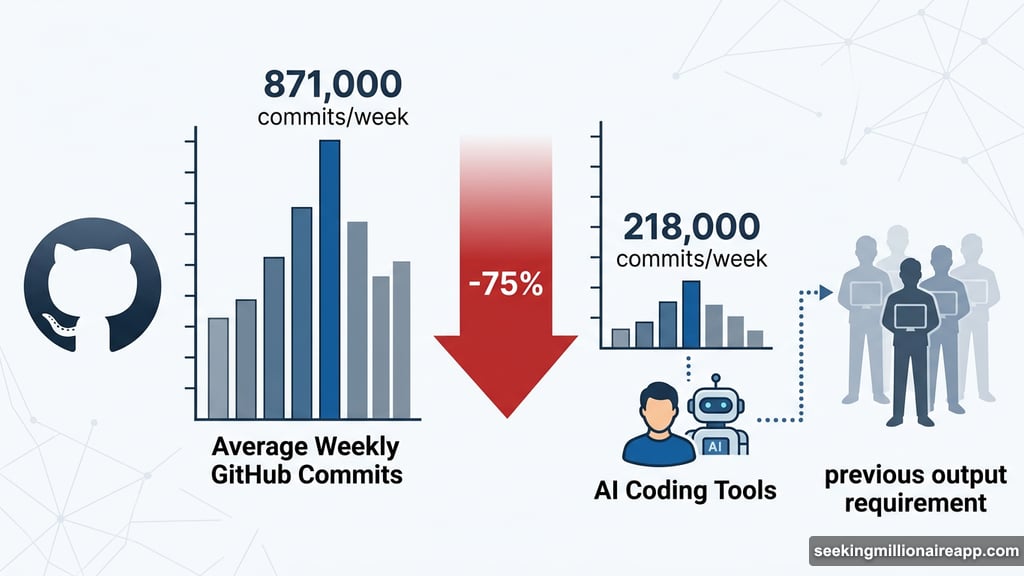
Open-source crypto commits dropped from 871,000 per week to just 218,000. That’s a 75% collapse in visible development activity. On the surface, it sounds alarming.
But the full story is messier than those numbers suggest. Several overlapping forces are reshaping how developers work — and not all of them point to doom.
Commits and Active Developer Numbers Both Crashed
Data from Artemis paints a stark picture. Weekly active developers in crypto fell from about 8,700 to roughly 4,600 — a drop of around 50% over the past year.
The decline isn’t isolated to one corner of the market either. EVM stacks, Layer 1 chains, Layer 2 networks, and Solana all saw development activity fall by an average of 34% to 40% over the past three months alone.
For investors, declining development activity traditionally signals trouble. Fewer commits often suggest less maintenance, shrinking teams, or drying-up funding. Token prices tend to follow expectations downward.
But 2026 has some unusual dynamics worth understanding before drawing conclusions.
Three Reasons Dragonfly’s Omar Points To
Omar, an investor at Dragonfly, breaks the decline into three distinct causes.
First, public attention has shifted heavily toward artificial intelligence, pulling interest away from crypto broadly. Second, lower token prices shrink the economic incentives that previously attracted developers to open-source projects. Third — and this one often gets overlooked — more projects are actively choosing closed-source development models, meaning their code never appears on GitHub at all.
That third factor matters a lot. If growing numbers of teams build privately, public repository metrics stop representing actual industry activity. The thermometer breaks, essentially.
AI Coding Tools Change What “Active” Even Means
Investor Justin Wu adds another layer to this. AI coding assistants now help crypto developers move dramatically faster through repetitive tasks, debugging, and complex code generation.
So here’s the counterintuitive reality: a single developer using AI tools today might produce the same output that previously required three or four developers making frequent public commits. The productivity happens. The public traces just don’t.
This means falling commit numbers partly reflect efficiency gains, not just declining participation. Visible activity drops while actual progress continues behind the scenes. That’s a meaningful distinction when trying to read industry health.
Crypto Is Entering Its App Era
X user Bunny highlights something even broader — a strategic shift in what the industry is actually building.
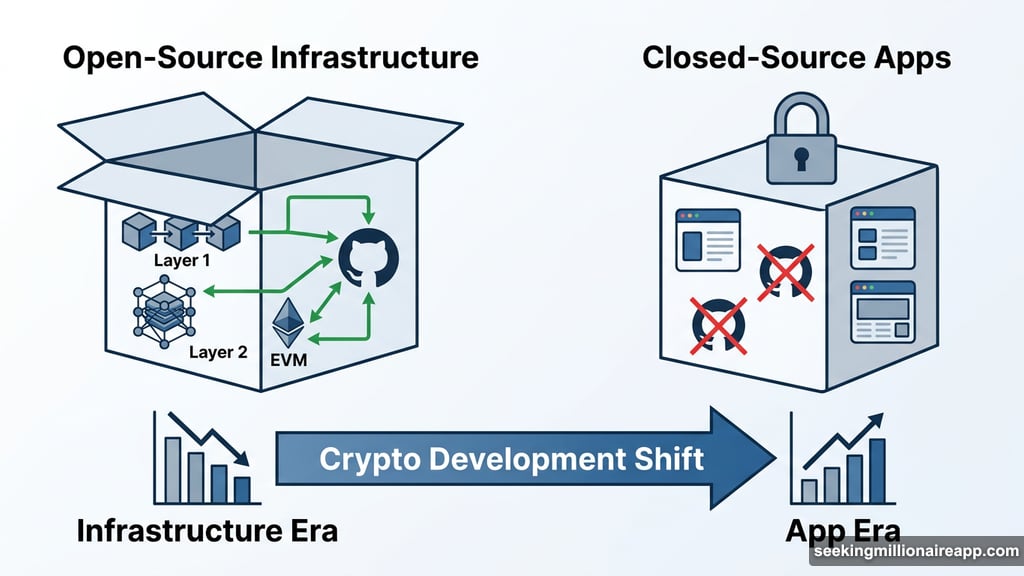
Earlier crypto development cycles focused almost entirely on infrastructure. New Layer 1 blockchains, new virtual machines, new consensus mechanisms. All of that work lives naturally in open-source repositories because infrastructure benefits from community scrutiny.
Now, according to Bunny, crypto is entering what she calls the “app era.” As she put it: “Every honest to god crypto thing lately is at the very least a version of an app with infra, with its app on top already developed by a team!”
Projects now launch as real applications built on top of existing platforms. Many combine infrastructure and application layers from the start. This shift means purely infrastructure-focused open-source repositories show declining activity simply because that’s not where the building is happening anymore.
Reading the Signal Honestly
So what does this all actually mean? The honest answer is: both positive and negative things at once.
On the negative side, falling altcoin prices genuinely reduce developer revenue and motivation. Some projects have quietly wound down. Funding rounds dried up in certain ecosystems. That’s real, and it’s not something to explain away.
On the positive side, a more mature infrastructure layer combined with AI productivity tools may push crypto applications deeper into real-world use cases faster than before. If that happens, capital returns. Token prices recover. Developer incentives strengthen again.
The 75% commit decline looks catastrophic in isolation. In context, it reflects a market restructuring around AI tools, private development models, and application-layer building rather than pure infrastructure work.
Whether that restructuring produces genuine long-term growth or just masks a prolonged slowdown is the real question — and the answer probably depends on whether those crypto apps find actual users in the next 12 to 18 months.