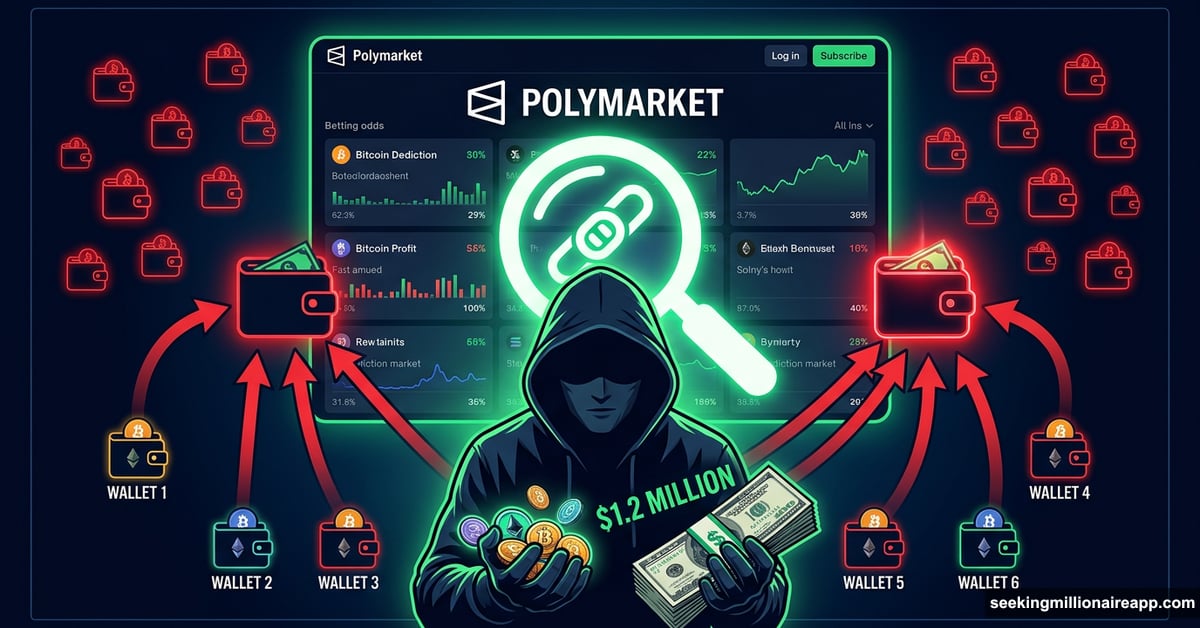
Prediction markets are supposed to level the playing field. Everyone sees the same odds. Everyone takes the same risk. But what happens when some players already know the answer before the question even goes live?
That’s exactly what unfolded on Polymarket around ZachXBT’s investigation into Axiom insider trading. And the numbers tell a pretty uncomfortable story.
The $1.2 Million Insider Edge on Polymarket
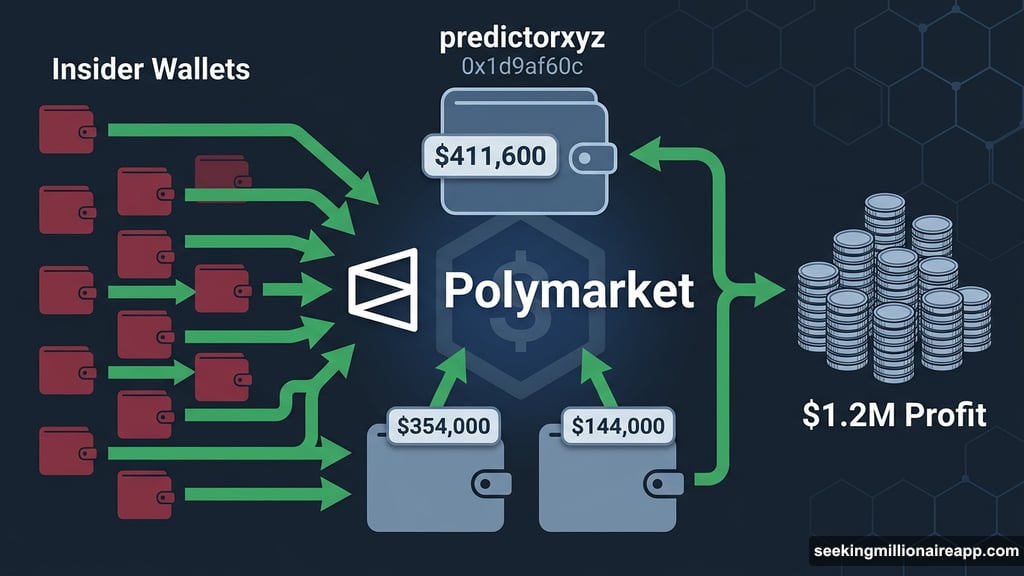
Here’s the short version. Eight of the top ten highest-earning wallet addresses on the Axiom prediction market are reportedly linked to insiders. Together, they pocketed over $1.2 million in profit.
Blockchain analytics firm Lookonchain identified 12 suspected insider wallets. Combined, those addresses generated about $1.02 million. One wallet alone, labeled “predictorxyz” and identified as address 0x1d9af60c679cd0b577c3c4ccb4b1a4be4174426d, earned an eye-watering $411,600. It traded only the Axiom market. Nothing else.
Two more addresses earned $354,000 and $144,000 respectively. Both traded a single market. That kind of laser-focused, perfectly-timed betting is hard to explain away as coincidence.
Who Paid the Price
While insiders cashed out, regular bettors absorbed the losses. Data shared by WuBlockchain shows 3,630-plus total addresses bet on the Axiom market. About 56.2% ended up profitable overall. But 52 addresses lost somewhere between $10,000 and $100,000 or more each.
Add those up and regular bettors lost over $1.6 million in total. That money didn’t disappear into the void. It flowed directly into the wallets of people who apparently knew what was coming.
So this wasn’t just an abstract ethics violation. Real people lost real money because someone else had non-public information and used it.
Front-Running on a Decentralized Platform
The pattern here looks a lot like front-running in traditional stock markets. An insider gets early access to market-moving information. They position themselves before the news drops. Then they collect when the outcome resolves in their favor.
The twist? On a decentralized finance (DeFi) platform like Polymarket, there’s no enforcement mechanism. No regulator. No trading halt. No compliance team flagging suspicious activity. On-chain transparency means you can see exactly what happened after the fact. But seeing it and stopping it are two very different things.
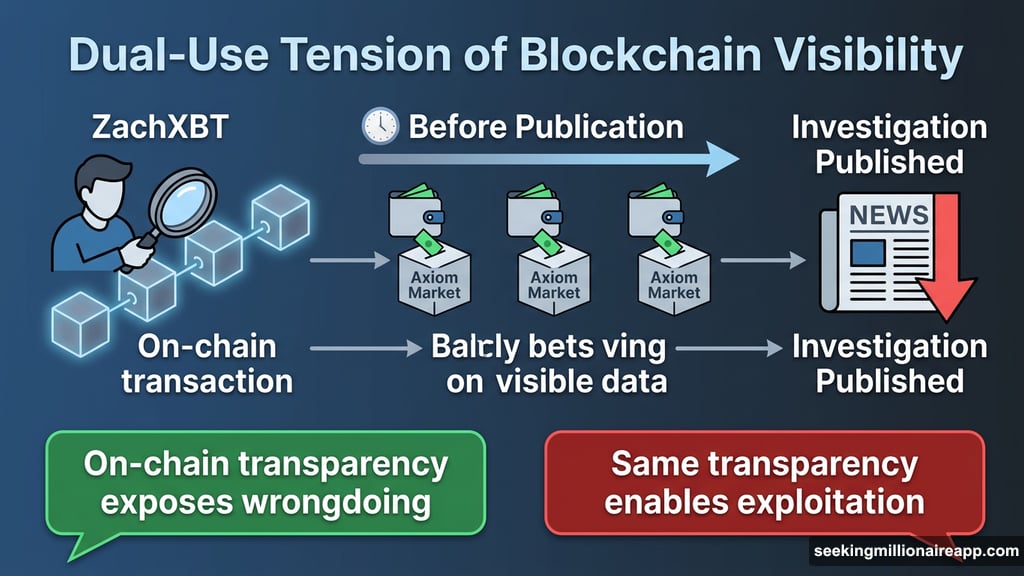
ZachXBT’s Axiom investigation actually demonstrates this tension perfectly. His on-chain analysis exposed the insider trading activity. But that same transparency also shows how the exploiters positioned themselves before his findings went public. The tool that catches wrongdoing can also enable it, depending on who gets there first.
DeFi’s Insider Trading Blind Spot
Traditional securities markets have enforceable insider trading rules. They’re imperfect, sure. But they exist. There are legal consequences for trading on material non-public information.
Decentralized prediction markets operate in a very different environment. Anyone with a wallet can participate. No KYC required. No regulatory body watching. And if someone happens to know something the market doesn’t, nothing technically prevents them from acting on it.
That structural gap is exactly what this incident exposes. Information asymmetry on decentralized platforms doesn’t just create unfair outcomes. It actively rewards those with insider access while punishing ordinary participants who play it straight.
The crypto community often points to transparency as blockchain’s killer feature. And it is powerful. But transparency after the fact doesn’t protect the 52 addresses that quietly lost their funds betting against people who already knew the score.
What This Means for Prediction Markets
Incidents like this push a real question to the surface. Can decentralized prediction markets function fairly without some form of insider trading protection?
Right now, the answer seems to be no. The Axiom case is a concrete, documented example of asymmetric information flowing into measurable profit for a small group at the direct expense of everyone else. That pattern undermines the entire premise of open prediction markets.
Some communities may push for voluntary disclosure standards or reputation-based accountability systems. Others might argue for on-chain governance mechanisms that flag suspicious concentration of winning bets before a market resolves. But none of those solutions are simple, and none exist today.
What’s clear is that the current setup lets well-positioned insiders treat prediction markets like a guaranteed payout. Until that changes, ordinary participants are essentially betting against people who’ve already read the answer key.