
The crypto market just lost nearly $200 billion in 24 hours. Bitcoin broke critical support. And Worldcoin crashed 21% in a single day.
This wasn’t isolated weakness. Instead, a massive risk-off wave hit global markets, erasing more than $3 trillion from gold, silver, stocks, and crypto within an hour. So when traditional finance panics, digital assets get hit even harder.
Let’s break down what triggered this crash and where prices might head next.
Why Everything Collapsed at Once
The sell-off started in traditional markets before spreading to crypto. Plus, two major policy developments spooked investors simultaneously.
First, reports emerged that President Trump would nominate Kevin Warsh as the next Federal Reserve chair. Warsh strongly opposes quantitative easing—the money-printing policy that fueled the last crypto bull run. Less liquidity in the financial system typically means less money flowing into risk assets like Bitcoin and altcoins.
Second, Indonesia’s financial regulator revealed that 72% of licensed crypto exchanges remained unprofitable in 2025. Moreover, domestic transaction volume collapsed from $650 trillion in 2024 to just $30 billion. That’s not a typo. Indonesian traders fled to overseas platforms, draining local exchange activity.
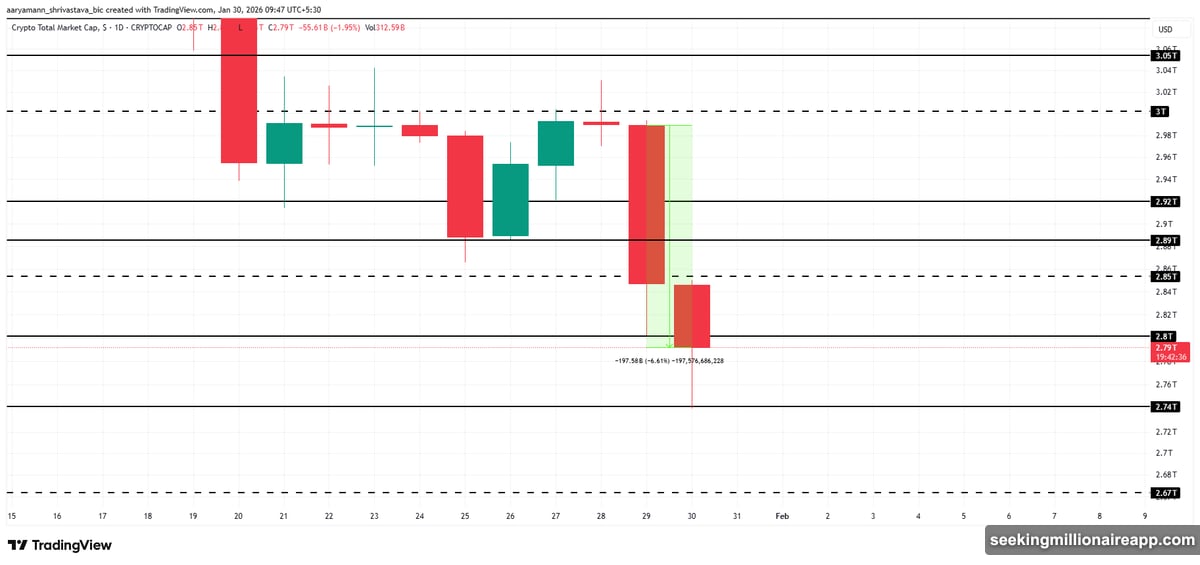
These developments amplified broader market anxiety. So when panic selling started, it accelerated fast. Total crypto market capitalization dropped from $2.97 trillion to $2.79 trillion—a 6% decline that wiped out $197 billion in value.
Bitcoin Confirms Bearish Pattern Breakdown
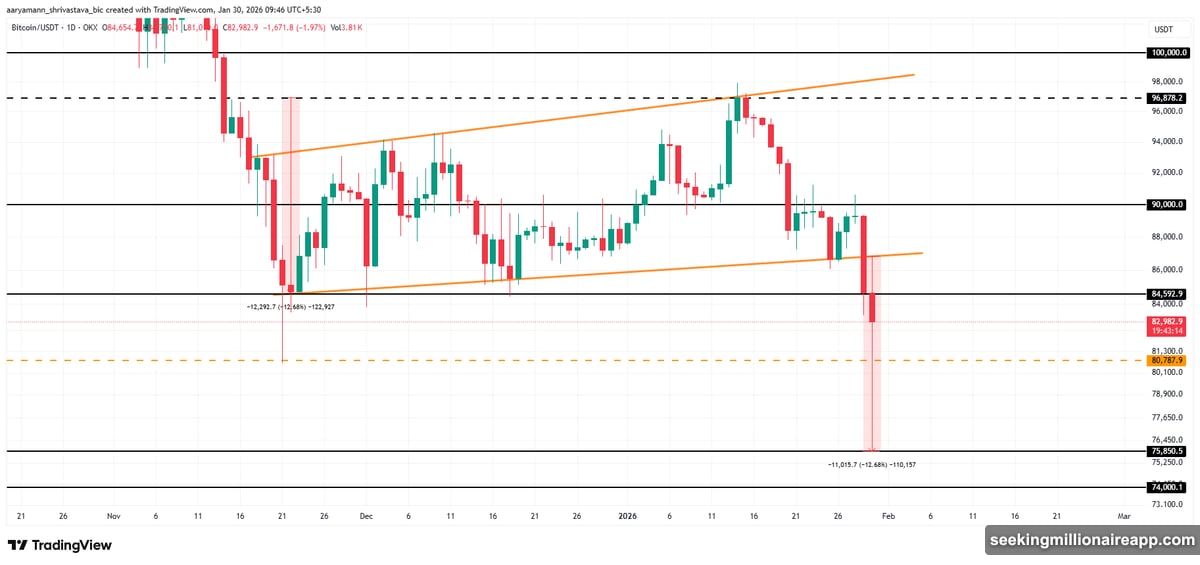
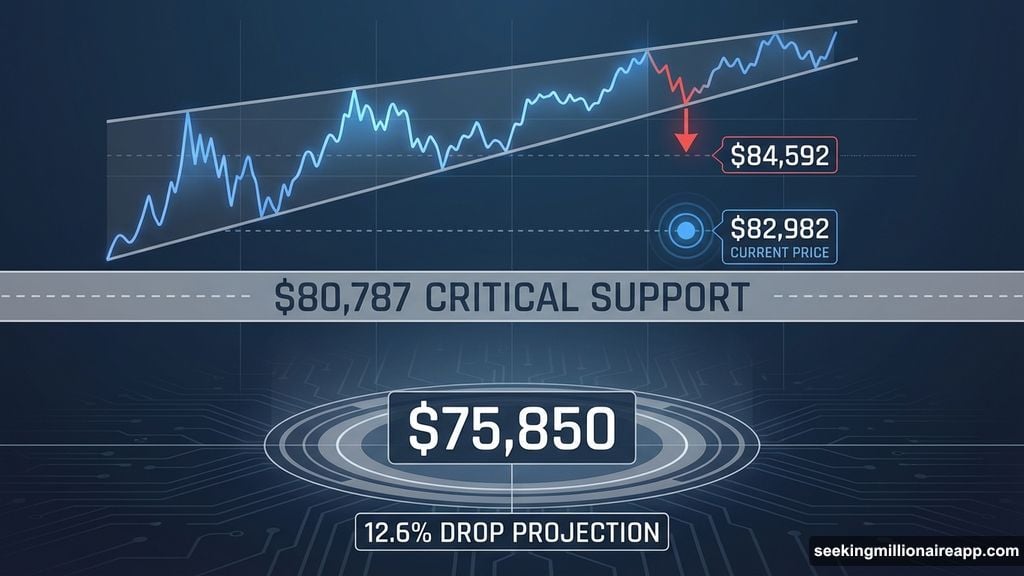
Bitcoin broke down from a broadening ascending wedge pattern near $84,592. This technical formation typically signals weakening momentum before a sharp decline.
The pattern projects a 12.6% drop from the breakdown point. That puts Bitcoin’s technical target near $75,850. Currently trading around $82,982, Bitcoin has already fallen partway toward that level.
Critical support now sits at $80,787. If this zone fails to hold, the path opens toward the full technical target. Besides, selling pressure remains intense as long-term holders take profits and overleveraged positions get liquidated.
However, a recovery scenario exists. Bitcoin needs to reclaim $84,592 as solid support. Holding above this level would invalidate the bearish breakdown and potentially trigger a bounce toward $90,000.
The next 48 hours matter. Either support holds and buying returns, or the technical target gets tested. There’s little middle ground when major patterns break down.
Worldcoin Takes the Biggest Hit
Worldcoin dropped 21% in 24 hours—the worst performance among major altcoins. WLD currently trades near $0.461, barely holding the $0.442 support level.
This wasn’t driven by project-specific news. Instead, Worldcoin suffered from extreme beta to broader market moves. When Bitcoin crashes, high-volatility altcoins typically fall harder. WLD exemplified this dynamic.
The $0.442 support zone is critical. If sellers push through this level, the next stop sits at $0.402—another 13% decline from current prices. Furthermore, weak market structure suggests limited buying interest at these levels.
A recovery requires WLD to reclaim $0.478 resistance. Breaking above this price would shift momentum and open the path toward the 50-day EMA at $0.554. That represents a 20% gain from current levels.

But here’s the problem. Worldcoin needs broader crypto market stability to mount a recovery. Without Bitcoin finding support, WLD will struggle to attract buyers regardless of its technical setup.
What Happens Next
Three scenarios are in play over the next week.
Scenario one: Bitcoin holds $80,787 support and stabilizes. This would give altcoins room to bounce. Total crypto market cap could reclaim $2.85 trillion if buying pressure returns. Worldcoin might recover toward $0.55 in this environment.
Scenario two: Bitcoin breaks support and tests $75,850. This would trigger another wave of altcoin selling. Total market cap could slip to $2.74 trillion. Worldcoin would likely test $0.402 or lower.
Scenario three: Sideways consolidation near current levels. Bitcoin chops between $80,787 and $84,592 while markets digest the sell-off. Altcoins trade in tight ranges without clear direction.
Right now, scenario two looks most probable based on momentum and market structure. Yet crypto markets can reverse quickly when overleveraged positions get flushed out. So staying nimble matters more than predicting exact price levels.
The Real Problem Isn’t Crypto-Specific
This crash highlights crypto’s continued correlation with traditional risk assets. When macro fears spike, digital assets sell off regardless of fundamentals.
The Warsh nomination signals a potential shift toward tighter monetary policy. Less liquidity means less speculative capital for crypto markets. Similarly, weak exchange profitability in major markets like Indonesia suggests retail interest remains fragile despite rising user numbers.
These are structural headwinds that won’t disappear quickly. Plus, overleveraged long positions created fragility that amplified the decline. When markets are positioned one-sided, small catalysts can trigger large moves.
The path forward depends on broader financial market stability. If equities stabilize and Treasury yields calm down, crypto can recover. But if macro uncertainty persists, expect more volatility and potential downside tests.
Watch Bitcoin’s $80,787 support level. Everything else follows from there.