
The crypto market melted down hard. Over $266 billion vanished in a single day, dragging Bitcoin to its lowest price in 28 months.
This wasn’t a normal pullback. Cascading liquidations totaling $2.2 billion triggered mass selling. Plus, major tokens collapsed in tandem. The damage hit everything from Bitcoin to smaller altcoins. Let’s dig into what drove this brutal selloff.
Bitcoin Crashed Below $65,000
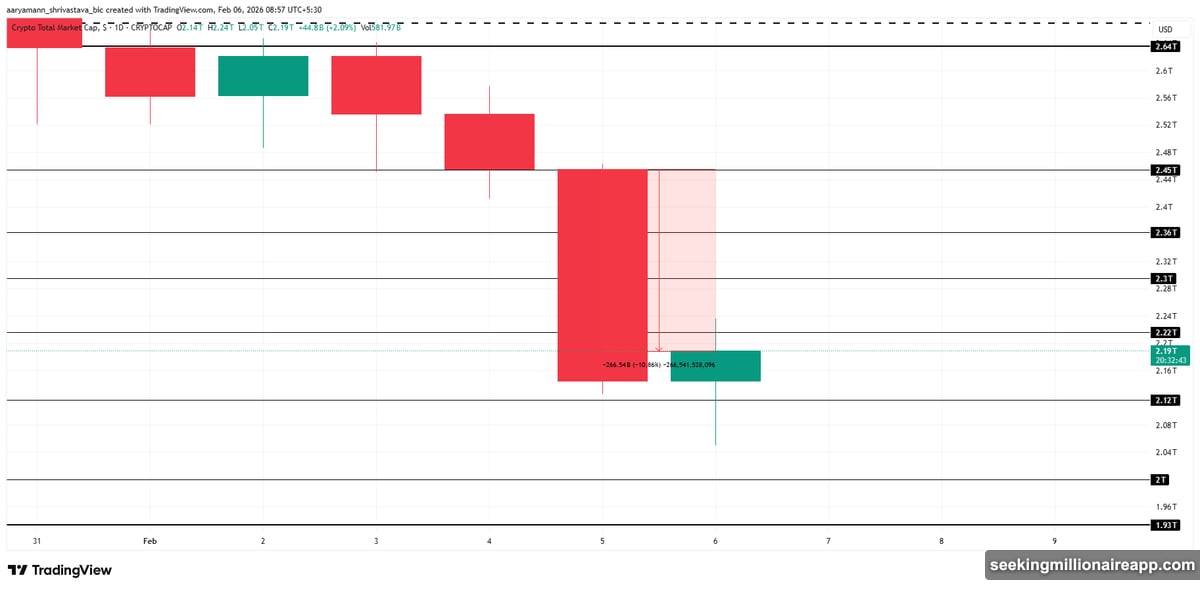
Bitcoin fell 11.6% in 24 hours, dropping to $64,536. That marks BTC’s biggest single-day decline of 2026 so far.
The crypto king barely held above $62,893 support. Breaking that level could trigger another wave of panic selling. Analysts warn the next major support sits at $59,986, with $55,883 after that if momentum continues downward.
Meanwhile, uncertainty keeps mounting. Investors pulled billions from the market as volatility spiked. Thin liquidity made price swings even more violent.
Here’s what worries traders most. Bitcoin now trades 21% below MicroStrategy’s average purchase price. The company holds massive BTC positions, and those unrealized losses create balance sheet risk. MicroStrategy shares dropped in response, trading at a discount to the company’s Bitcoin holdings.
$2.2 Billion in Liquidations Crushed Leveraged Positions
Cascading liquidations destroyed overleveraged traders. Nearly $2.2 billion in positions got wiped out as prices fell.
How did this happen? Many traders used high leverage betting on continued gains. When Bitcoin dropped, exchanges automatically closed those positions to limit losses. But forced selling pushed prices down further, triggering more liquidations in a vicious cycle.
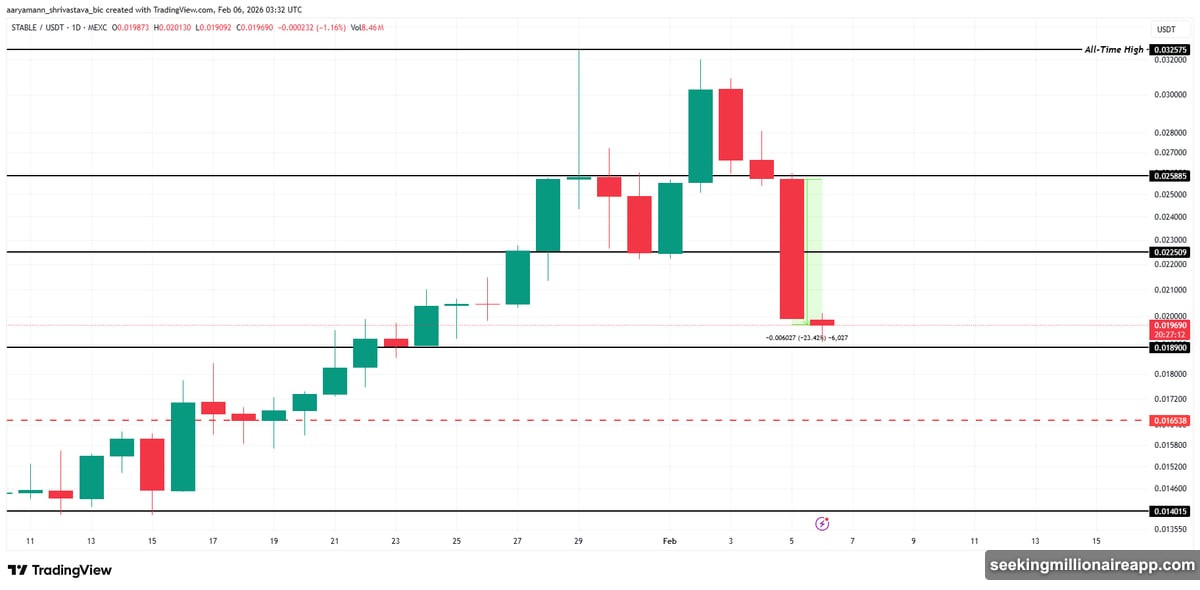
Total crypto market cap fell from $2.45 trillion to $2.19 trillion. Now the market barely holds above $2.12 trillion support. That level represents the last major defense before potential decline to $2.00 trillion.
Recovery depends on deleveraging slowing down. If forced selling eases and buyers return, the market might stabilize. But right now, momentum points downward as fear dominates trading decisions.
Altcoins Got Hammered Even Harder
Smaller tokens suffered worse than Bitcoin. Take Stable (STABLE), which plunged 23.4% in 24 hours to $0.0196.
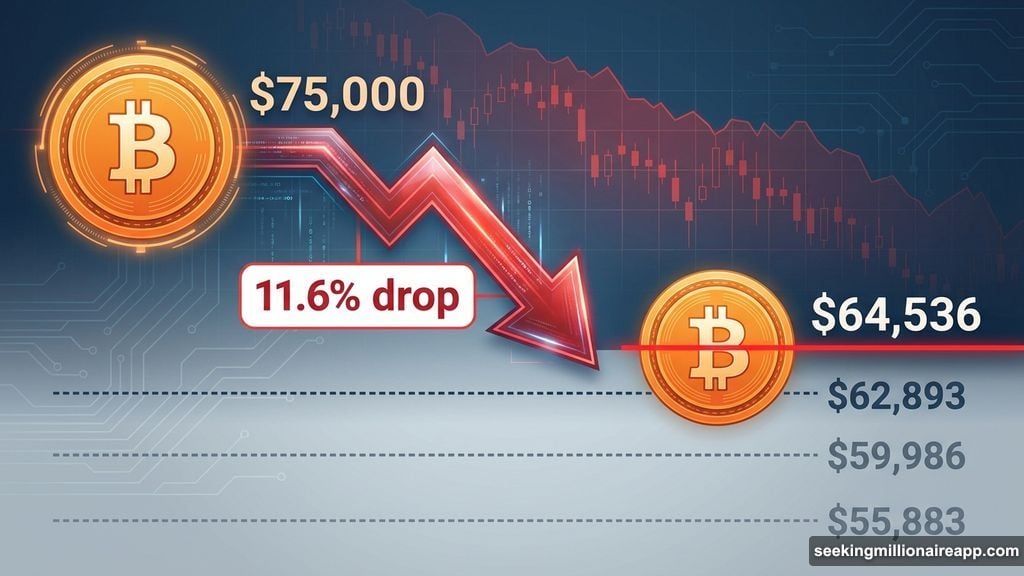
The selloff dragged STABLE far from its $0.0325 all-time high. Persistent distribution signals weakened investor confidence across the board. If selling continues, analysts expect STABLE could test $0.0165 support next.
Other altcoins faced similar pressure. Rising outflows and thin liquidity amplified price swings. Many tokens broke key support levels, exposing them to further declines.
Plus, broader market conditions worsened. Gemini announced shutdowns in the UK, EU, and Australia, cutting 200 jobs. The exchange cited the crypto market downturn as reason for refocusing on US operations. That news added to negative sentiment.
What Happens Next
The market faces a critical moment. Total crypto market cap holds above $2.12 trillion, but barely.

Breaking that support opens the door to deeper losses. Without sustained inflows and stabilizing sentiment, recovery timing remains uncertain. Rebuilding confidence takes time, especially after violent selloffs scare away casual investors.
However, a bounce remains possible. If buyers defend current levels and deleveraging slows, the market could recover some recent losses. Bitcoin would need to reclaim $65,360 and push toward $69,922 to signal stabilization.
For now, caution dominates. Traders watch support levels closely. Any breakdown could accelerate selling pressure and extend this brutal correction further.
The crypto market proved again how quickly billions can evaporate. Overleveraged positions, weak support levels, and coordinated selling created perfect conditions for a crash. Whether this marks a temporary correction or the start of deeper trouble depends on what happens at current support zones.
Watch those levels carefully. They’ll determine if this selloff ends here or just getting started.