
Dark money flows through blockchain networks more than ever before. New data reveals a disturbing trend that law enforcement can’t ignore.
Cryptocurrency payments to services linked with suspected human trafficking surged 85% in 2025. That’s not a typo. These networks moved hundreds of millions of dollars through digital channels last year. Plus, the real number is likely higher since blockchain analytics only catches what they can identify.
Chainalysis dropped this bombshell in their latest report. The blockchain analytics firm tracks illicit crypto flows globally. What they found paints a troubling picture of how criminal networks adapted to digital payments faster than anyone expected.
Four Types of Criminal Networks Using Crypto
The data breaks down into four main categories. Each represents a different facet of exploitation and abuse.
First, Telegram-based “international escort” services dominate the landscape. These operations coordinate across borders using encrypted messaging. They collect payments in cryptocurrency to avoid traditional banking oversight.
Second, forced labor recruitment networks funnel victims into scam compounds. These operations promise legitimate jobs abroad. Instead, workers face passport confiscation and forced participation in cryptocurrency scams. The cruel irony? Victims help steal crypto that funds their own captivity.
Third, prostitution networks expanded their crypto acceptance dramatically. Payment processing became their primary growth bottleneck. Cryptocurrency solved that problem for them.
Fourth, vendors selling child sexual abuse material continue operating on dark web markets. Bitcoin remains their preferred currency despite increased law enforcement scrutiny.
“The dollar amounts significantly understate the human toll of these crimes, where the true cost is measured in lives impacted rather than money transferred,” Chainalysis noted in their report.
That statement hits hard. Behind every transaction sits a human being trapped in exploitation.
Stablecoins Replace Cash for Escort Services
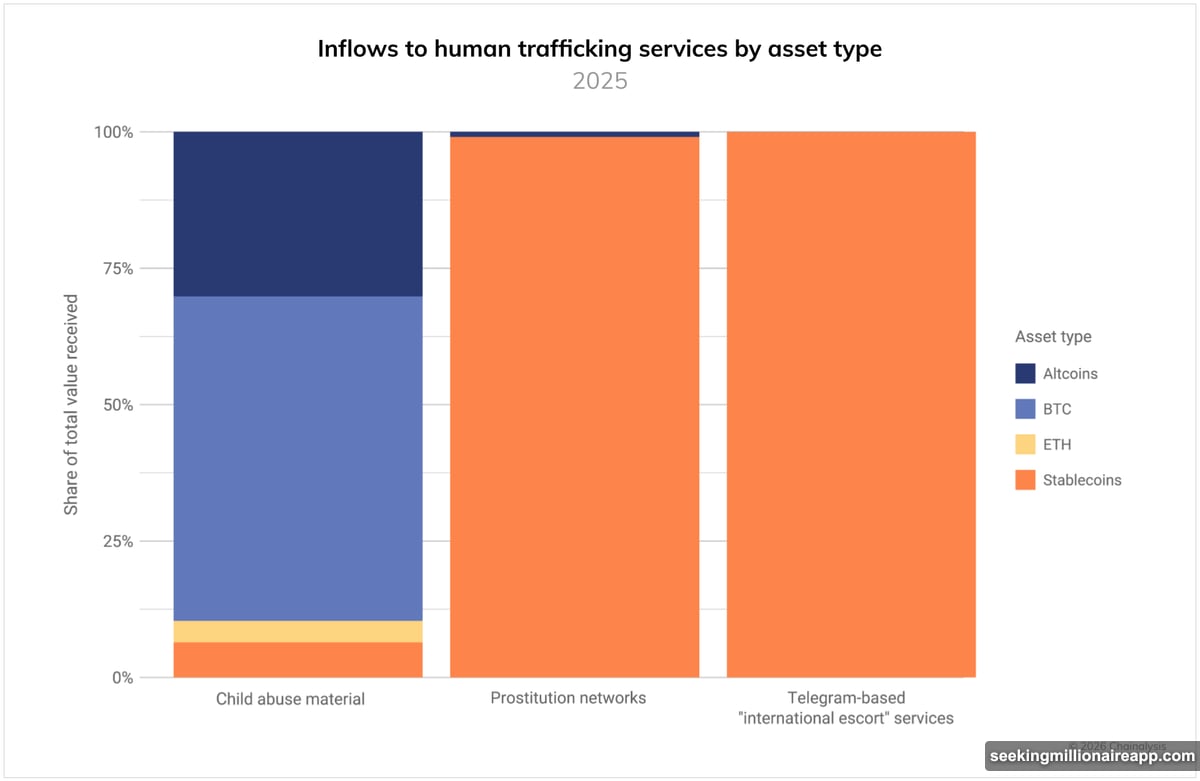
Payment methods tell an interesting technical story. International escort services and prostitution networks switched heavily to stablecoins in 2025.
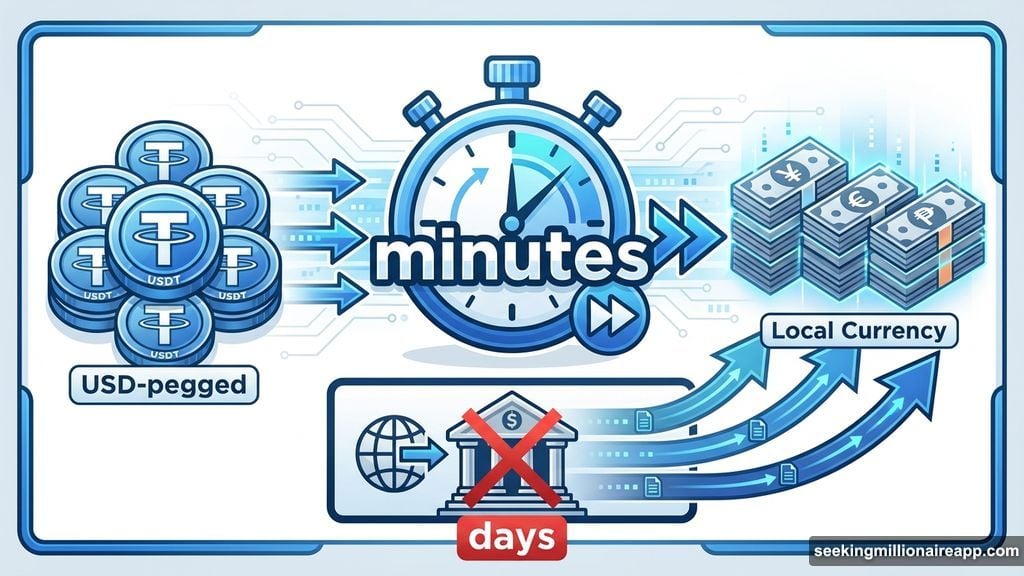
Why stablecoins? Price stability matters when you’re running a business. Moreover, these networks integrated tightly with Chinese-language money laundering operations. Those services rapidly convert USD-pegged stablecoins into local currencies worldwide.
The speed creates a critical advantage. Traditional financial systems take days to process international transfers. Crypto moves in minutes. So by the time anyone notices suspicious activity, the money already converted to local cash.
“These networks rapidly facilitate the conversion of USD stablecoins into local currencies, potentially blunting concerns that assets held in stablecoins might be frozen,” the Chainalysis report explained.
Freezing stablecoins requires coordination between issuers and law enforcement. That process takes time. Criminal networks exploit that delay window aggressively. They cash out before anyone can react.
Bitcoin Usage Drops While Privacy Coins Rise
Child exploitation networks historically relied on Bitcoin. That’s changing now.
In 2025, Bitcoin’s dominance declined sharply in CSAM transactions. Alternative Layer 1 networks gained ground. But the biggest shift happened in laundering proceeds rather than direct payments.
Monero emerged as the privacy coin of choice for cleaning dirty crypto. Its built-in privacy features make transactions nearly impossible to trace. So criminals accept payments in Bitcoin, then immediately convert to Monero through instant exchangers.
These exchangers operate without Know Your Customer requirements. They facilitate rapid anonymous swaps between different cryptocurrencies. For law enforcement, the trail goes cold at the exchanger. Tracking funds becomes exponentially harder once they convert to Monero.
This represents a significant evolution in criminal tradecraft. Early darknet markets used Bitcoin naively. Criminals assumed pseudonymity meant anonymity. Many learned otherwise through arrests.
Today’s trafficking networks show sophisticated understanding of blockchain analytics. They actively work to defeat tracking tools. The shift to Monero proves they’re learning from predecessors’ mistakes.
Southeast Asia Becomes the Hub
Geographic analysis reveals where these networks operate. Southeast Asia emerged as the clear regional center for crypto-enabled trafficking operations.
The region hosts a booming illicit ecosystem. Scam compounds, online casinos, money laundering services, and trafficking networks all interconnect. They operate primarily through Telegram channels and encrypted apps.
But payment flows tell a global story. While services base themselves in Southeast Asia, cryptocurrency arrives from everywhere. Significant transaction volumes traced back to the United States, Brazil, United Kingdom, Spain, and Australia.
This matters because it demonstrates global reach. These aren’t isolated regional operations. They built sophisticated infrastructure to accept payments from customers worldwide. Traditional cash-based systems couldn’t scale internationally this way.
Chinese-language services dominate this space. Networks operating across mainland China, Hong Kong, Taiwan, and Southeast Asian countries show advanced payment processing capabilities. They manage cross-border flows more efficiently than many legitimate businesses.
“The diversity of destination countries suggests these networks have developed sophisticated infrastructure for global operations,” Chainalysis noted.
Think about what that means. Criminal networks built payment systems that rival legitimate global commerce platforms. They process international transactions at scale with minimal friction. That’s genuinely impressive from a technical standpoint, however disturbing the application.
Blockchain Creates New Tracking Opportunities
Here’s the counterintuitive part. Cryptocurrency actually helps investigators more than cash ever did.

Traditional human trafficking relied on cash transactions. Those leave virtually no trace. An envelope of bills changes hands. Nobody documents the serial numbers. The money vanishes into circulation immediately.
Blockchain transactions work differently. Every payment generates a permanent public record. Investigators can trace flows across wallets, exchanges, and services. That visibility creates investigation opportunities impossible with cash.
Chainalysis emphasized this point strongly. Blockchain transparency offers law enforcement deeper visibility into trafficking-related financial activity than traditional payment methods. Smart analytics can identify patterns, link networks, and build cases.
Several major trafficking rings got disrupted in 2025 specifically because investigators followed the crypto. They traced payments back through multiple wallets. Those trails led to real-world identities and physical locations. Cash transactions never would have provided those leads.
So cryptocurrency cuts both ways. Yes, it enables criminals to move money globally with minimal friction. But it also creates permanent evidence trails that skilled analysts can exploit. The question becomes whether law enforcement develops tools and expertise fast enough to keep pace.
The Money Laundering Network Connection
These trafficking operations don’t exist in isolation. They plug into broader criminal financial infrastructure.
Chinese-language money laundering networks provide essential services. They handle currency conversion, cash delivery, and asset movement globally. These services operate through Telegram channels with sophisticated payment processing.
The integration runs deep. International escort services immediately funnel stablecoin payments into these laundering networks. Within minutes, those cryptocurrencies convert to local fiat currencies worldwide. The money disappears into cash before anyone notices the transaction.
This creates a fast-moving threat. Traditional financial surveillance relies on detection during the transaction clearing process. But crypto transactions clear instantly. By the time suspicious activity flags appear, the money already left the blockchain entirely.
Moreover, these laundering networks serve multiple criminal enterprises simultaneously. The same service that cleans trafficking proceeds also handles scam compound earnings, illegal gambling profits, and general cybercrime revenue. They built efficient criminal financial infrastructure at scale.
Disrupting trafficking payments requires attacking this underlying infrastructure. Taking down individual trafficking operations treats symptoms rather than causes. The laundering networks enable multiple forms of crime simultaneously.
Privacy Versus Public Safety
This data reignites uncomfortable debates about cryptocurrency privacy features. Privacy advocates argue financial privacy represents a fundamental right. Surveillance tools threaten everyone’s liberty, not just criminals.
They’re not wrong. Mass financial surveillance creates serious civil liberties concerns. Governments with complete visibility into every transaction can abuse that power. History provides countless examples.
But the human trafficking statistics make this conversation brutally difficult. Real people suffer exploitation while criminal networks exploit privacy tools to evade justice. That’s not theoretical harm. It’s measured in shattered lives.
The Monero adoption trend highlights this tension. Privacy coins serve legitimate purposes. Dissidents in authoritarian countries need financial privacy to survive. Journalists protecting sources require untraceable payments. Privacy tools enable important social functions.
Yet those same tools also shield human traffickers from investigation. They allow child exploitation networks to operate with reduced detection risk. The technology doesn’t distinguish between uses we consider legitimate versus criminal.
This creates genuine policy dilemmas without easy answers. Banning privacy coins might reduce some criminal activity. But it would also harm legitimate users who depend on financial privacy for safety. Meanwhile, criminals would likely find alternative methods anyway.
The blockchain analytics industry represents one attempted middle ground. Companies like Chainalysis build tools to trace illicit activity while respecting baseline privacy for ordinary users. They focus on identifying criminal patterns rather than surveilling everyone.
Whether that approach succeeds remains uncertain. Criminal networks actively work to defeat these tools. It’s an ongoing arms race between analytics and evasion techniques.
The Numbers Don’t Tell the Full Story
Chainalysis stressed one critical point repeatedly. The financial figures dramatically understate the true scope of harm.
Hundreds of millions of dollars in tracked transactions sounds like a lot. But each transaction represents a human being trapped in exploitation. The real cost measures in destroyed lives, traumatized victims, and shattered families.
Moreover, these numbers only capture identified services. Blockchain analytics firms can only track what they discover. Unknown networks operating below the radar don’t appear in these statistics. The actual scale of crypto-enabled trafficking likely exceeds the reported figures significantly.
Some experts estimate these reports capture perhaps 30-40% of the real activity. Criminal networks constantly develop new techniques to avoid detection. They create fresh wallets, use novel laundering methods, and exploit emerging privacy technologies. Analysts play catch-up continuously.
So while the 85% year-over-year increase looks alarming, the baseline itself is probably conservative. The true growth rate might be even worse than reported.
This matters for resource allocation. Law enforcement agencies need to understand they’re fighting a bigger problem than the visible statistics suggest. Adequate funding and staffing require accurate threat assessment.
Technology Enables Scale Previously Impossible
Traditional human trafficking operated through local networks with physical limitations. Moving money internationally required complex arrangements with multiple intermediaries. Each step introduced risk and friction.
Cryptocurrency eliminated those barriers. Now a trafficking network in Southeast Asia instantly receives payments from customers in Europe, Americas, and Australia. No banks involved. No paperwork required. No suspicious activity reports filed.
The technology fundamentally changed the economics of these operations. Lower friction means higher volume. Easier international payments mean broader customer reach. Cryptocurrency enabled trafficking networks to scale globally in ways cash-based systems never permitted.
This represents a genuinely new threat vector. Law enforcement still largely operates with frameworks designed for local, cash-based trafficking. Those approaches don’t translate well to globally distributed, crypto-enabled networks.
International cooperation becomes essential but remains frustratingly slow. Different countries maintain different legal frameworks. Evidence sharing takes months or years. Meanwhile, criminal networks move money instantly across dozens of jurisdictions.
The speed mismatch creates enormous challenges. Investigations develop leads long after the money already moved and converted. By the time authorities coordinate across borders, the trail is cold.