
Millions of Brits now hold digital assets. And they’re starting to vote like it matters.
Cryptocurrency is moving fast from financial niche to genuine political talking point in the UK. Industry leaders are watching a motivated bloc of crypto-holding voters grow bigger with every election cycle. And the message to political parties is getting harder to ignore.
The Crypto Voter Bloc Is Getting Bigger
Adriana Ennab, UK Director at Stand With Crypto, puts it bluntly. The “crypto voter is becoming much, much bigger,” she says. But this isn’t simply about people wanting to own Bitcoin or Ethereum.
At its core, it’s about financial freedom. People want the legal right to do what they choose with their own money, transparently and without interference. Ennab argues that blocking access to these markets in a developed economy doesn’t eliminate demand. It just pushes activity offshore.
Her organisation sends policy communications to all major parties. If one picks it up and runs with it, that creates useful political pressure. “We would like to use that to leverage to say to all the other parties, you need to understand what’s happening in the constituencies,” she explained.
That’s a clever strategy. And it’s already bearing fruit.
Politicians Can’t Call This Niche Anymore
Dion Seymour, Crypto Tax Technical Director at Andersen and former HMRC Policy Lead, has watched the data closely. Surveys consistently show the number of UK crypto holders rising year on year. This is no longer a fringe concern limited to tech enthusiasts.
“It’s actually trying to make ministers realise it’s not so niche anymore,” Seymour said. That shift in perception matters enormously. When a voter bloc reaches critical mass, political parties start paying real attention.
And the numbers back him up. With millions of holders across the UK, crypto represents a constituency that crosses traditional party lines. Reform voters hold it. Labour voters hold it. So do Liberal Democrats and Conservatives.
Crypto Policy Is Heading the Same Way as the US
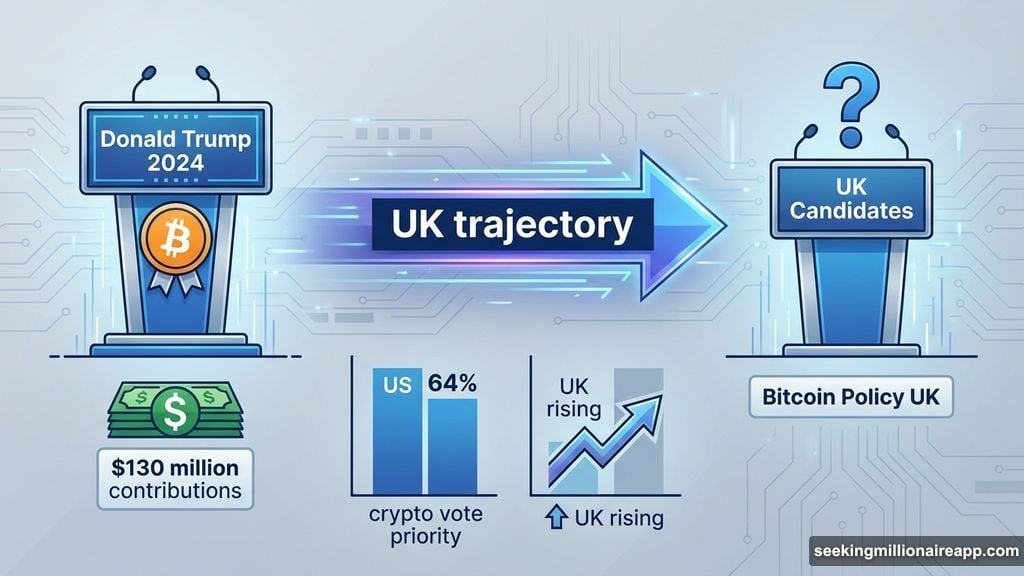
Freddy New, Chief Policy Officer at Bitcoin Policy UK, draws a sharp comparison with American politics. During the 2024 US presidential election, Donald Trump positioned himself as a “pro-crypto candidate” and actively courted the digital asset industry.
The results were striking. Crypto executives and investors collectively contributed over $130 million to the election cycle. A survey of 800 digital asset investors found that 64% consider a candidate’s stance on cryptocurrency “very important” when deciding how to vote. New points out that swing districts and swing states in the US saw Bitcoin and crypto votes swing toward Trump.
The UK trajectory looks familiar. A motivated, well-funded group of voters who care deeply about one specific policy issue is a powerful political tool. Most people remain indifferent to crypto. But those who care, care intensely.
Why No Government Can Simply Ban Its Way Out
New makes another important point. This isn’t an industry that politicians can “fundamentally control.” People will participate in crypto markets regardless of what any government decides.
That changes the political calculation entirely. Restrictive policy doesn’t eliminate crypto activity. It just drives it underground or pushes it to more permissive jurisdictions. Meanwhile, the UK loses tax revenue, investment, and a motivated voter base that feels ignored.
For any party doing the political maths, the case for supporting the industry becomes obvious. The downside risk of being seen as anti-crypto is real. The upside of being the party that gets this right could be significant.
What This Means for Reform, Labour, and Beyond
Neither Labour nor Reform has staked out a firmly pro-crypto position yet. But the pressure is building. Stand With Crypto’s approach of engaging all parties simultaneously creates a race to the top rather than a race away from the issue.
The US showed that crypto voters can genuinely swing close elections. The UK may not be far behind. With millions of holders, a growing advocacy infrastructure, and a community that skews toward highly engaged, informed voters, crypto is becoming an electoral issue as much as a financial one.
Parties that understand this early will have an advantage. Those that dismiss it as fringe tech enthusiasm may find themselves on the wrong side of a very motivated group of voters come election day.