November has been brutal for crypto. The total market index is down about 20% this month. Plus, that kind of drop has traders whispering about a new bear market.
But here’s the twist. The biggest wallets in crypto are buying, not selling. These whales are quietly accumulating three specific tokens while everyone else panics. Their 30-day buying patterns suggest they’re positioning for something the rest of the market hasn’t priced in yet.
Let’s break down what they’re buying and why it matters.
Optimism Mega Whales Add $54 Million Despite 13% Drop
Optimism (OP) is down 13.3% over the past month. Yet the top 100 OP addresses increased their holdings by 3.15% during that same period. At current prices, that means they added roughly $54 million worth of tokens.
That’s not panic buying. That’s conviction.

Optimism is one of the larger Layer-2 scaling solutions for Ethereum. So these whales might see long-term infrastructure value that short-term price action doesn’t reflect. Their accumulation also lines up with a technical signal that often precedes reversals.
Between April 7 and November 3, OP’s price made a lower low. But the Relative Strength Index (RSI) made a higher low during that same stretch. This mismatch is called a bullish RSI divergence. It suggests downside momentum is fading even as price continues to drop.
For that reversal to activate, OP needs to break cleanly above $0.47. That level has blocked every rally attempt since mid-October. A breakout there opens the path toward $0.61, and potentially $0.85 if sentiment improves across the broader market.
On the downside, losing $0.38 puts $0.31 back in play. A breakdown below $0.31 exposes $0.23 and would invalidate the bullish setup whales seem to be positioning for.
Aster Whales Jump 140% in 30 Days
The accumulation pace in Aster (ASTER) is significantly faster than Optimism. Over the past 30 days, whales expanded their holdings by 140%. That pushed their total stash to 67.03 million ASTER.

At the current price of nearly $1.13, the total whale stack is worth approximately $75.7 million. Nearly $44 million of that came from recent buying. Smart money wallets moved even more aggressively. Their holdings jumped 678% over the same period.
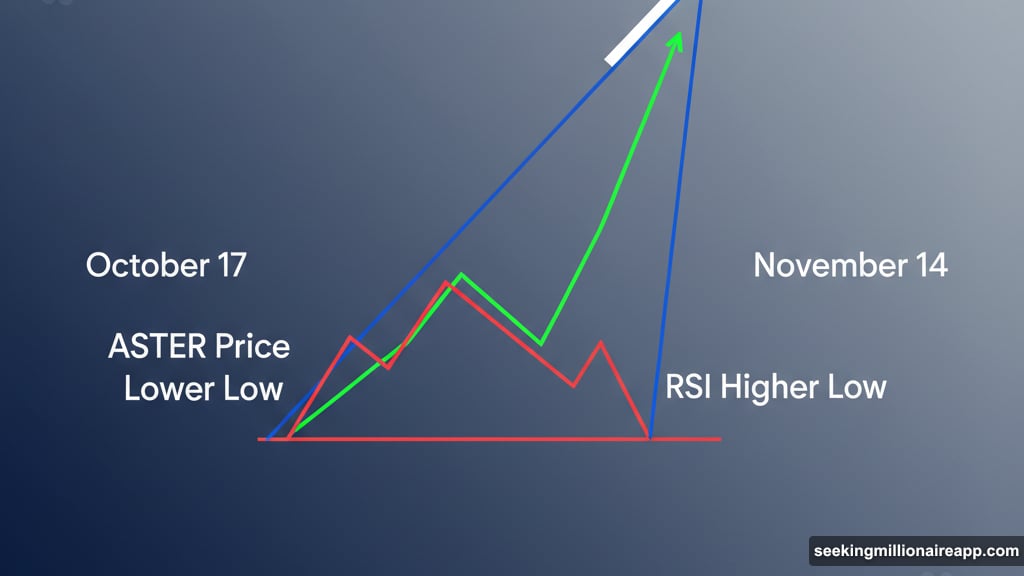
The chart supports what these wallets are doing. ASTER broke out of a falling channel on the 12-hour timeframe. That indicates the bearish trend is losing force. There’s also a clear bullish RSI divergence between October 17 and November 14.
During that period, ASTER’s price made a lower low while the RSI made a higher low. That shift suggests momentum is turning, and price could follow if buyers stay active. Short-term price action already reflects some of this. Aster is up almost 9% in the past 24 hours.
But the bigger picture still leans toward a reversal rather than a simple bounce. The next major hurdle sits at $1.29. This level blocked the rally attempt on November 2. So a clean close above it would confirm stronger upside potential.
If that break happens, Aster could stretch toward $1.59 next. On the downside, $1.11 remains the first support. Losing $1.11 opens the path to $1.00. If that fails, the deeper level at $0.81 would come into play.

All Major Maple Finance Holder Groups Are Accumulating
Maple Finance (SYRUP) shows a more measured but consistent accumulation pattern. Over the past 30 days, the top 100 mega-whale addresses increased their holdings by 3.47%. That raised their combined stash to 1.11 billion SYRUP.
At the current price, the total mega-whale stack is valued at approximately $499.5 million. Other holder groups are moving in the same direction. Smart money wallets added 1.86%, and regular whales increased holdings by 4.57%.
When all these groups point in the same direction, it usually reflects rising confidence. The chart shows why traders might be positioning here. SYRUP is trying to complete an inverse head and shoulders pattern. The neckline currently sits near $0.53.
If the price moves above it, the breakout becomes valid. The target would extend toward $0.65 or even higher. There’s also the On-Balance Volume (OBV) trend to consider. OBV tracks buying and selling pressure. Buying has appeared on OBV, but the indicator is still sitting under a falling trendline that began around October 14.
For a stronger trend reversal, whales likely want to see both: a break above the neckline at $0.53 and OBV breaking that trendline at the same time. When price and OBV break together, rallies tend to hold better.
For now, the setup shows conviction, not confirmation. Yet if buyers fail and the price slips, the invalidation sits at $0.38. A drop under $0.38 would weaken the pattern and could push SYRUP toward $0.28.
What This Whale Activity Actually Means
These three tokens share a common thread. Whale wallets are accumulating despite market weakness, not because of it. That suggests they’re positioning for a longer-term play rather than reacting to immediate price movement.
Optimism benefits from Ethereum’s scaling narrative. Aster is gaining traction with both technical breakouts and fundamental support. Maple Finance focuses on institutional DeFi lending, a niche that could grow regardless of retail sentiment.
But whale buying doesn’t guarantee profits. It just shows where the biggest wallets think value exists. Markets can stay irrational longer than these positions stay solvent. And if the broader market breaks down further, even whale-backed tokens could face deeper corrections.
Still, when mega wallets, smart money, and regular whales all move in the same direction across multiple tokens, it’s worth paying attention. They might see something the rest of the market hasn’t priced in yet.