Global tension has a funny way of revealing what sophisticated money really thinks. While retail traders panic or freeze, crypto whales do something different. They rotate.
As the US-Iran conflict rattles traditional markets, on-chain data tells a surprisingly precise story. Certain tokens are being quietly accumulated. Others are getting dumped into strength. And the patterns behind each move offer real clues for traders watching closely.
BeInCrypto analysts have spotted three tokens where whale activity is unusually clear right now.
Smart Money Signals Push WHITEWHALE Buys
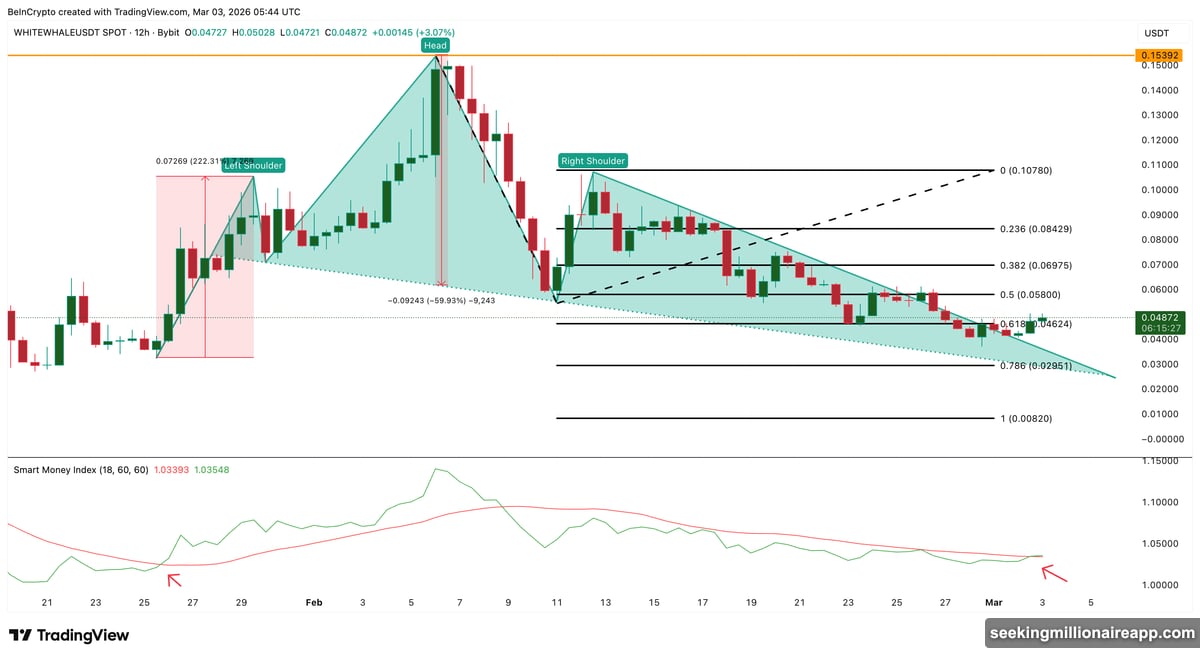
At first glance, buying The White Whale (WHITEWHALE) during a geopolitical crisis seems counterintuitive. The 12-hour chart shows a classic head-and-shoulders pattern, which typically signals further downside. If the neckline breaks, technical projections point to nearly a 60% drop.
But whale wallets aren’t reading the chart alone. They’re watching something else.

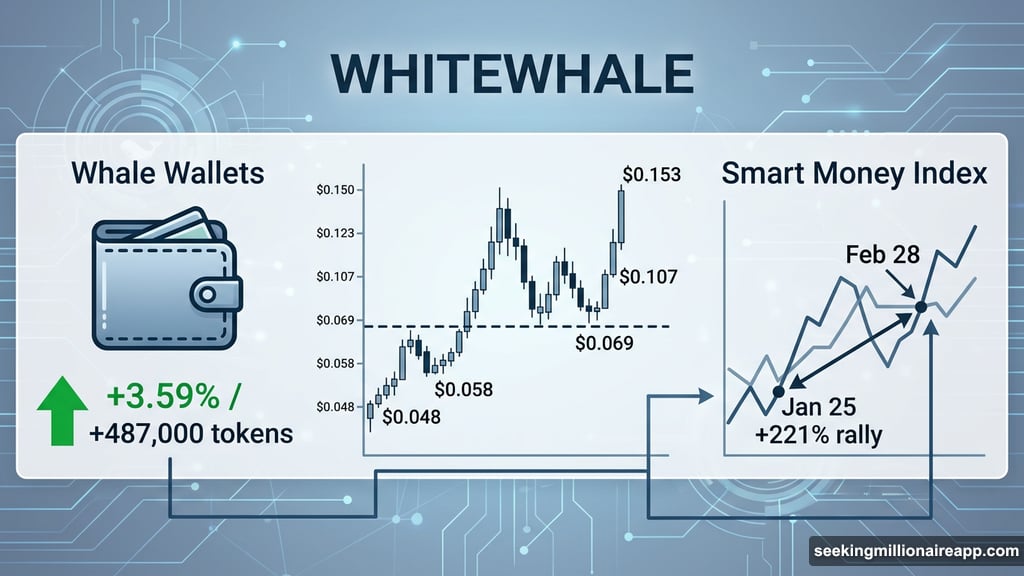
Over the past 24 hours, whale holdings in WHITEWHALE grew by 3.59%. That translates to roughly 487,000 tokens added in a single day, bringing the total stash to 14.07 million. The timing aligns with a specific signal: the Smart Money Index, which tracks positioning by informed, alpha-seeking traders, began crossing toward its signal line on February 28.
That’s the same kind of crossover that appeared on January 25. Back then, WHITEWHALE rallied about 221% shortly after.
So the setup is intriguing. WHITEWHALE currently trades near $0.048, up about 14% in 24 hours. For a meaningful rally to unfold, price needs to clear $0.058 and then $0.069. A push above $0.107 would start weakening the bearish structure. Full invalidation sits near $0.153, which looks distant for now.
Still, the risks are real. The head-and-shoulders pattern hasn’t been broken. If the Smart Money Index reverses and WHITEWHALE drops below $0.029, a sharp selloff becomes likely. Whales appear to be positioning ahead of a potential signal confirmation, not chasing price momentum.
![Illustration of cryptocurrency whale wallets accumulating WHITEWHALE tokens on a trading dashboard during market volatility]
WAR Token Rallies 40%. Whales Are Leaving Anyway.
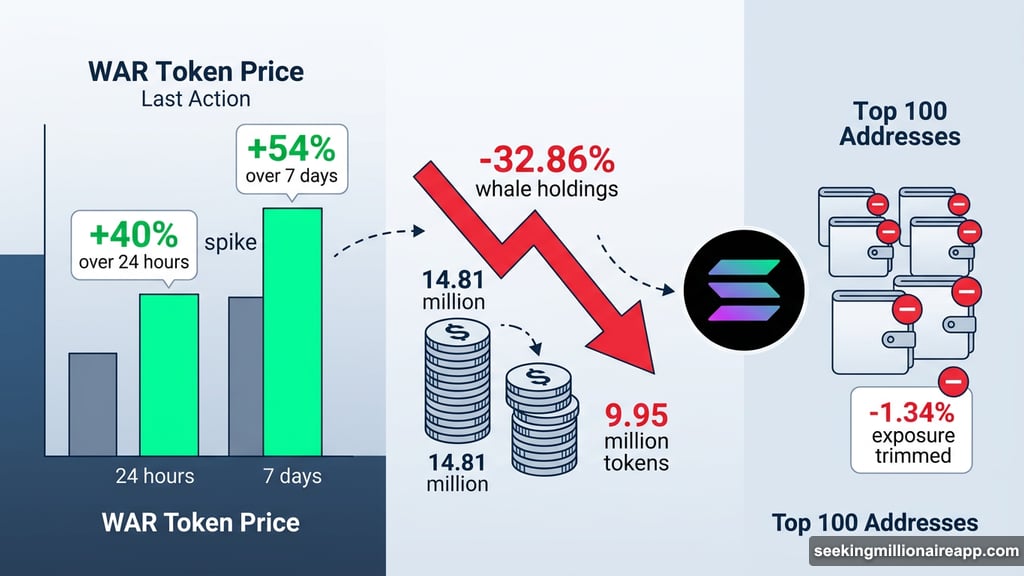
Here’s where things get ironic. A Solana-based token literally named WAR has surged over 40% in 24 hours and about 54% over the past week, directly coinciding with real-world war headlines dominating global media.
But large holders aren’t chasing it. They’re exiting.
On-chain data shows WAR whale holdings dropped by 32.86% in just 24 hours. That’s roughly 4.86 million tokens offloaded in a single day, pushing the total whale stash down to 9.95 million. Even the top 100 addresses trimmed exposure by 1.34%, a clear sign that large players are selling into strength rather than holding for more upside.
The technical picture supports that caution. On the hourly chart, bearish divergence is flashing. Between two candles on March 2, price printed higher highs while the Relative Strength Index (RSI) printed lower highs. RSI measures momentum on a scale from 0 to 100. When price rises but momentum falls, buying strength is fading. That setup often precedes a trend reversal.
For WAR to extend its rally, it needs a strong hourly close above $0.030, which would open the path toward $0.034. But if $0.026 support gives way, the next meaningful level sits near $0.020. That would represent roughly a 27% decline from current prices.
The combination of heavy whale selling and fading momentum makes the downside scenario more probable right now than another leg higher.
Uniswap Whales Trim Despite a Legal Win
The Uniswap (UNI) situation might be the most surprising of the three.
Just days ago, Uniswap secured a significant legal victory. A court ruled that open-source smart contract developers are not liable when scammers misuse their code. For a decentralized exchange protocol, that’s meaningful legal protection and a positive signal for DeFi’s long-term outlook.
And yet, whales have been selling.
Supply held by whale wallets (excluding exchanges) fell from 639.19 million UNI on February 27 to 637.61 million as of March 3. That’s a reduction of 1.58 million UNI. At current prices, that equals roughly $6.1 million worth of tokens quietly moved out of large wallets. Notably, the selling started before the full US-Iran conflict escalation, suggesting deliberate repositioning rather than panic.
![Chart showing Uniswap UNI cup-and-handle pattern with whale wallet supply reduction overlaid on price action]
The daily chart still shows a cup-and-handle formation that projects a potential breakout toward $6.18 if the pattern confirms. But the handle consolidation, which started around February 25, is stretching longer than expected. Between January 28 and March 2, price formed a lower high while RSI formed a higher high. That combination, known as hidden bearish divergence, often leads to short-term pullbacks even within broader uptrends.
For UNI to confirm strength, it needs to reclaim $4.40, the 0.618 Fibonacci retracement level. Above that, $4.99, $5.89, and $6.18 become realistic targets. But if price slips toward $3.53, the cup-and-handle structure weakens. A breakdown below $2.83 invalidates the pattern entirely.
The fact that whales are trimming despite bullish fundamental news suggests the recent DeFi rotation may have been short-term positioning rather than long-term conviction. The momentum that briefly lifted the sector appears to be fading for now.
What the Rotation Actually Signals
Taken together, these three moves paint a coherent picture. Whales aren’t running from crypto during the US-Iran conflict. They’re repositioning carefully, building selective exposure where smart money signals look promising and cutting exposure where momentum is deteriorating.
WHITEWHALE gets bought on a technical signal that previously preceded a massive rally. WAR gets sold despite a 40% pump because divergence suggests the move is exhausted. UNI gets trimmed despite positive legal news because the rotation into DeFi may have already run its course.
For traders, the lesson is straightforward. In high-volatility, news-driven environments, following whale positioning on-chain often tells a more useful story than following price alone. These wallets aren’t reacting to headlines. They’re reading data and moving accordingly.
Watching where the smart money flows, rather than where media attention points, tends to give you a cleaner picture of where things might actually be heading next.