
There was a time when a single tweet could move Bitcoin by double digits overnight. Now? The same kind of headline barely causes a ripple — at least not right away.
Something has quietly shifted in how crypto markets respond to news. The old playbook, the one built around instant reactions and headline-driven explosions, no longer works the way it used to. And if you’re still trading like it’s 2021, the market probably feels completely broken to you.
It isn’t broken. It’s grown up.
The Wild Days When Headlines Ruled Everything
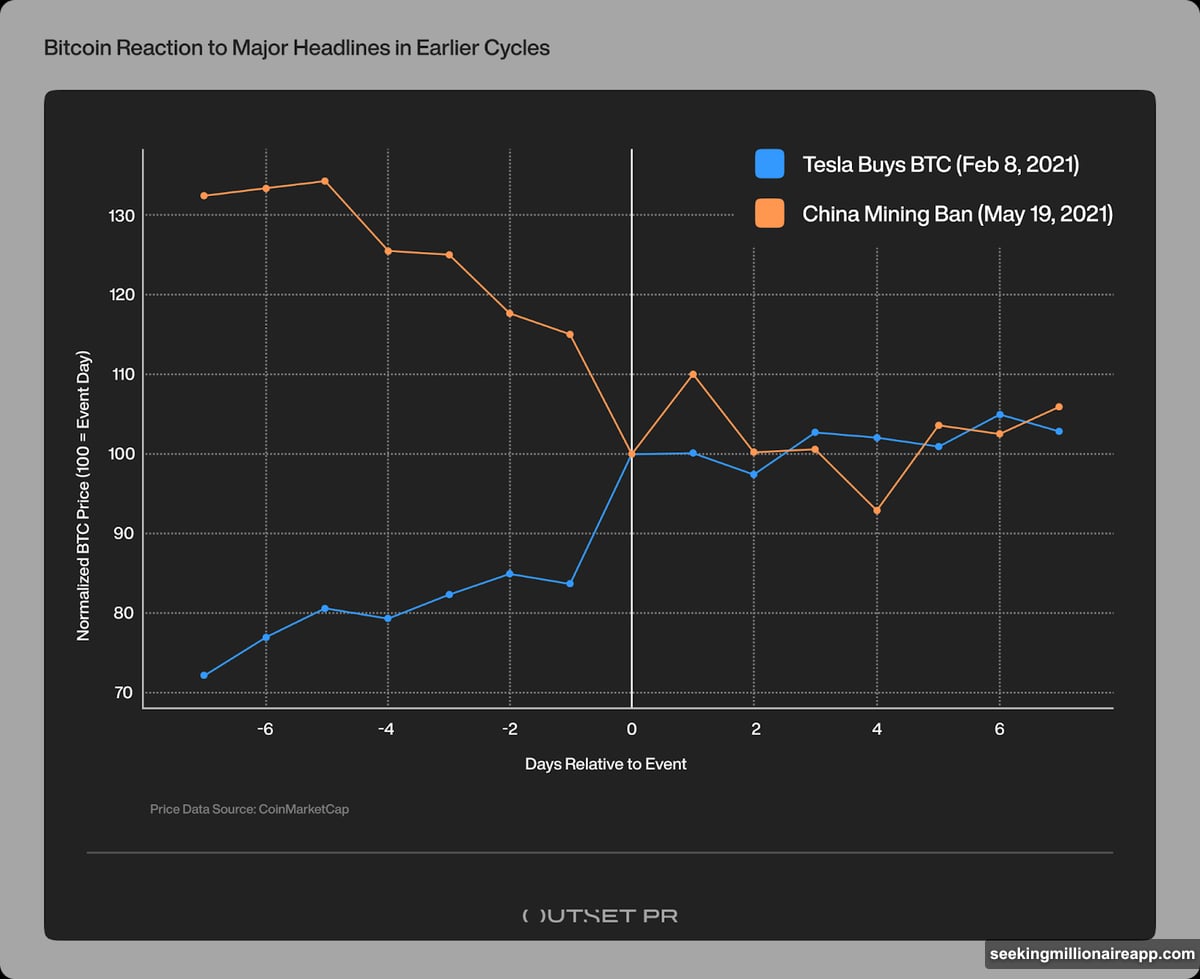
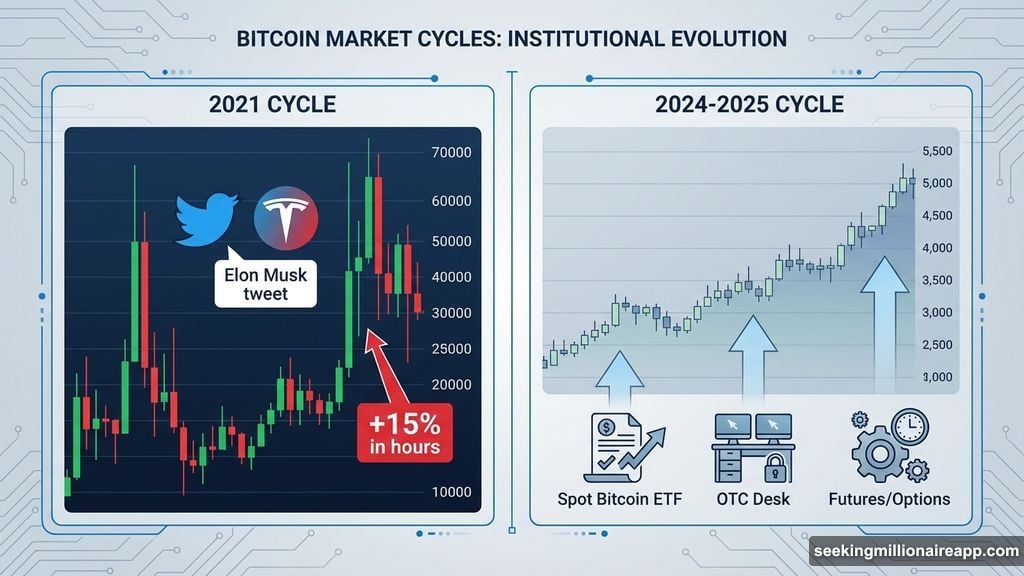
Cast your mind back to early 2021. Tesla announced it had purchased $1.5 billion worth of Bitcoin. At the time, Bitcoin was trading around $38,000. Within hours, it blasted past $44,000 — a 15% surge in a single session. No buildup, no gradual drift. Just a headline and an immediate explosion.
The same thing worked in reverse just months later. China intensified its Bitcoin mining crackdown in May 2021. Bitcoin fell from roughly $40,000 to near $30,000 in a matter of days. It didn’t drift lower. It collapsed. Panic selling triggered forced liquidations, which triggered more panic selling.
Back then, volatility wasn’t an exception. It was the baseline.
And it wasn’t just institutional announcements moving markets. Research analyzing Bitcoin and Dogecoin during the 2020–2021 cycle found statistically significant price and volume increases on days when Elon Musk posted about crypto. The effect on Dogecoin was particularly striking — its volatility response ran more than ten times stronger than Bitcoin’s on those days. A single influential voice could reshape the market in real time.
How Spot ETFs and Derivatives Changed Price Discovery
So why doesn’t that happen anymore? The short answer is that the market’s plumbing completely changed.
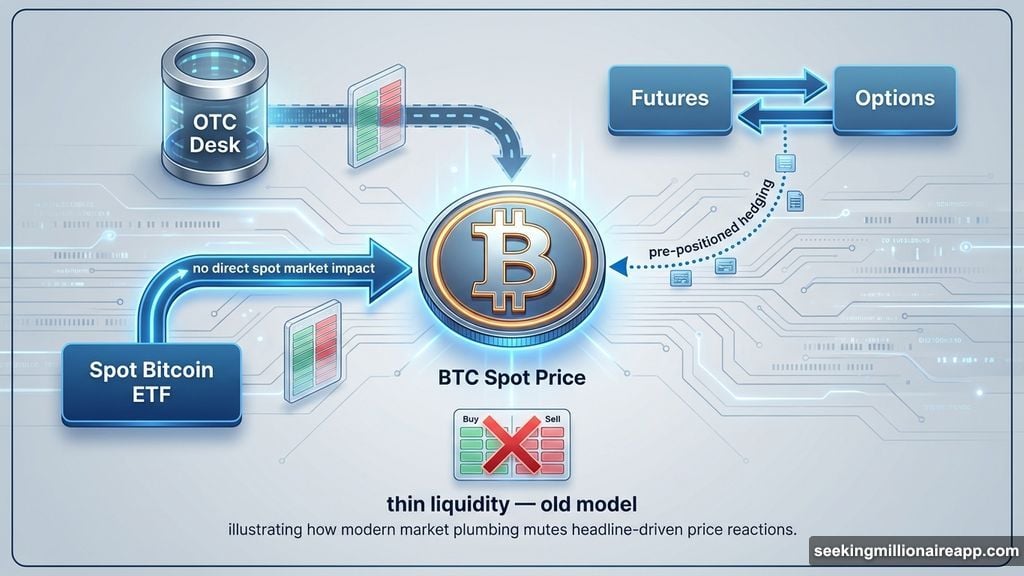
Earlier crypto cycles ran mostly on thin spot market liquidity. Big trades hit visible order books and immediately forced prices to adjust. Derivatives were less dominant, positioning was more transparent, and reactions clustered tightly around the moment news broke.
Today, large players build and hedge exposure through futures and options markets before major announcements even become public. Capital flows in and out through spot Bitcoin ETFs without ever hitting the open spot market directly. Massive trades route through over-the-counter (OTC) desks, absorbing volume quietly and away from public price feeds.
Together, these channels mute the sharp, black-and-white reactions that once defined earlier cycles. Whales can reposition without immediately forcing the price to respond. The market still moves — it just moves differently.
Gary Gensler’s Exit: A Perfect Case Study
Want a concrete example of how different things feel now? Look at what happened when Gary Gensler announced his departure as Chair of the U.S. Securities and Exchange Commission (SEC) in late 2024.
For crypto, this was genuinely significant news. Gensler had been the industry’s most aggressive regulatory adversary for years. His exit represented a meaningful shift in the regulatory landscape. In 2021, news like this would have triggered an immediate breakout candle and a flood of breathless headlines about the coming bull run.
Instead, Bitcoin was trading in the mid-$80,000s when news of his departure became public. Over the following weeks, it pushed toward $100,000. But the move unfolded gradually, with much of the appreciation happening before the leadership change became official in January 2025. No single breakout moment. No sudden repricing at the moment of confirmation.
The market had already priced in a broader regulatory shift. The official announcement was almost anticlimactic.
The 2025 Tariff Sell-Off: Calm Under Pressure
A similar pattern emerged during the macro-driven sell-off in February 2025. Rising U.S. tariff announcements pushed global markets into risk-off mode. Bitcoin slipped from just above $100,000 to the mid-$90,000s.
The decline was real. But it was measured, spread over several sessions rather than concentrated in a single shock. Compare that to the China mining ban in 2021, where the market felt like it was falling apart in real time. This time, price fell calmly. There was no panic cascade, no sense of structural failure.
Same magnitude of external pressure. Completely different emotional response from the market.
Bitcoin Now Trades Like a Macro Asset
This shift makes more sense when you consider the broader context. Bitcoin increasingly trades alongside equities, bonds, and commodities as a recognized macro asset. Institutional money now accesses it through regulated channels — primarily ETFs — rather than through the Wild West of earlier exchanges.
That means Bitcoin now responds more to liquidity conditions and capital flows than to isolated news events. Tighter global liquidity, reduced expectations of central bank bailouts, and more disciplined monetary policy have all reinforced this shift. The macro environment shapes Bitcoin’s behavior in ways that a single headline simply cannot override anymore.
And the volatility that remains? It looks different. Instead of sharp double-digit moves clustered around a single news event, you get multi-day trends where price often moves ahead of official announcements. The shape of volatility has changed from spiky and sudden to smoother and more drawn out.
What This Means If You’re Still Using the Old Playbook
Here’s the honest reality. If you’ve been waiting for explosive headline-driven moves like those in 2021, you’ve probably felt like you’re missing something. Every major announcement lands, and the market just… grinds. It moves, sure. But not with that electric, instant snap you remember.
That’s not a bug. That’s the new normal.
The “buy the rumor, sell the news” strategy assumed that markets were emotionally reactive and that news created immediate, sharp repricing. Both of those assumptions are weaker today than they were three years ago. Positioning and expectations now do most of the heavy lifting well before any announcement goes public.
Big players don’t broadcast their moves through obvious spot-market shocks anymore. They work quietly through derivatives, ETFs, and OTC channels. By the time a headline hits, the smart money has already adjusted.
The crypto market hasn’t stopped reacting to news. It stopped overreacting to it. And for anyone paying close attention, that distinction matters more than almost anything else right now.