
The first quarter of 2026 looked big on paper. A total of $20.57 trillion in crypto trading volume sounds impressive until you realize the market was still nursing serious wounds from late 2025.
A new quarterly report from CoinGlass tells the real story. Capital moved cautiously, liquidity pooled at the top, and one decentralized upstart crashed the top ten party. Here’s what the data actually shows.
Q4’s Crash Still Haunted Every Trade
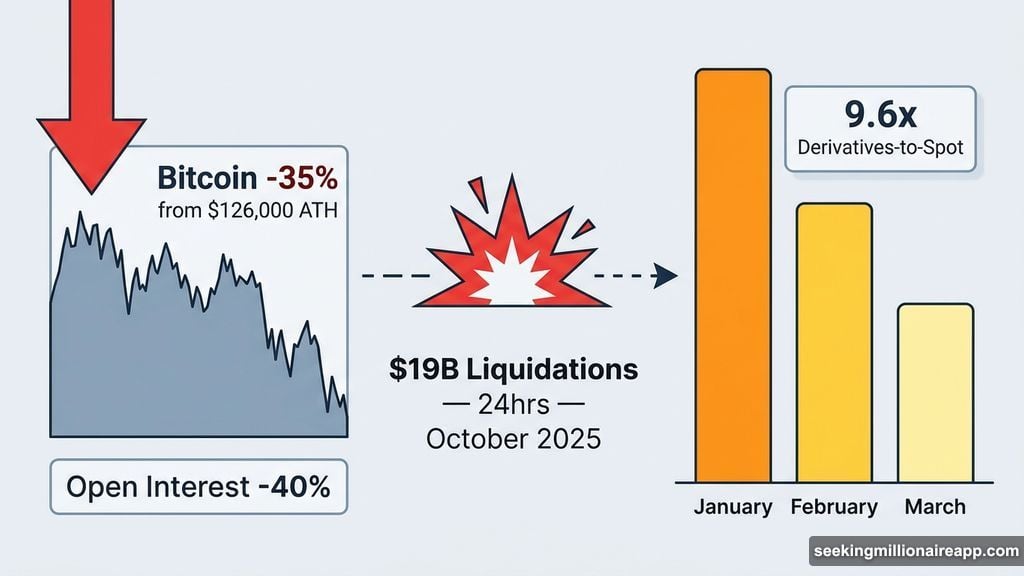
October 2025 hit the crypto market hard. A sudden tariff shock triggered $19 billion in liquidations within a single 24-hour window. That’s the largest single-day deleveraging event in crypto history.
Bitcoin dropped roughly 35% from its all-time high above $126,000. Open interest across exchanges fell more than 40%. By January, things had stabilized enough to trade again, but barely.
Total Q1 volume split into $1.94 trillion in spot and $18.63 trillion in derivatives. Each month posted lower numbers than the one before. January ran hottest, March ran coldest.
The derivatives-to-spot ratio held steady at about 9.6x throughout the quarter, sitting just above the 2025 full-year average. That number tells you something important. Traders weren’t making bold directional bets in spot markets. Instead, they were hedging and positioning through futures, playing it safe while the market found its footing.
Binance Dominated Every Single Metric
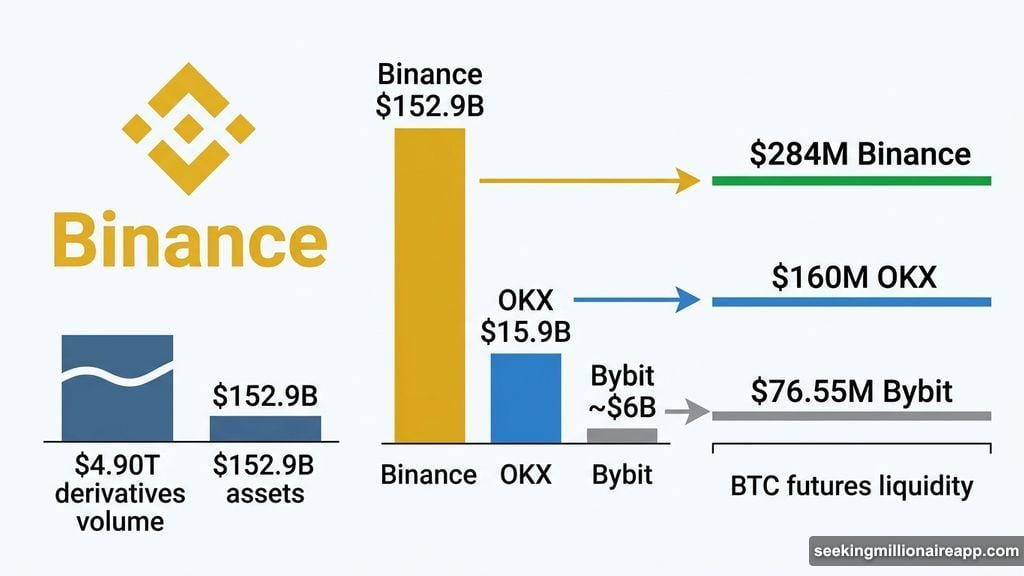
CoinGlass measured exchanges across four categories: trading volume, open interest, order book depth, and user asset reserves. Binance ranked first in all four. No exceptions.
In derivatives volume, Binance posted roughly $4.90 trillion for the quarter. That’s a 34.9% share among the top ten exchanges. More striking, that figure topped the combined totals of OKX at $2.19 trillion and Bybit at $1.49 trillion.
Daily open interest averaged $23.9 billion for Binance. Bybit came in second at roughly half that figure.
The liquidity depth gap looked just as wide. In BTC futures, Binance’s average two-sided depth within 1% of the mid-price sat at approximately $284 million. OKX followed at $160 million, and Bybit trailed at $76.55 million. That same pattern repeated across BTC spot, ETH futures, and ETH spot markets.
But the most striking number involved user asset reserves. Binance held roughly $152.9 billion in custodial assets. That represents 73.5% of the top ten exchanges combined. OKX finished a distant second at $15.9 billion. Gate, Bitget, and Bybit all clustered between $5 billion and $7 billion.
That custody gap dwarfs Binance’s lead in trading or open interest. According to CoinGlass, asset retention reflects brand trust, product ecosystem breadth, and on/off-ramp convenience. So it signals a stronger long-term competitive position than raw volume numbers alone.
Hyperliquid Crashed the Top Ten
One of the quarter’s biggest surprises came from an entirely different corner of the market.
Hyperliquid, a decentralized derivatives protocol, posted approximately $492.7 billion in Q1 trading volume. That was enough to land it inside the top ten exchanges for the first time. Its average daily open interest ran around $6.0 billion, peaking at $9.7 billion. That puts it in the same conversation as mid-tier centralized platforms like Bitget.
CoinGlass had actually called this in their 2025 annual report. Decentralized derivatives were shifting from interesting experiment to genuine market share competition. Hyperliquid’s Q1 performance validated that prediction.
The broader finance world took notice too. JPMorgan flagged Hyperliquid in a March report, noting that demand for round-the-clock access to traditional assets was fueling decentralized exchange growth. Grayscale also filed an S-1 for a HYPE exchange-traded fund in March, seeking a Nasdaq listing.
Hyperliquid still sits far below the leading centralized exchanges in absolute scale. But its entry into the competitive space adds real pressure on second-tier platforms fighting for derivatives market share. Mid-tier players can no longer dismiss decentralized protocols as niche.
What Q2 Is Watching
CoinGlass highlighted three variables that could shape the next quarter. First, the Federal Reserve’s monetary policy path. Second, changes in Bitcoin spot ETF fund flows. Third, progress on regulatory framework implementation across major jurisdictions.
Any shift in those three areas could change the picture quickly, either accelerating recovery or introducing fresh headwinds.
Q1 wasn’t a comeback story. It was a stabilization story. Capital concentrated at the strongest platforms, derivatives trading reflected caution rather than confidence, and a decentralized challenger proved it belongs in the same conversation as established names.
The lines between platforms that attract capital and those that risk falling behind are getting sharper. And based on what Q1 showed, Binance’s grip on the top looks tighter than ever while everyone else scrambles to hold their position.