
Ethereum just punched back above $2,000, briefly touching $2,200 for the first time since February 5. That sounds like a victory lap moment. But a closer look at the data suggests bulls should hold off on the champagne for now.
Here’s why the March picture is more complicated than the price tag suggests.
Binance Trading Volume Hits a Six-Month High
The raw numbers from CryptoQuant are striking. Over the past 30 days, ETH trading volume on Binance reached roughly 29.6 million ETH. That’s the highest level since September of last year.
But here’s the catch. The actual ETH supply sitting on Binance is only about 3.5 million ETH. So you’ve got an enormous volume of trades chasing a much smaller pool of available coins. That gap matters a lot.
Meanwhile, more than 31.6 million ETH were pulled off exchanges in February 2026 alone. That’s the biggest exchange outflow since November of the previous year. Combined, these two trends created a very unusual market condition.
What the Liquidity Ratio Tells Us About Speculative Positioning
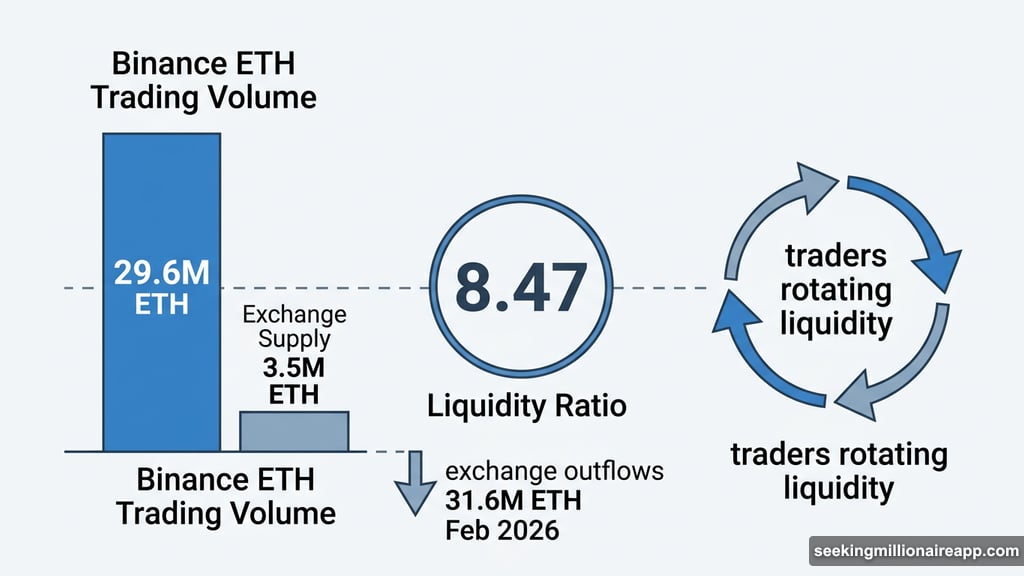
When you divide trading volume by the actual supply available on exchanges, you get the Liquidity Ratio. Right now, that number sits at around 8.47 for ETH on Binance.
To put that in plain terms: the same ETH is being traded back and forth roughly eight times over within a short window. Traders are rotating liquidity rather than making clean, directional bets.
CryptoQuant analyst Arab Chain flagged exactly this pattern. According to Arab Chain, it reflects extremely active trading driven largely by speculation. Traders may be scalping short-term price moves, or using ETH as collateral in futures and perpetual contracts. These strategies can push volume sky-high without any real increase in underlying supply.
“This pattern often emerges during periods of significant price volatility or when the market is undergoing a repositioning phase among investors,” Arab Chain noted.
Historically, high Liquidity Ratio readings have lined up with sharp price swings and rising risk appetite. But they’ve also created environments where sudden liquidations hit traders hard. So the elevated activity cuts both ways.
The SuperTrend Resistance Nobody Should Ignore
Plenty of analysts feel good about ETH closing back above $2,000. But market analyst IncomeSharks offered a more cautious read of the daily chart.
His analysis shows ETH still trading below the SuperTrend line near $2,230. That level currently acts as meaningful resistance. One strong daily candle doesn’t change the structural picture.
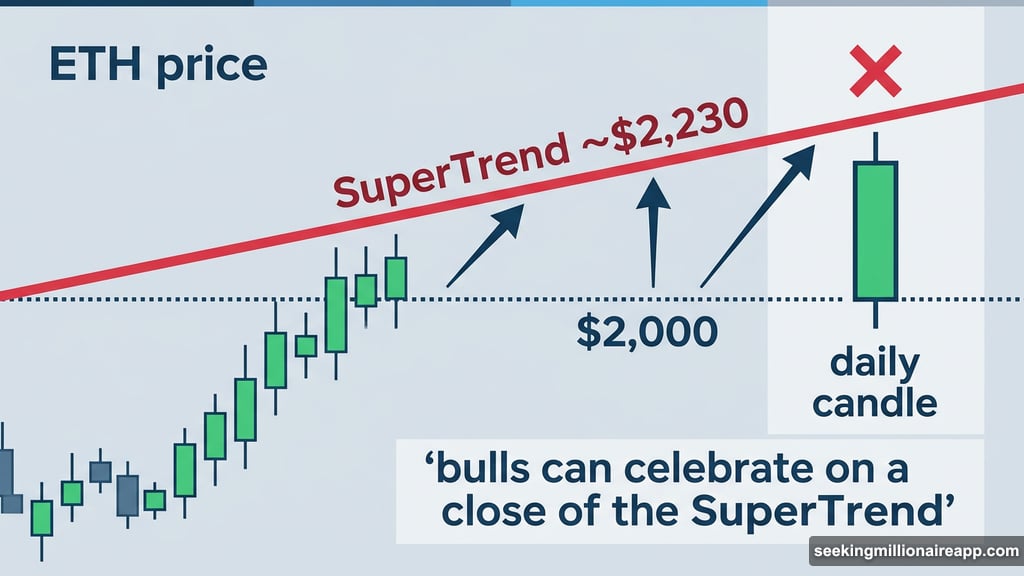
“A nice daily candle is good to see but means nothing if it’s not followed by more. The bulls can celebrate on a close of the SuperTrend or after we see follow through,” IncomeSharks stated.
That’s an important distinction. Price breaking above a round number like $2,000 feels significant. But technical analysts tend to care more about sustained closes above defined resistance levels than single-session spikes.
ETH Needs to Clear $2,140 to Exit the Sideways Trap
According to BeInCrypto’s latest analysis, Ethereum needs a confirmed close above $2,140 to officially break out of the sideways range it’s been stuck in since early February.
Until that happens, the current move looks more like a bounce than a reversal. And without follow-through from buyers, prices could drift back toward lower support levels.
The combination of high speculative volume, thin exchange supply, and unbroken overhead resistance makes for a tricky setup. Excitement is understandable after weeks of grinding sideways action. But the market hasn’t delivered a clean confirmation signal yet.
Watching how ETH handles that $2,140 to $2,230 resistance zone over the next few sessions will tell us a lot more than any single price spike can.