
The Ethereum Foundation just made headlines for all the right and wrong reasons at the same time.
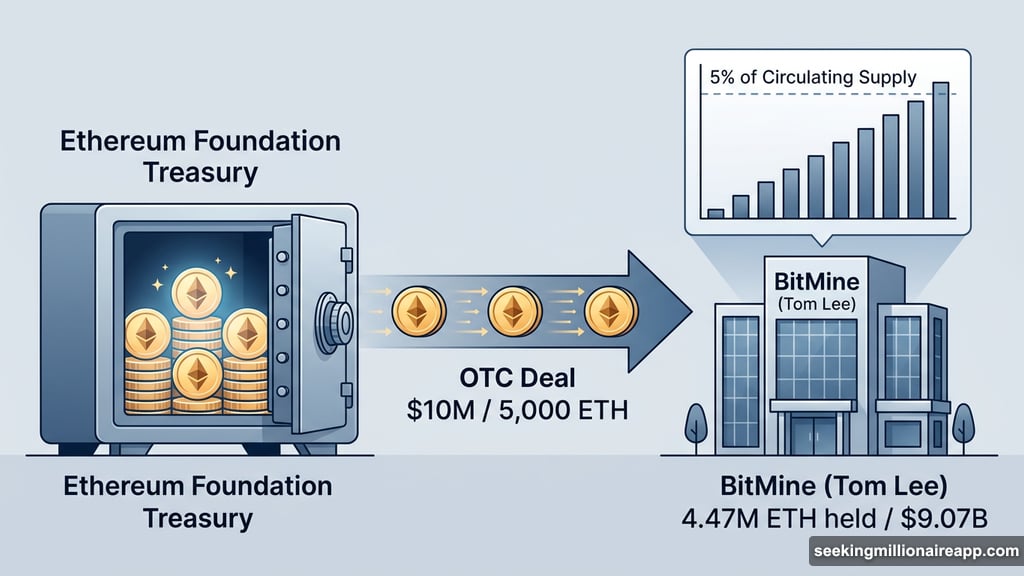
On March 14, the non-profit organization behind Ethereum’s blockchain confirmed it sold 5,000 ETH directly to BitMine through an over-the-counter transaction. The deal, executed at an average price of $2,042.96 per token, brought in roughly $10 million to fund core operations. But it’s not the sale itself that has the crypto community talking. It’s who bought those tokens.
BitMine’s Push Toward 5% Supply Control
BitMine isn’t just any corporate buyer. The Tom Lee-led firm currently holds more than 4.47 million ETH, worth approximately $9.07 billion at current prices. That makes it the single largest corporate holder of Ethereum in existence.
More importantly, BitMine hasn’t been quiet about its ambitions. The company has publicly stated its goal to capture 5% of Ethereum’s total circulating supply. And the Foundation just handed them another 5,000 tokens to get there.
In a proof-of-stake network like Ethereum, token holdings directly translate to voting power and consensus influence. So the more ETH BitMine accumulates, the more sway it holds over network decisions. That dynamic sits awkwardly alongside the Ethereum Foundation’s longtime commitment to decentralization.
A Foundation Quietly Reinventing Itself
This sale reflects something bigger than one transaction. The Ethereum Foundation is undergoing a significant strategic overhaul, and the changes are coming fast.
Following the deal, the Foundation now holds just over 200,000 ETH, valued at roughly $424 million. That’s a shrinking treasury runway, and the organization clearly feels the pressure. Last month, the Foundation broke from its long-standing policy of keeping assets idle and staked 70,000 ETH to generate yield. The original hands-off approach was designed to avoid influencing network consensus. Now, staking rewards will flow toward ecosystem development and community grants.
Also notable is the Foundation’s new governance manifesto, released alongside these financial moves. The document binds the Foundation and its staff to strict ideological standards centered on decentralization and open-source principles. It explicitly rules out involvement with protocols considered “surveillance-friendly” or “centralization-dependent.”
The irony here is hard to miss. The Foundation is loudly committing to decentralization in writing while simultaneously selling a large block of tokens to a firm aggressively consolidating Ethereum supply.
Leadership Changes Add to the Turbulence
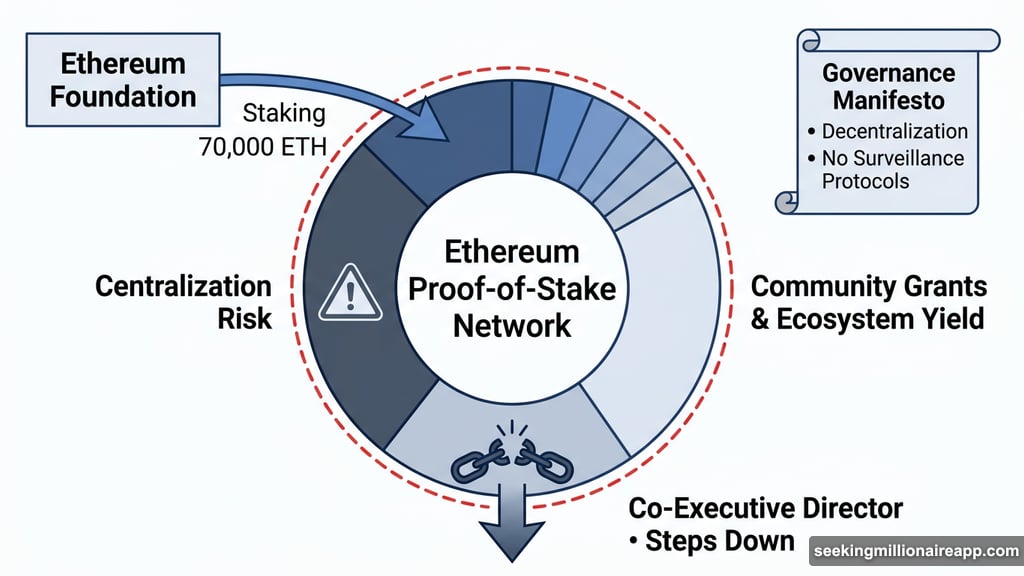
The strategic shifts don’t stop at finances and governance. Earlier this month, Co-Executive Director Tomasz Stańczak stepped down abruptly. Bastian Aue has since taken over as interim replacement.
Leadership transitions during periods of financial and policy change tend to create uncertainty. For a foundation steering one of the world’s most valuable blockchain ecosystems, that uncertainty carries real weight. Community members and developers watching these moves closely will want to see how Aue’s interim leadership shapes the Foundation’s direction in the months ahead.
What This Means for Ethereum’s Decentralization Story
Here’s the tension worth sitting with. Ethereum’s entire value proposition rests on being a decentralized, trust-minimized network. The Foundation has long positioned itself as a steward of those values, not just a financial operator.
But selling directly to BitMine, a company openly racing toward 5% supply control, sends a complicated signal. Yes, the Foundation needed liquidity. Yes, over-the-counter deals with known buyers are common practice. Still, the choice of counterparty matters when decentralization is supposedly your north star.
The Foundation’s new governance manifesto and its staking strategy suggest it wants to be seen as leaning harder into its core values. Whether the BitMine deal contradicts that narrative or simply reflects financial pragmatism depends on who you ask. What’s clear is that the Ethereum Foundation is navigating a delicate balancing act right now, and the entire crypto ecosystem is watching how it manages the tightrope between sustainability and principle.