
The Ethereum Foundation just made a move that turned heads across the crypto world. On April 8, 2026, the organization converted 5,000 ETH into stablecoins — worth roughly $11 million at current prices.
But this wasn’t panic selling. Far from it. The move is part of a carefully planned treasury overhaul that’s been quietly reshaping how one of crypto’s most influential organizations manages its money.
CoW DAO’s TWAP Feature Does the Heavy Lifting
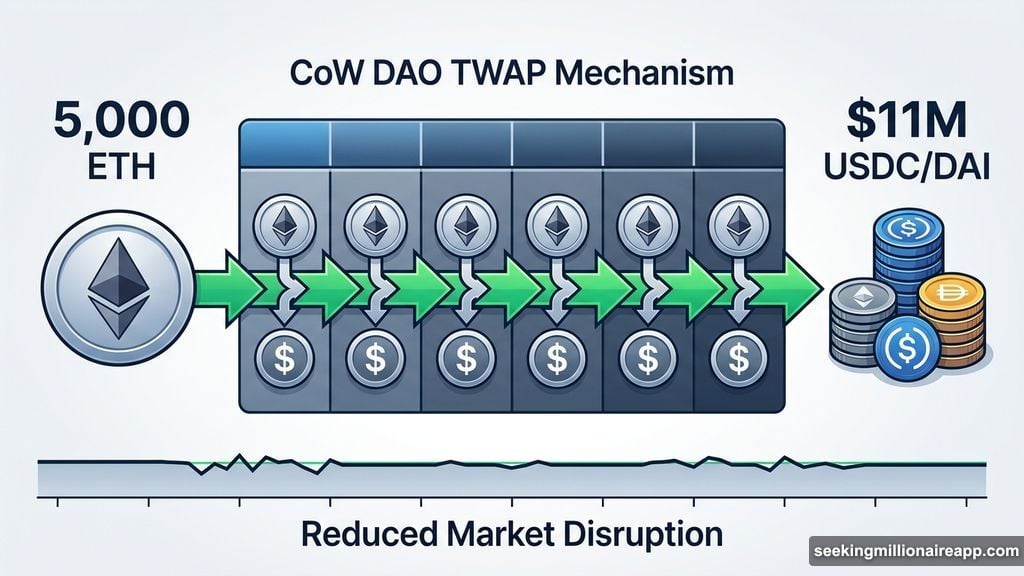
The Foundation didn’t just dump 5,000 ETH on the open market all at once. Instead, it used CoW DAO’s time-weighted average price (TWAP) mechanism to spread the sale over time.
Think of TWAP like selling a house slowly through multiple small auctions rather than one giant fire sale. The result? Less market disruption. Prices stay steadier, and the Foundation gets a fairer average rate across the full transaction.
That’s smart treasury management. And it shows the EF is thinking carefully about market impact, not just moving fast.
A Treasury Policy Built on “Defipunk” Principles
The sale connects directly to a framework the Ethereum Foundation published back in June 2025. That document laid out strict rules for how the organization handles its money.
Under the policy, annual operating expenses are capped at 15% of total treasury value. The Foundation also maintains a 2.5-year cash buffer as a safety net. Whenever fiat reserves dip below their target level, periodic checks trigger ETH sales over the following quarter to top things back up.
So this latest conversion isn’t a surprise — it’s the policy working exactly as designed.
Beyond the numbers, the framework reflects something bigger. The EF is committing to what it calls “Defipunk” principles. That means deploying capital through permissionless, privacy-preserving, open-source protocols whenever possible.
Solo Staking, DeFi Lending, and On-Chain Strategy
The treasury policy goes further than simple expense management. The EF is actively moving its on-chain strategy toward DeFi participation.
That includes solo staking ETH to earn yield, lending through established protocols, and potentially borrowing stablecoins. For a major institutional holder, that’s a genuinely interesting approach.
Plus, the Foundation set clear criteria for which DeFi protocols qualify. Projects must support self-custody, use free and open-source code, and minimize reliance on oracles and admin keys. Privacy features rank especially high on their checklist.
Why the emphasis on privacy? The EF argues it protects participants from front-running, targeted phishing, and even physical coercion. That’s a serious and thoughtful position — not just idealism.
Five Years to a Leaner Foundation
Here’s where the long-term plan gets interesting. The Ethereum Foundation has publicly committed to cutting its annual spending rate from 15% down to just 5% over the next five years.
That’s a dramatic reduction. It signals the organization plans to shrink its operational footprint significantly over time.
Still, the policy frames 2025 and 2026 as pivotal years for Ethereum’s development. So elevated spending right now makes sense — there’s heavy work to fund, including research, grants, and ecosystem donations. The Foundation is spending while it matters most, then tightening up afterward.
How Did the Market React?
ETH was trading at $2,212 at press time, up 6.5% in the previous 24 hours. Markets absorbed the conversion news without any meaningful sell-off.
That’s telling. Historically, EF selling activity has drawn community concern and occasional price pressure. This time, the transparent framework and measured execution seem to have kept confidence steady.
When organizations communicate their strategy clearly in advance, markets tend to react calmly. The EF seems to have learned that lesson well.
The Foundation’s approach here is worth watching as a model. Large treasury holders across the crypto space often move chaotically, spooking markets and frustrating communities. The EF’s structured, philosophy-driven framework offers a different path — one built on transparency, DeFi participation, and long-term discipline.