
The crypto market has been rattled by fear and uncertainty lately. Yet one corner of the blockchain world is quietly booming, and Ethereum sits right at the center of it.
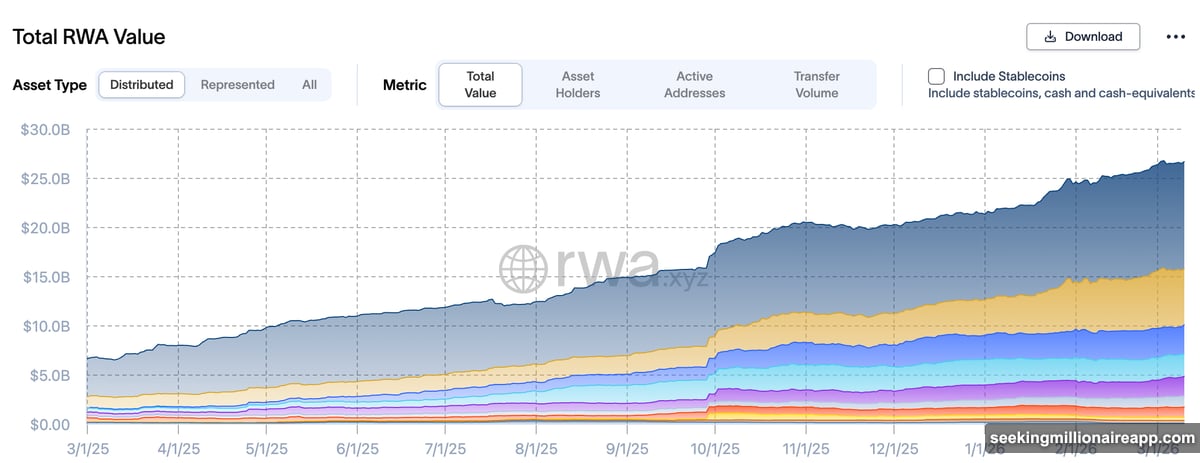
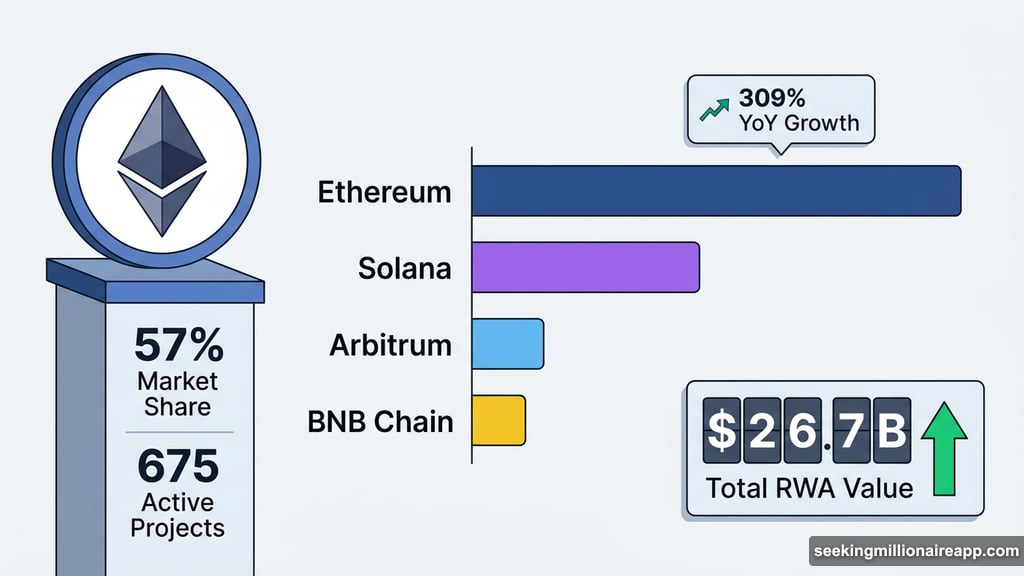
Tokenized real-world assets (RWA) just hit an all-time high of $26.7 billion in early March 2026, according to data from RWA.xyz. That figure represents a staggering 309% jump from just $6.5 billion a year earlier. And through all of it, Ethereum has held onto its throne as the go-to blockchain for institutional money.
Tokenized RWA Market Hits Record Highs
The numbers here are genuinely impressive, especially given the broader market mood.
While crypto sentiment has been stuck in “extreme fear” territory recently, tokenized RWAs have kept climbing. The total on-chain distributed RWA value nearly quadrupled in just one year. That kind of growth, in that kind of environment, tells you something important about where institutional confidence is actually landing.
Holder counts have spiked too. Ethereum, Solana, Arbitrum, and BNB Chain all saw sharp increases in early 2026. The ecosystem is expanding across multiple networks, not just concentrating in one place.
Solana Leads in Holders, But Ethereum Leads in Everything Else
Here’s where it gets interesting. Solana recently passed Ethereum for the first time in terms of RWA holders, sitting at roughly 157,682 compared to Ethereum’s count. That’s a notable milestone for Solana.
But holder count is just one piece of the picture. When you look at actual market share and infrastructure depth, Ethereum still dominates by a wide margin.
Ethereum currently controls more than 57% of the distributed RWA market. It also supports around 675 active tokenization projects, making it the clear leader in institutional-grade blockchain infrastructure. Solana winning on holder numbers is real progress, but Ethereum winning on value and project count is what matters most to Wall Street right now.
JPMorgan and the Institutional Vote of Confidence
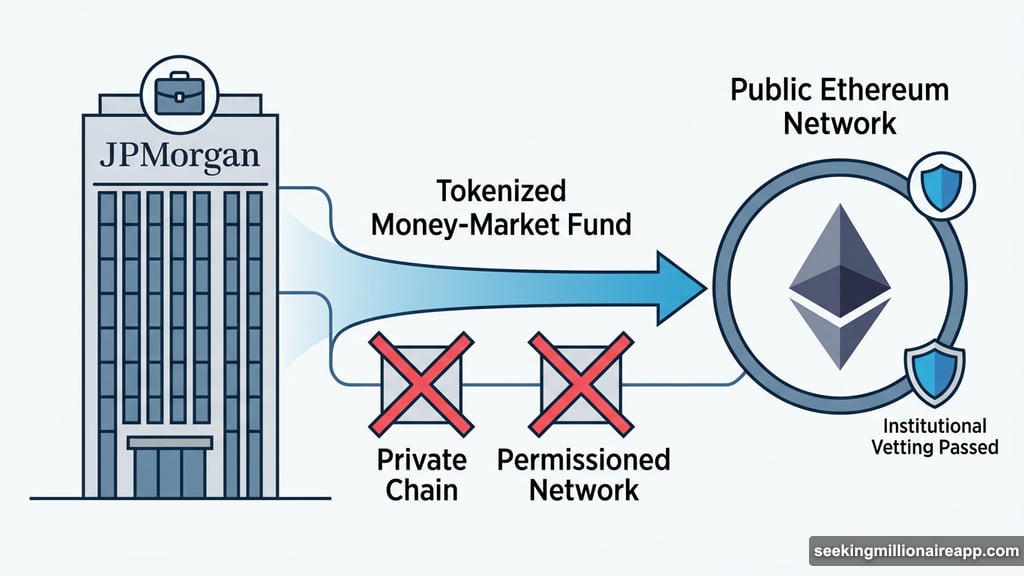
Sometimes one headline says more than a thousand data points. In December, JPMorgan launched its first tokenized money-market fund directly on Ethereum. Not on a private chain. Not on a permissioned network. On Ethereum.
That kind of move from one of the world’s largest banks signals something beyond experimentation. It suggests Ethereum has passed a serious institutional vetting process, and institutions don’t make those calls lightly.
Why Risk-Averse Banks Choose Ethereum
So what actually drives institutions toward Ethereum? It turns out the answer has less to do with technology and more to do with risk management.
Geoff Kendrick, Global Head of Digital Asset Research at Standard Chartered, put it plainly in comments shared with BeInCrypto. He argued that most TradFi blockchain activity over the next couple of years will happen on Ethereum, almost by default.
“I think Ethereum probably wins for the next little while on the back of TradFi getting involved,” Kendrick said. “As banks and others build stuff on the blockchain, it’s almost all going to happen on Ethereum for the next couple of years.”
His reasoning gets even more revealing when you dig into the incentive structure of big financial institutions. There’s a well-known saying in traditional finance: if you do something sensible and it goes wrong, you keep your job. But if you do something unconventional and it fails, you probably don’t.
That mindset shapes everything. Ethereum is the sensible, defensible choice. Choosing a less established network might offer technical advantages, but it introduces career risk for the decision-maker. So institutions gravitate toward Ethereum because it’s the choice they can explain and defend.
Could Permissioned Blockchains Challenge Ethereum?
Not everyone is fully sold on public blockchains for institutional use, and that’s a fair conversation to have.
Private and permissioned blockchains offer real advantages for large institutions: tighter privacy controls, regulatory compliance tools, faster transaction speeds, and more predictable costs. Those are genuinely attractive features when you’re managing billions in assets and have compliance teams looking over your shoulder.
Bitwise CIO Matt Hougan acknowledged this tension. He noted that many institutions are “putting their toes in the water” with more controlled blockchain environments. And he suggested that permissioned networks could eventually gain significant traction as institutional adoption matures.
But here’s the tradeoff. Permissioned blockchains sacrifice the openness and decentralization that make public blockchains valuable in the first place. For institutions that want interoperability, liquidity, and transparency, those are hard things to give up.
For now, Ethereum holds a rare combination that institutions seem to want: established credibility, deep liquidity, a massive developer ecosystem, and a public track record long enough to feel trustworthy.
What Comes Next for Ethereum’s RWA Dominance
Kendrick also left the door open for alternative networks further down the road. Lower costs and faster transactions, traits associated with chains like Solana, will matter more as adoption scales. So Ethereum’s current lead isn’t guaranteed forever.
Still, the near-term picture looks solid. Wall Street is actively building on Ethereum now. The infrastructure is already in place. And switching costs, once a network is embedded in institutional workflows, can be enormous.
Ethereum’s 57% market share will face real pressure as competition intensifies. But if the past year of 309% RWA growth is any indication, the bigger story is that the whole sector is expanding fast. And Ethereum is currently the main beneficiary of that expansion.
Watching how this plays out over the next 12 to 24 months will be one of the more fascinating stories in crypto. The institutions have placed their bets. Now we see if Ethereum can hold the lead.