
Ethereum bounced 4.6% off its recent low near $2,160. On the surface, that looks like relief after a brutal 37% crash since mid-January.
But dig into on-chain data, and the picture darkens. Long-term holders—the smart money that usually accumulates during weakness—have nearly stopped buying. Meanwhile, every price bounce triggers a fresh wave of exchange deposits. That’s not how bottoms form.
If this pattern continues, ETH could revisit $1,500 or lower. Here’s what the data actually shows.
Falling Wedge Held, But Conviction Collapsed
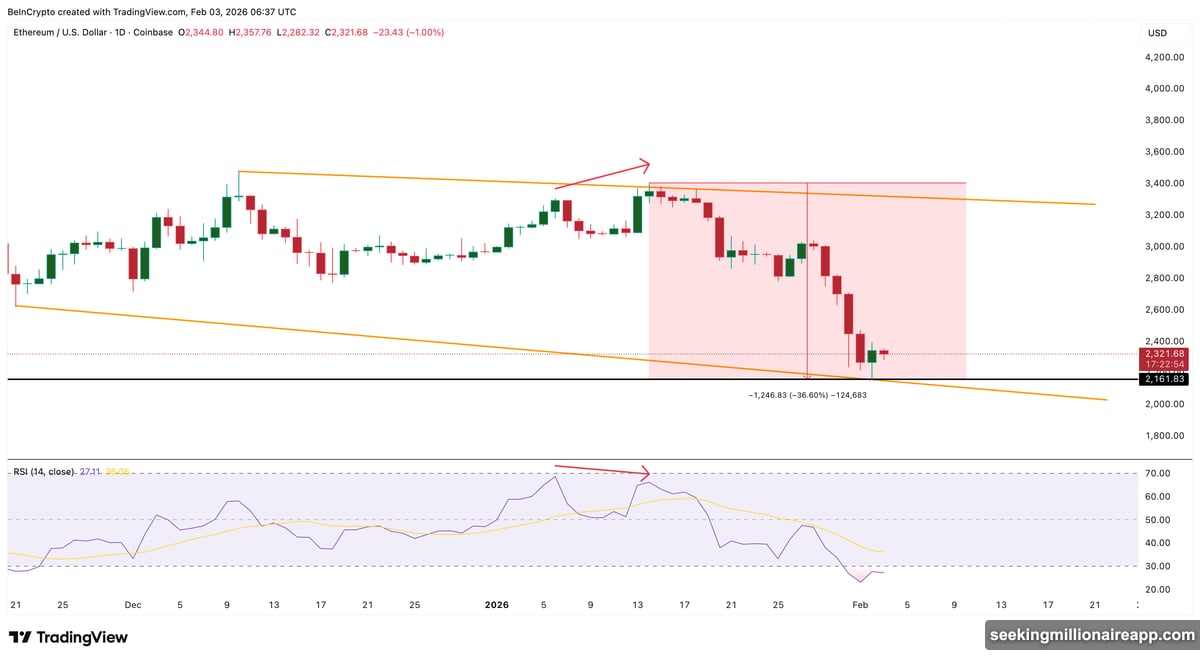
Since January 6, Ethereum formed a textbook falling wedge pattern. Price made lower highs and lower lows inside converging trendlines. Plus, the Relative Strength Index (RSI) showed bearish divergence. ETH hit a higher high around mid-January, but RSI made a lower high.
That divergence signaled fading momentum. So the 37% drop that followed made sense. Yet the wedge structure itself never broke. Falling wedges typically resolve upward when selling pressure exhausts itself.
However, there’s a problem. The pattern still holds, but long-term holder behavior tells a different story.
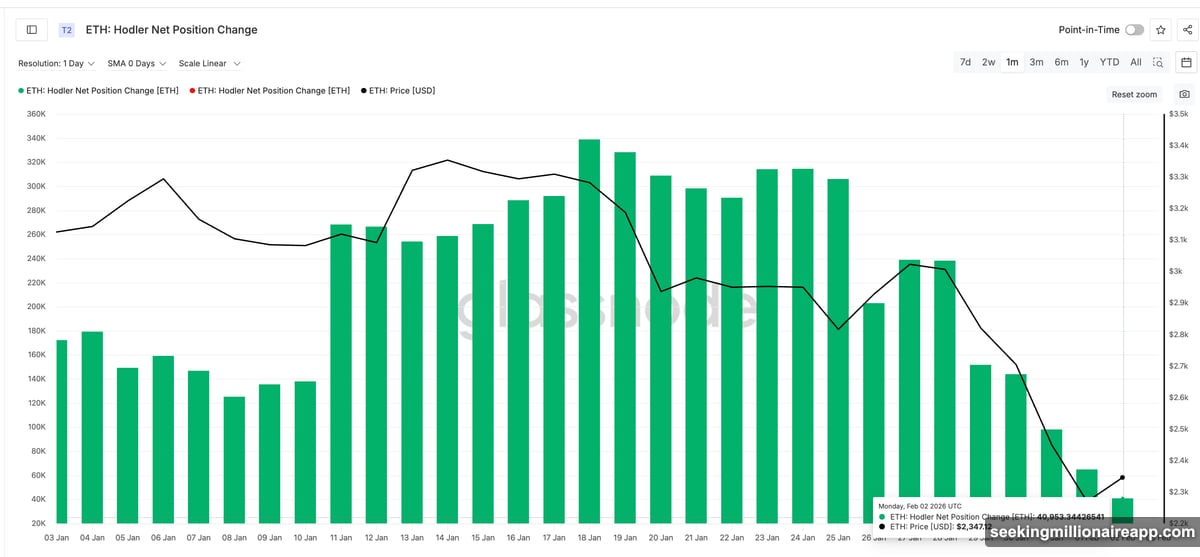
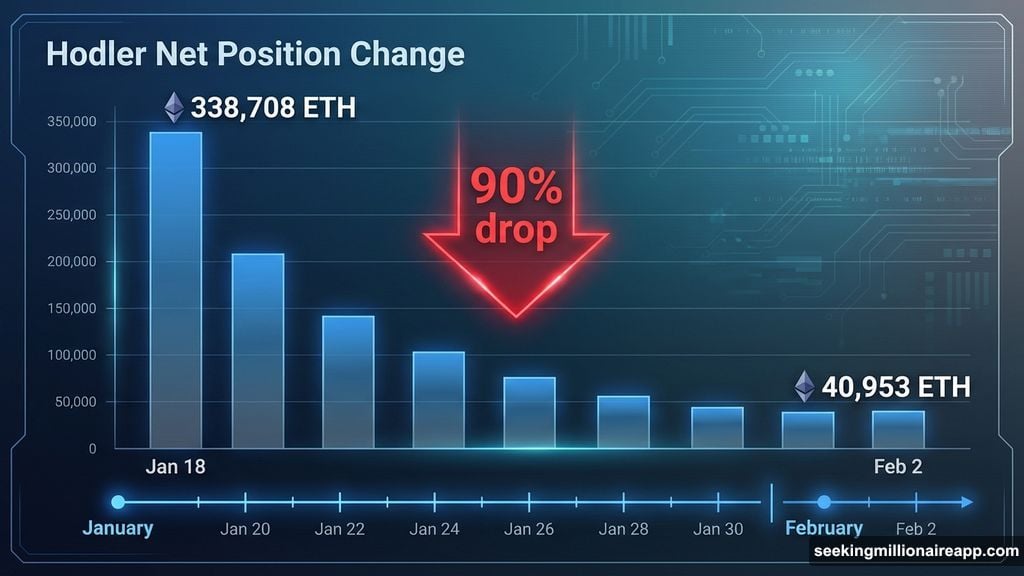
Hodler Net Position Change measures whether seasoned investors are accumulating or distributing. On January 18, the 30-day net position change peaked near 338,708 ETH. That showed strong accumulation during the early part of the dip.
By February 2, that figure crashed to around 40,953 ETH. That’s a drop of roughly 90% in just two weeks. So the very investors who should be buying the dip have almost completely stopped.
Strong bottoms form when long-term holders keep accumulating even as prices fall. That’s not happening now. Instead, conviction has evaporated right when it matters most.
Paper Profits Vanished, But Capitulation Hasn’t Hit Yet
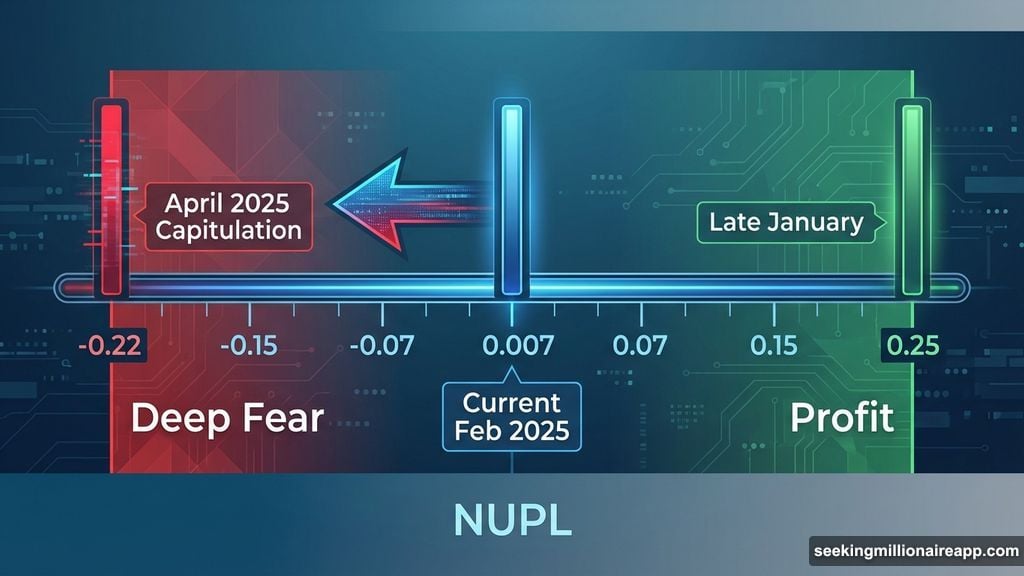
Ethereum’s Net Unrealized Profit/Loss (NUPL) tracks how much profit or loss holders have on paper. It compares current prices with the average purchase price across all coins. High NUPL means most investors sit in profit. Negative NUPL means widespread losses.
In late January, NUPL dropped from around 0.25 to near 0.007 by February 1. That means paper profits almost completely disappeared. But here’s the catch: NUPL hasn’t turned deeply negative yet.
On a one-year view, NUPL remains far above true capitulation levels. In April 2025, NUPL fell to −0.22. That marked deep fear and max pain. After that bottom, ETH rallied from about $1,472 to $4,829—a surge of roughly 228%.
Today’s NUPL sits at 0.007. That’s neutral, not capitulation. So despite the 37% crash, the market hasn’t reached the kind of fear level that historically precedes strong recoveries.
This suggests there may still be room for further downside before a durable bottom forms. Until NUPL resets closer to April 2025 levels, any rally risks running out of steam quickly.
Exchange Transfers Spiked During the Rebound
Exchange transfer data adds another warning sign. During the late-January crash, the number of transfers to exchanges fell to around 23,000–24,000 per day. That showed reduced selling pressure near the lows.
But between February 1 and February 2, transfers jumped above 37,000. That’s a rise of more than 50% in one day. So the rebound triggered a fresh wave of coins moving to exchanges.
When every bounce brings a spike in exchange deposits, it signals distribution, not accumulation. Holders are using rallies to sell, not to add to positions. That pattern keeps upward moves weak and fragile.
Gil Rosen, Co-Founder of the Blockchain Builders Fund, explained the split in market behavior:
“There are two separate capital flows. There is institutional capital that was beginning to heavily invest in crypto across all asset classes, and then there are retail flows. Institutional capital is always macro first, and when markets shift, crypto is still viewed as a risk asset. Meanwhile, short-term speculative capital surged in Q4.”
This divide between long-term institutional capital and short-term speculative flows helps explain why rallies keep failing. Speculative traders are selling into strength, while institutional buyers haven’t returned in force yet.
Key Price Levels Show Why $1,500 Is Back in Play
With structure holding but conviction weakening, Ethereum’s price levels now matter more than indicators. The first key support sits near $2,250. This level has acted as a short-term base after the recent bounce.
Below that, $2,160 remains critical. This marks the recent low and sits close to the lower boundary of the falling wedge. A confirmed break below this zone would weaken the bullish structure.
If $2,160 fails and the wedge breaks, risk opens toward the $1,540 region. This is a key Fibonacci extension level to the downside. A drop to $1,540 would also bring NUPL closer to historical capitulation levels. That’s where a deeper reset could finally occur.
On the upside, Ethereum must reclaim $2,690 to change the narrative. This level marks major Fibonacci resistance and a prior breakdown zone. Only a sustained move above $2,690 would signal that buyers are regaining control.
Until then, rallies between $2,250 and $2,690 are likely to face heavy selling pressure. As long as ETH remains trapped in this range, every bounce risks becoming another exit opportunity.
The Rebound Might Just Be Another Distribution Event
Ethereum’s 4.6% bounce looks like relief after a sharp drop. But on-chain data shows it’s probably just another distribution event. Long-term holders have slashed accumulation by 90%. NUPL hasn’t reset to capitulation levels. And exchange transfers spike every time price bounces.
These patterns suggest the market hasn’t found a true bottom yet. If this behavior continues, Ethereum could revisit $1,500 or lower before a durable recovery begins.
The falling wedge structure still holds. That’s technically bullish. But without conviction from long-term holders, technical patterns alone won’t sustain a rally. Until NUPL resets and hodlers start accumulating again, every bounce remains suspect.
Watch $2,160 closely. A break below that level would confirm the wedge failure and open the path to $1,540. Until ETH reclaims $2,690 with volume and conviction, assume rallies are being sold.
The structure hasn’t broken yet. But conviction has. And in crypto, conviction matters more than patterns.